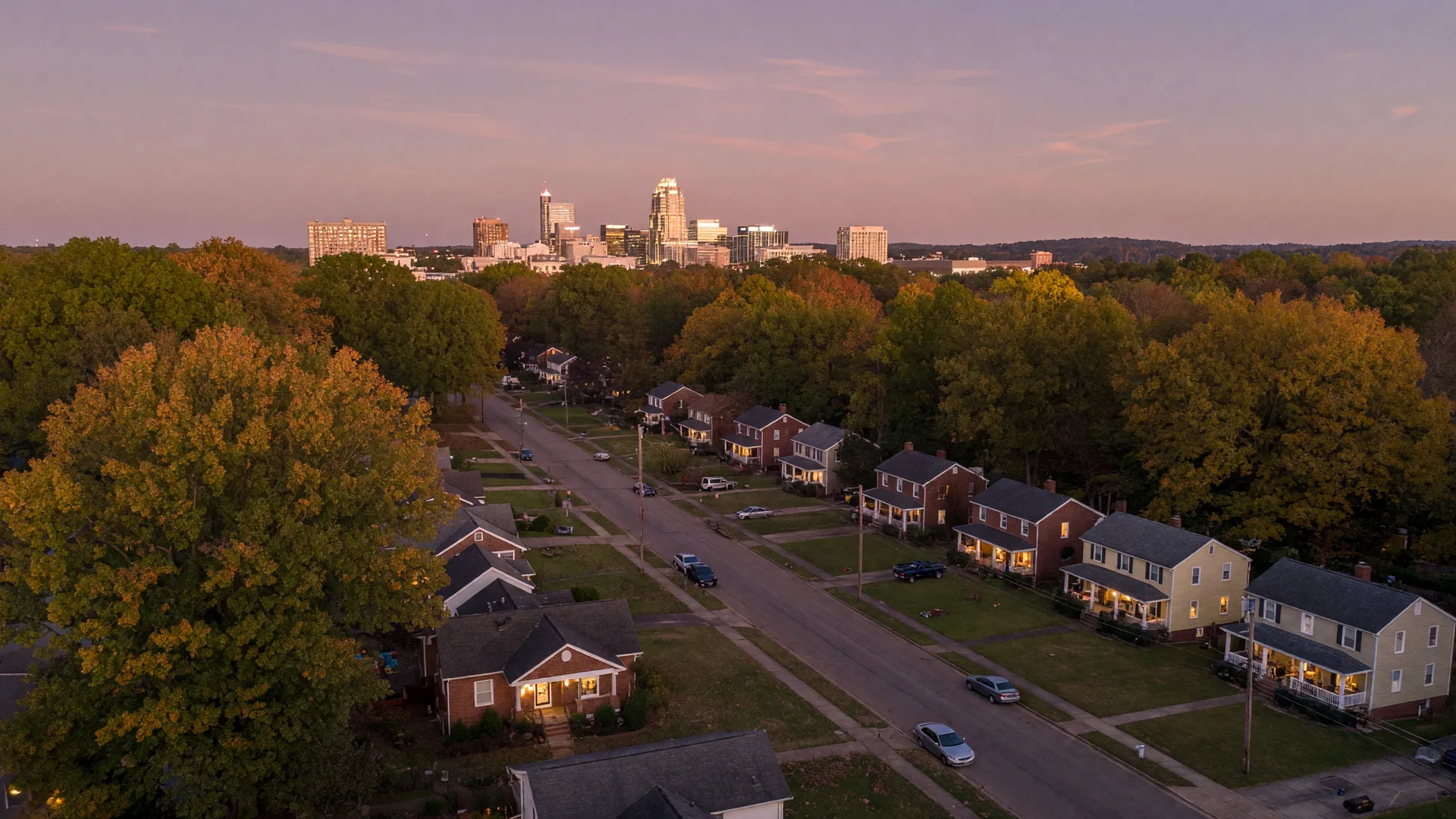
The honest forecast for Raleigh and the Triangle in 2027 is flat to modestly softer prices, nowhere near a crash. Wake County's median sale price is running around $450,000 to $460,000, a few percent below early-2025 peaks, inventory is climbing, and the two most-cited national forecasts point in opposite directions: Realtor.com projected Raleigh-Cary prices down 3.7% in 2026, while Zillow's model has Raleigh values up about 1.4% through the year. Read both together, and 2027 looks like a balanced, negotiable market where price movement is measured in a couple of percentage points, not double digits.
What actually decides 2027 is the thing nobody can call with precision: mortgage rates. The Mortgage Bankers Association expects 30-year fixed rates near 6.5% through 2027, and Fannie Mae raised its own outlook in August 2026 to an average of 6.8% for Q4 2026, holding through the first half of 2027. That is the number every buyer at this table is planning around, and it shapes this forecast more than any single data point. Here is the full picture, with sources, so you can decide for yourself.
"To give you total clarity, unfiltered local data, and zero risk, backed by a lifetime guarantee that puts your peace of mind first."
The short answer
2027 prices in the Triangle: roughly flat to a few percent lower, with movement split by price range and town. Wake County's median is about $450,000 to $460,000 now, down a few percent year over year. Rates are forecast to hold near 6.5% to 6.8%, which keeps the market balanced and gives buyers real negotiating power while it lasts. There is no crash coming: population growth and Research Triangle Park hiring put a floor under demand. The risk is not a price collapse, it is overpaying out of habit from the 2021 to 2022 playbook, or waiting years for rates that may not move.
What Actually Happened to Triangle Prices in 2026
Before forecasting 2027, get the 2026 baseline straight, because it is not what the national headlines say about North Carolina. This is Triangle-specific data from the MLS, not a state average.
- Wake County median price: about $450,000 in January 2026, down 4.3% from January 2025, then back up around $460,000 by August 2026, still down a few percent year over year. The market cooled more in late 2025 than it has since, and is now finding a floor.
- Raleigh itself: near $450,000, roughly 5% below a year earlier per Triangle MLS reporting. The city is where most of the visible price adjustment has landed.
- Zillow's average home value: about $428,671 as of August 2026, down 1.7% year over year across the Raleigh metro. Different metric, same story: a modest pullback off the top, not a collapse.
- The Doorify/Triangle median: $425,000 in 2025 as a full-year figure, after a $427,200 peak in 2024. The Triangle gave back a few thousand dollars of the boom, then steadied.
The pattern across every dataset is the same: prices are a few percent off their peaks, inventory has climbed, and homes are sitting on the market longer. That is the definition of a rebalancing, and I laid out the full case in my is the Raleigh market crashing post, which answers the panic version of this question with the same data.
What the Published Forecasts Say About 2027
Here is the honest part that most forecast articles skip: the major published price forecasts for this metro mostly run through 2026, not 2027. The only firm 2027 numbers that exist are the mortgage rate paths. So the honest way to build a 2027 forecast is to take the 2026 forecast range, adjust it for where the market actually landed, and stress-test it against the rate outlook.
- Realtor.com (December 2025): forecast Raleigh-Cary prices down 3.7% in 2026 with sales down 4.4%, one of the deeper forecast declines of any U.S. metro. Notably, the same forecast had Chapel Hill-Durham up about 2.9%. The suburbs closest to the peaks are where the softest read landed.
- Zillow: forecast Raleigh home values rising about 1.4% through 2026, a recovery read after values dipped. Zillow tracks average home value rather than median sale price, which is a big part of why the two forecasts disagree so visibly.
- Local analysts: the consistent local read in 2026 has been stabilization, not decline, built on the region's population growth and Research Triangle Park hiring. That is the same argument I make, and it is the reason nobody local is calling for a 2008-style event.
Why the Forecasts Disagree, and How to Read Them
The 3.7% decline versus 1.4% gain gap looks like chaos until you realize the two models measure different things. Realtor.com forecasts median sale price by metro area, which is what the local MLS actually transacts. Zillow tracks its own average home value estimate, which is slower-moving and covers a wider geography. Both can be right at once, and both point to the same practical conclusion: 2027 is a year for single-percentage-point movement, not a boom or a bust.
The other reason to sanity-check any forecast is that national models do not see your street. They blend Cary and Zebulon into one number. In the Triangle the range within the range is enormous: entry-level price points under $400,000 are still competitive, the luxury tier above $900,000 has been softest (Durham still gives you more house for the dollar for exactly this reason), and new construction is negotiating hardest of all because builders need to move inventory at scale.
The Rate Question Is the 2027 Question
Mortgage rates are the single biggest driver of where 2027 lands, so this is the number to watch, not another price headline. Here is where the main forecasts sit, and they agree for once:
- Mortgage Bankers Association: 30-year fixed rates near 6.5% in Q3 and Q4 2026, holding at about 6.5% through 2027.
- Fannie Mae (August 2026): raised its outlook to an average of 6.8% in Q4 2026, holding at that level through the first half of 2027.
- Freddie Mac actuals: the 30-year fixed has already been trading in the 6.52% to 6.69% band through summer 2026.
In plain English: nobody credible expects rates back in the 3% or 4% territory in 2027, and the difference between 6.5% and 6.8% matters far less than whether you buy into a balanced market with negotiating room. My rent versus buy math shows what today's payments actually look like, and the income-to-qualify numbers at these rates. If you have been waiting for a rate drop to buy, plan on waiting through 2027.
A Realistic Range for 2027: Flat to Modest, Not a Crash
Putting the pieces together, here is the range I work with for 2027, stated honestly as a range because that is what the data support:
The soft case
- Rates drift toward 7% and inventory keeps building
- Median prices settle another 1% to 3% lower, concentrated in the $600K+ range
- Buyers get the most negotiating room of the past five years
- Sellers who price to 2024 levels sit for months
The steady case
- Rates hold near 6.5%, job growth absorbs more inventory
- Prices flatten or drift up 1% to 2%, led by entry-level
- Market stays balanced, 30 to 45 day selling times for well-priced homes
- The Triangle keeps outperforming the national average
The crash scenario, a double-digit decline, would require conditions that are not visible in the data: a spike in distressed sales, a local job shock, or rates suddenly above 8%. None of those is in any published forecast for this metro. What a crash would also look like is covered honestly in that dedicated post, including the inventory numbers to watch.
What 2027 Means If You're Buying
This is the best buying setup the Triangle has offered since before the 2021 frenzy, and it does not require prices to fall further. There are more homes to choose from, sellers are doing the price math again, and builder rate buy-downs are still in the market, which my new construction versus resale piece shows can flip the monthly-payment comparison. The honest cautions are the usual ones: rates near 6.5% to 6.8% make the monthly payment the binding constraint, so qualifying math and closing-cost cash matter more than any forecast. You are not racing a rising market anymore, which means you can take the time to negotiate, inspect, and read the fine print.
My advice for buyers in 2027: date the payment, not the market. If the numbers work on the home you want at today's rate, buy it on terms you control. If they don't work, waiting for a 1% price drop is a strange strategy when seller concessions on rate buy-downs and closing costs can be worth far more than a negotiated price cut. We run that exact comparison together in a free consultation, and the full process is in my buyer's guide.
What 2027 Means If You're Selling
Sellers have to unlearn 2022. The days of listing 5% above the last sale and waiting for a bidding war are over in most Triangle price ranges, and the homes that sell in 2027 will be priced against closed sales from the last 90 days, not peak comps from early 2025. Price it right, stage it properly, and you still get multiple showings the first weekend. Price it at the top of 2024, and you will announce a price reduction by week four, which costs you more than pricing correctly the first time.
For sellers who are also buying their next home, there is a smarter play than selling at a discount just to move: my Sold Zero Commission System eliminates the listing-side commission when you buy your next home through the team, which can add thousands back to the equity side of the trade in a market where price appreciation is flat. Run the free number at what's my home worth before you decide anything.
The Signs I'm Actually Watching for 2027
Forecasts get rewritten every quarter, so here are the four signals that will tell you faster than any prediction which 2027 we are actually in:
- Months of inventory. If the Triangle holds around three to four months of supply, prices stay flat. A sustained six-plus months, which has not happened here since 2010, is when you worry.
- The August-to-October selling season. Every 2027 forecast is really an extrapolation of the late-2026 absorption rate. If fall 2026 inventory clears at 2025's pace, the soft case fades.
- Rate headlines and the 10-year Treasury. Rates drive everything. Watch the weekly Freddie Mac survey, not the clickbait.
- Job announcements at RTP and in biotech. Relocation demand is the Triangle's floor, and it is still intact. A hiring slowdown changes the math faster than anything else.
I publish the actual monthly numbers for 20 Triangle cities and four counties in the market reports section, updated each month with Triangle MLS data, so you can track these signals yourself instead of relying on a single forecast.
A 20-Year Local's Honest Take on 2027
I have watched this market through three full cycles since moving here from Connecticut, and here is the honest pattern: this region keeps growing, the jobs keep coming, and every slowdown since 2008 has been an inventory correction, not a value destruction event. The people who get hurt in markets like this are the ones who make decisions on one headline instead of their own numbers.
So treat 2027 the way the data says to: as a balanced, negotiable market with modest price risk and real opportunity. Buy when the payment works. Sell when the move makes sense. Track inventory and rates instead of fear. And when you want the unfiltered read on a specific town, price range, or property rather than a metro-average forecast, that is what a relocation conversation is actually for. My guarantee is in writing on the Buyer Home Guarantee page: if you buy through the team and the home is not right, we sell it for $0 listing commission or, in many cases, buy it back ourselves. Peace of mind is part of the deal, not an upsell.
Frequently Asked Questions About the 2027 Raleigh Housing Market
Will Raleigh NC home prices drop in 2027?
Most published forecasts point to flat or modest price movement in 2027, not a crash. Realtor.com's 2026 forecast called for Raleigh-Cary prices to slip 3.7% in 2026, while Zillow's model had Raleigh values up about 1.4% through 2026 after a small pullback. Triangle MLS data show Wake County's median around $450,000 to $460,000, a few percent below early-2025 peaks. Read across the forecasts, a fair range for 2027 is roughly minus 2% to plus 2%, with the direction depending mostly on mortgage rates and how much inventory builds.
Will mortgage rates drop in 2027?
Leading forecasters expect 30-year fixed rates to stay in the mid-6 percent range through 2027, not fall sharply. The Mortgage Bankers Association forecasts rates near 6.5% in Q4 2026 and holding around 6.5% through 2027, while Fannie Mae raised its August 2026 outlook to an average of 6.8% in Q4 2026, holding there through the first half of 2027. Anyone waiting for the 3% or 4% era should plan around today's numbers instead.
Is the Triangle housing market crashing?
No. The recent data describe a rebalancing, not a crash: prices are a few percent below their 2025 peaks, inventory is climbing, and homes are sitting longer. Wake County's median was roughly $450,000 in January 2026 and around $460,000 in August 2026. Population growth and Research Triangle Park job growth continue to put a floor under demand.
Is 2027 going to be a good time to buy a house in the Triangle?
For many buyers, yes, and the reasons have nothing to do with catching a falling price. Inventory is up, competition is down, and sellers are negotiating again, so you have leverage on price, closing costs, and repairs. The trade-off is that rates near 6.5% to 6.8% keep monthly payments high, so buying power depends on budget and down payment more than on timing the market.
Will 2027 be a buyer's market in Raleigh NC?
It will be the most balanced market the Triangle has seen in years, but not a classic buyer's market. Inventory has climbed meaningfully, homes are sitting longer, and sellers are negotiating, all of which favor buyers. But the Triangle still has steady population and job growth underneath it, so a full-on buyer's market with deep price cuts is not what the current data show.
Lifetime Buyer Home Guarantee
Buy the 2027 Market Without the 2027 Risk
In a flat market, the risk is not the price you pay, it is the uncertainty you carry. If you don't love your new home at any point, we'll sell it for free, or in many cases, buy it back ourselves. Backed completely in writing, for as long as you own the home.
Option 1
We Sell It for $0 Listing Commission
If the home isn't the right fit, we list, market, and sell it while waiving the entire listing-side commission, so you keep more of your hard-earned equity.
Option 2
The Direct Buyback Option
In specific scenarios, we may offer to purchase the home directly from you.
Either way, you're covered for the life of your homeownership. No ticking clock. No expiration date. When you purchase your next home through our team, you're automatically enrolled in the protection plan from day one. Full details are on the Lifetime Buyer Home Guarantee page.
Sources and Methodology
Median price and inventory figures in this post come from Triangle MLS data as reported by WRAL and Axios Raleigh; Zillow figures are its metro home value estimate as reported in its market pages and forecast; Realtor.com's 2026 Housing Forecast is the December 2025 national and metro release; mortgage rate forecasts are from the Mortgage Bankers Association and Fannie Mae as published by Forbes Advisor and The MortgagePoint, with Freddie Mac weekly survey actuals for summer 2026. The 2027 scenario range of roughly minus 2% to plus 2% is the author's synthesis of those forecasts, not a single published number. Market data change monthly; the author's market reports carry the current figures.
WRAL: Triangle housing market shifts toward balance as inventory climbs (Triangle MLS data)
Axios Raleigh: Where the Raleigh area's real estate market is headed in 2026 (Doorify MLS data)
News & Observer: Where Triangle home prices will drop and by how much in 2026 (Realtor.com forecast)
Zillow forecast and Raleigh average home value, via Norada Real Estate Investments
Forbes Advisor: mortgage rate forecasts 2026-2027 (MBA and Fannie Mae)
The MortgagePoint: Fannie Mae raises mortgage rate forecast through mid-2027

Phil Slezak
Real Estate Broker · NC #242173 · 20+ years in the Triangle
I moved to Raleigh from Connecticut and have spent two decades watching this market cycle through booms, corrections, and recoveries. If you want the honest read on 2027 for a specific town, price range, or property, I can walk you through the numbers, no slide show required.
Book a callPhil Slezak Real Estate brokered by LPT Realty