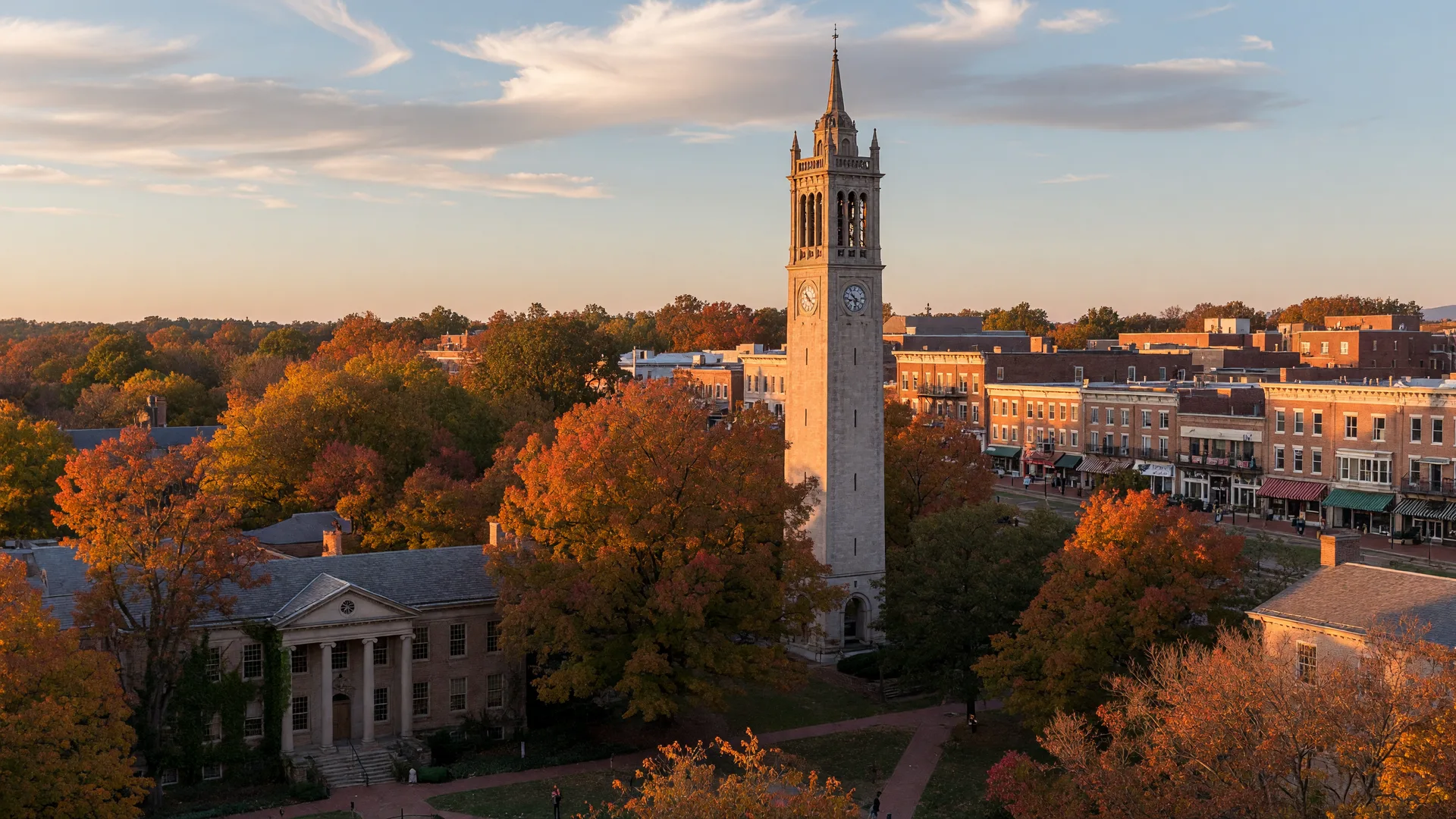
Living in Chapel Hill, NC (2026 Guide)
Chapel Hill is the Triangle's most prestigious city -- home to the University of North Carolina, top-rated schools, and a walkable downtown that defines college-town living. Here is the honest truth about what it is really like to live here.
This complete 2026 guide covers home prices, neighborhoods, schools, commute times, cost of living, and the honest truth about what it is really like to live in Chapel Hill -- from a licensed broker who has spent 20+ years helping buyers find the right fit in the Triangle.
~64,000
Population and Growing
~$825,000
Median Home Price
~$85,989
Median Household Income
$1.2862
Combined Property Tax Rate
This Chapel Hill guide is researched and written by Phil Slezak, a licensed NC broker with 20+ years in the Triangle who has helped 500+ buyers and sellers across the Greater Triangle.
Living in Chapel Hill, NC -- The Complete Package
Chapel Hill is home to the University of North Carolina at Chapel Hill, the nation's first public university and a world-class research institution. As one of the three points of the Research Triangle, Chapel Hill offers relocation buyers a rare combination of academic prestige, top-rated public schools, walkable urban design, and a vibrant cultural scene that sets it apart from every other Triangle community.
Located in Orange County, Chapel Hill anchors the western edge of the Triangle market. Its nationally ranked Chapel Hill-Carrboro City Schools, historic neighborhoods like Gimghoul and Northside, and direct access to Franklin Street make it a top destination for university faculty, medical professionals at UNC Health, and relocating families who prioritize schools and walkability.
Chapel Hill blends Southern charm with progressive, intellectual energy. Destinations like Franklin Street, the Ackland Art Museum, and the North Carolina Botanical Garden define the city's unique character. Paired with an extensive greenway network, a thriving local food scene, and the iconic Carolina basketball tradition, Chapel Hill continues to attract buyers who want an elite educational environment wrapped in a walkable, tight-knit community. Whether you are moving from out of state or relocating within the Triangle, Chapel Hill demands serious consideration, and this guide covers everything you need to make an informed decision.
What's Inside This Guide
Chapel Hill, NC Real Estate Market Snapshot (July 2026)
| Metric | July 2026 | July 2025 | Change |
|---|---|---|---|
| Home Sold Chapel Hill | 103 | 85 | +21.2% |
| Median Sales Price | $825,000 | $785,000 | +5.1% |
| Median Home Price (Townhouse/Condo) | $375,000 | $375,000 | 0% |
| Median $/sq ft | $298 | $292 | +2.1% |
| Median Days on Market | 16 | 28 | -42.9% |
| List Price Received | 99.3% | 98.9% | +0.4% |
"Chapel Hill commands a premium in the Triangle market for good reason. You are paying for top-rated schools, a walkable college-town lifestyle, and proximity to UNC Health and the university -- and the resale values reflect that lasting demand."
Phil Slezak -- Broker, Phil Slezak Real Estate
Chapel Hill Market Snapshot — Frequently Asked Questions
What is the median home price in Chapel Hill, NC?
The median home price in Chapel Hill sits between $640,000 and $660,000 overall, while single-family detached homes in core school zones average roughly $825,000. Price points vary by property type: entry-level townhomes range from $320,000 to $495,000, while detached homes in premier master-planned neighborhoods like Meadowmont frequently exceed $1.1 million.
How fast are homes selling in Chapel Hill?
Turnover velocity depends heavily on pricing and condition. Turnkey homes in top school zones go pending in 19 to 25 days, with hot listings receiving multiple offers inside 4 to 7 days. However, luxury inventory priced over $900,000 or homes requiring updates average 45 to 70 days on market, giving buyers more room for price and repair negotiations.
Are buyers paying over list price in the Chapel Hill real estate market?
The market-wide sale-to-list price ratio averages roughly 98.5% to 99.5%. Roughly 25% to 30% of homes sell above list price due to competitive bidding, while over 50% of listings close slightly below original asking price — demonstrating a balanced market where prime, updated homes command premiums while overpriced inventory receives price adjustments.
Why is real estate inventory so limited in Chapel Hill?
Inventory stays tight due to strict municipal growth boundaries (Urban Services Boundaries), low-density zoning across rural Orange County, and strong structural demand driven by UNC-Chapel Hill and UNC Health employment. As a result, supply levels stay constrained, keeping resale values stable and protecting long-term property equity.
Why People Are Moving to Chapel Hill, NC
Chapel Hill has earned its reputation as one of the most desirable places to live in the Southeast. Known as the Southern Part of Heaven, it combines academic excellence with a small-town feel and big-city amenities.
Key Reasons to Call Chapel Hill Home
UNC Chapel Hill and UNC Health
The University of North Carolina and UNC Health System anchor the local economy with over 30,000 employees. The university is a top-5 public university nationally, bringing world-class academics, healthcare, and athletics to the community.
Walkable Downtown and Franklin Street
Franklin Street is the heart of Chapel Hill, an iconic main street lined with restaurants, bookstores, music venues, and shops. It connects the UNC campus with the community and offers one of the most walkable downtown experiences in the Triangle.
Top-Rated Public Schools in the Triangle
Chapel Hill-Carrboro City Schools (CHCCS) is consistently ranked #1 in North Carolina. This alone drives relocation demand from families across the country who want access to elite public education.
Rich Cultural and Arts Scene
From the Ackland Art Museum and Carolina Performing Arts to the legendary Cat's Cradle music venue, Chapel Hill offers cultural depth that rivals cities many times its size.
Historic and Established Neighborhoods
Chapel Hill's neighborhoods range from historic Gimghoul and Northside districts with early 1900s homes to master-planned communities like Southern Village and Meadowmont, offering a range unmatched in the Triangle.
Proximity to RTP
While Chapel Hill feels like a world apart, Research Triangle Park is just 15 miles east. This proximity, combined with easy access to RDU International Airport, makes it ideal for biotech, pharma, and tech professionals who want a quieter home base.
Trails, Greenways, and Green Space
Chapel Hill is home to the Bolin Creek Greenway, Morgan Creek Trail, the North Carolina Botanical Garden, and Jordan Lake, offering residents abundant outdoor recreation from hiking and biking to kayaking and fishing.
Cost Snapshot: Chapel Hill vs. the Triangle
| Chapel Hill | Cary | Raleigh | Durham | |
|---|---|---|---|---|
| Median Home Price | $825K | ~$698K | ~$475K | ~$460K |
| Effective Prop. Tax Rate | 1.3284% | ~0.9850% | ~0.9700% | ~1.1500% |
Figures reflect local MLS data for July 2026. Tax rates are combined city and county effective rates and may vary by specific location and assessed value.
The Chapel Hill Difference
Raleigh, Cary, Durham
Chapel Hill
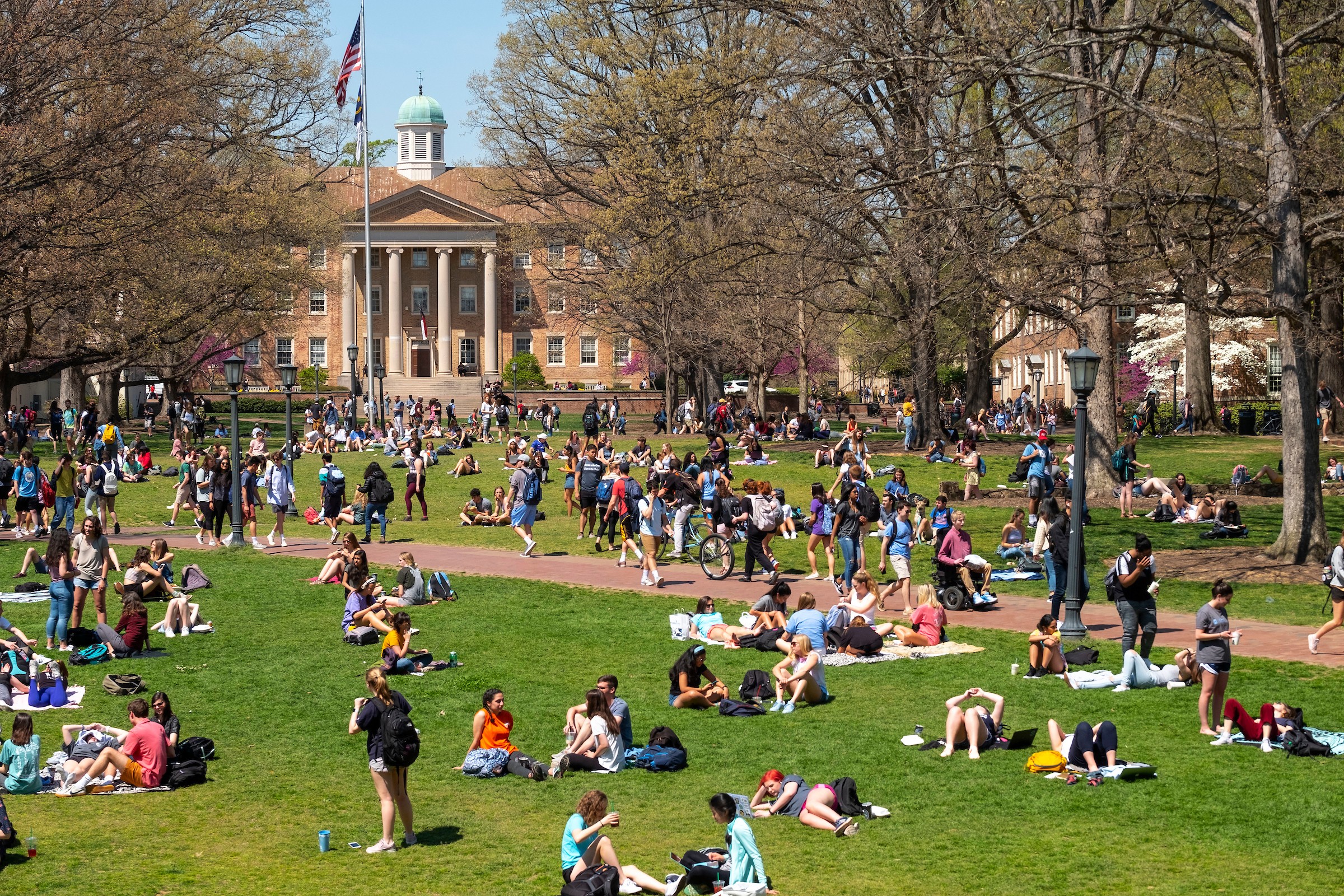
The Vibe: Where the rest of the Triangle skews toward master-planned suburbs and rapid growth corridors, Chapel Hill is a mature, built-out college town with strict zoning and historic preservation. Expect tree-lined streets, brick sidewalks, and a pace of life that is intentional and community-focused.
Curious what's currently on the market in Chapel Hill?
View Chapel Hill Homes for SaleWhy People Are Moving to Chapel Hill — Frequently Asked Questions
What are the primary reasons buyers choose Chapel Hill over other Triangle cities?
The primary relocation drivers are the Chapel Hill-Carrboro City Schools (CHCCS) district — consistently ranked #1 in North Carolina — academic and medical employment at UNC-Chapel Hill and UNC Health, a walkable college-town culture along Franklin Street, zero-fare public transit, and long-term home resale value stability.
Where do Chapel Hill residents work, and what is the commute to RTP?
Many residents work locally at UNC-Chapel Hill, UNC Health, or downtown tech hubs. However, Chapel Hill is also a prime residential base for commuters to Research Triangle Park (RTP) — located just 12 to 18 miles east via I-40 or NC-54 (roughly a 18 to 25-minute drive) — as well as healthcare and tech hubs in nearby Durham and Raleigh.
Who is moving to Chapel Hill from out of state?
Out-of-state relocations are largely driven by young families seeking top-tier public schools, medical professionals and university faculty, tech executives moving to RTP, and retirees seeking academic healthcare and lifelong learning. A significant portion of out-of-state buyers arrive from high-cost metros in the Northeast, Midwest, and California.
Is living in Chapel Hill worth the higher housing costs compared to surrounding towns?
For buyers prioritizing education, culture, and long-term equity, yes. While entry home prices ($825,000 median) and property taxes are higher than in Durham or Mebane, buyers receive access to NC's top public schools, a 100% fare-free town bus network, 1,200+ acres of protected parks and greenways, and exceptional downside price protection due to strict municipal growth limits.
Homes for Sale in Chapel Hill, NC
Browse active Chapel Hill listings updated directly from the MLS. Use the search below to filter by price, beds, baths, and neighborhood.
Chapel Hill Housing Guide
Chapel Hill's housing stock is a mix of historic homes near campus, established suburban enclaves, luxury golf communities, and modern urban infill. Inventory remains tightly managed due to strict growth boundaries, meaning desirable properties consistently command a premium.
Types of Homes in Chapel Hill
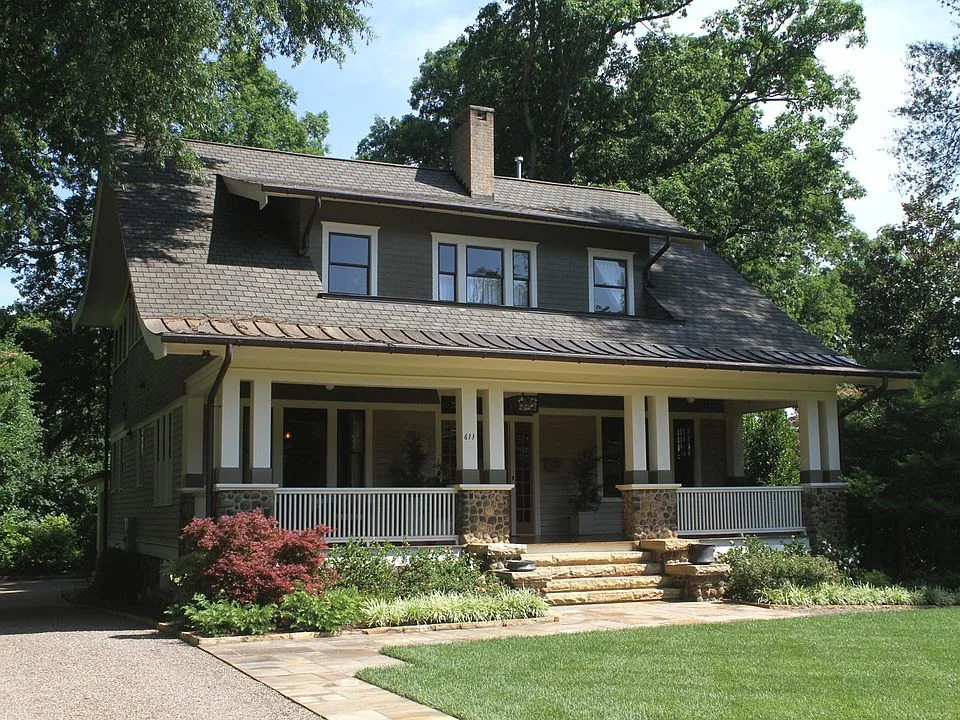
Historic Bungalows and Craftsman ($400K-$1.2M+)
Northside, Gimghoul, Franklin Street corridor. Early-1900s bungalows, craftsman homes, historic cottages. Renovated homes command premium, original-condition rare.
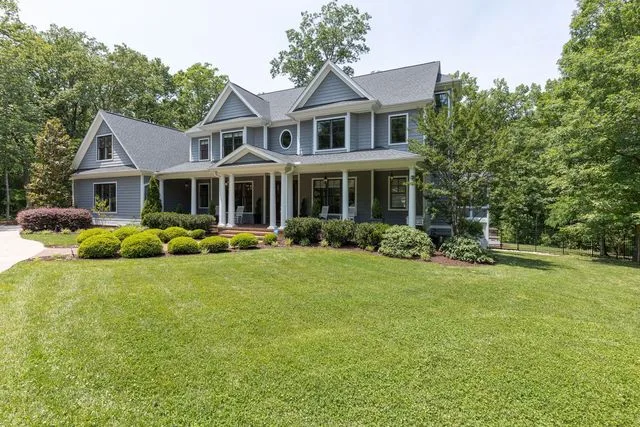
Single-Family Suburban ($500K-$900K+)
Southern Village, Meadowmont, Estes Hills. Community pools, clubhouses, greenway access, mature landscaping. Optimal balance of square footage, top-tier schools, local amenities.
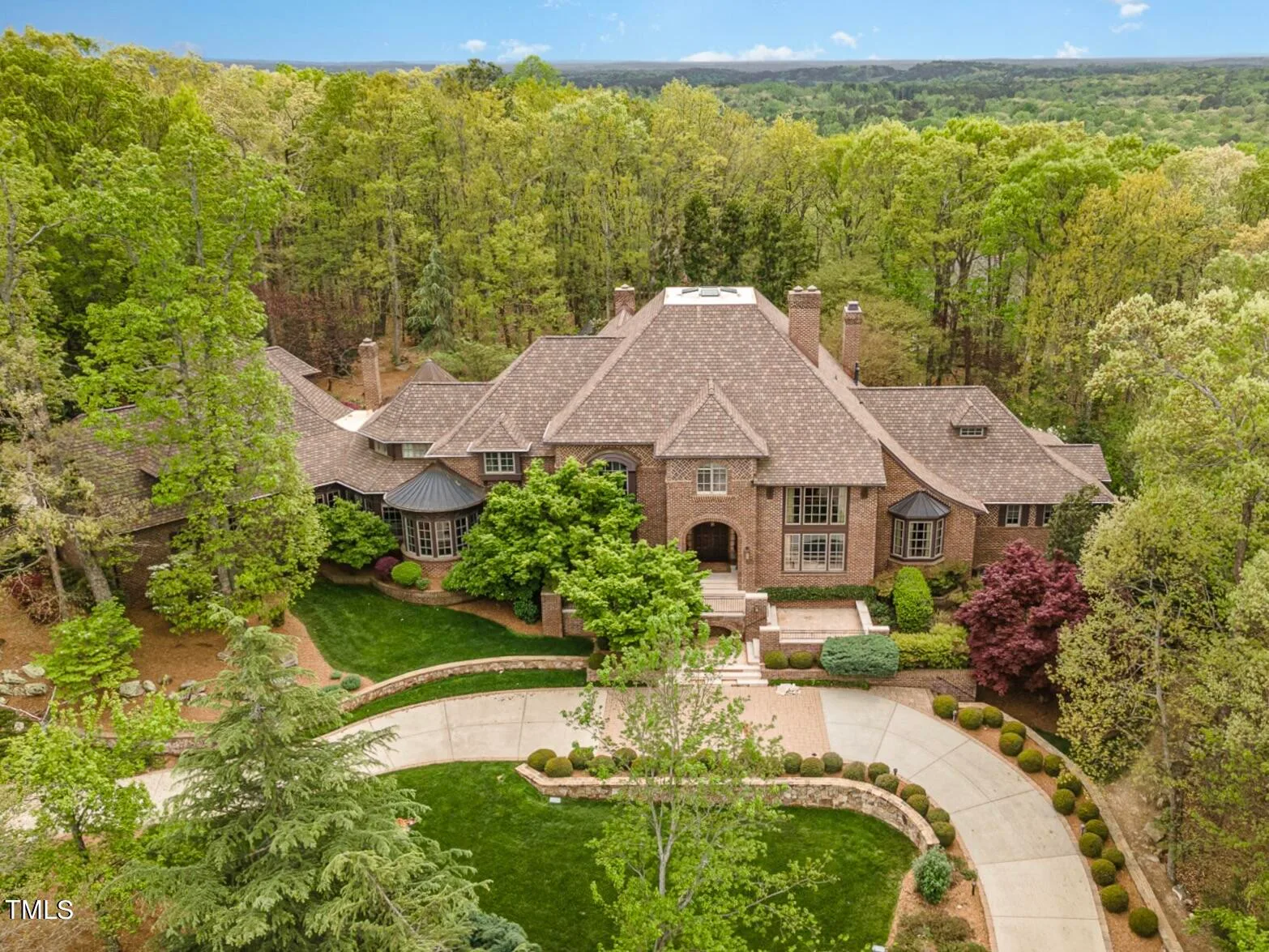
Luxury Estates and Gated Communities ($800K-$3M+)
Governors Club (27-hole Jack Nicklaus golf course). The Preserve at Jordan Lake (Davis Love III golf layout). Fearrington Village with walkable village center.
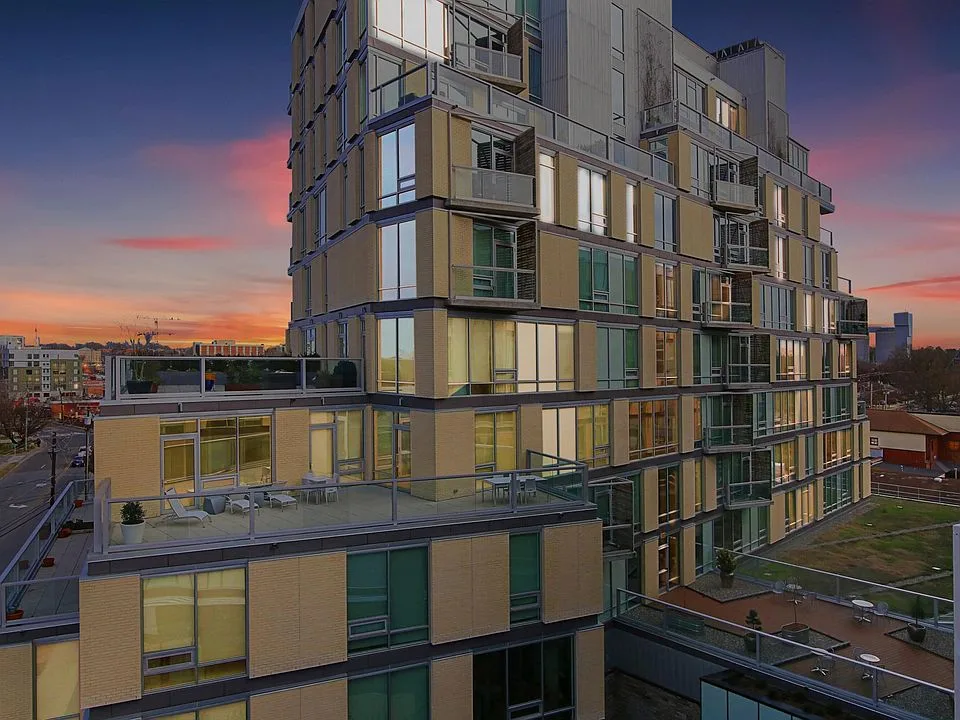
Downtown Townhouses and Condos ($175K-$1M+)
140 West Franklin, Short Street Condos, East 54. Low-maintenance living on/near Franklin Street. Ideal for faculty, healthcare executives, downsizers.
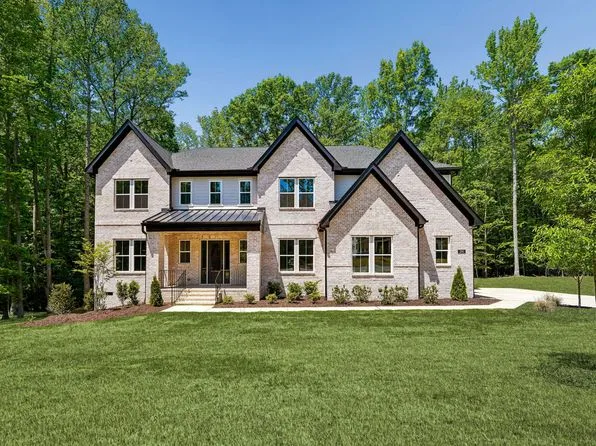
New Construction Communities ($500K-$1.5M+)
Jade Creek, The Summit at Morgan Ridge, Governors Club Infill. Sanderway, Chestnut Creek, Chapel Oaks. Briar Chapel (resort-style, Chatham County line).
Pro Tip for Buyers: Chapel Hill's strict zoning laws and limited developable land mean inventory is perpetually constrained. Well-priced homes in top school districts often receive competitive offers within days. Securing dedicated buyer representation and full mortgage pre-approval before beginning your search is essential to success in this market.
Chapel Hill Housing Guide — Frequently Asked Questions
What kind of home can you buy in Chapel Hill across different price points?
Starter condos and townhomes range from $250,000 to $450,000. Established single-family mid-century homes in central CHCCS school zones generally run $650,000 to $950,000. Executive move-up properties in neighborhoods like Meadowmont and Southern Village trade between $1M and $1.8M, while luxury estates in Governors Club can exceed $3 million.
How do historic downtown homes compare to master-planned Chapel Hill communities?
Historic districts like Franklin-Rosemary and Gimghoul offer character, mature tree canopies, and direct campus walkability, but often lack HOAs and require historic oversight for exterior updates. Master-planned communities like Southern Village and Meadowmont feature built-in village centers, swim clubs, HOA-maintained spaces, and structured architectural standards.
Is new construction single-family housing available in Chapel Hill?
New single-family suburban subdivisions are extremely rare within town limits due to strict Urban Services Boundaries and limited raw land. Most new construction occurs through high-density infill projects (condos/townhomes), luxury custom tear-downs in established neighborhoods, or master-planned developments just across county lines, such as South Creek or Briar Chapel.
Why do property tax rates vary significantly across Chapel Hill neighborhoods?
Chapel Hill mailing addresses span both Orange and Chatham counties. Homes inside town limits in Orange County pay a combined rate of $1.2862 per $100 assessed value (including the CHCCS special school tax). Homes in Chatham County with Chapel Hill addresses (like Governors Club) sit outside the CHCCS tax district, carrying much lower tax rates around ~$0.70 to $0.74 per $100.
Chapel Hill Neighborhoods -- Finding Your Right Fit
Chapel Hill's neighborhoods range from historic, tree-lined enclaves near UNC to luxury golf communities and walkable New Urbanist villages. Finding the right fit depends on your lifestyle priorities, commute destination, and school preferences.
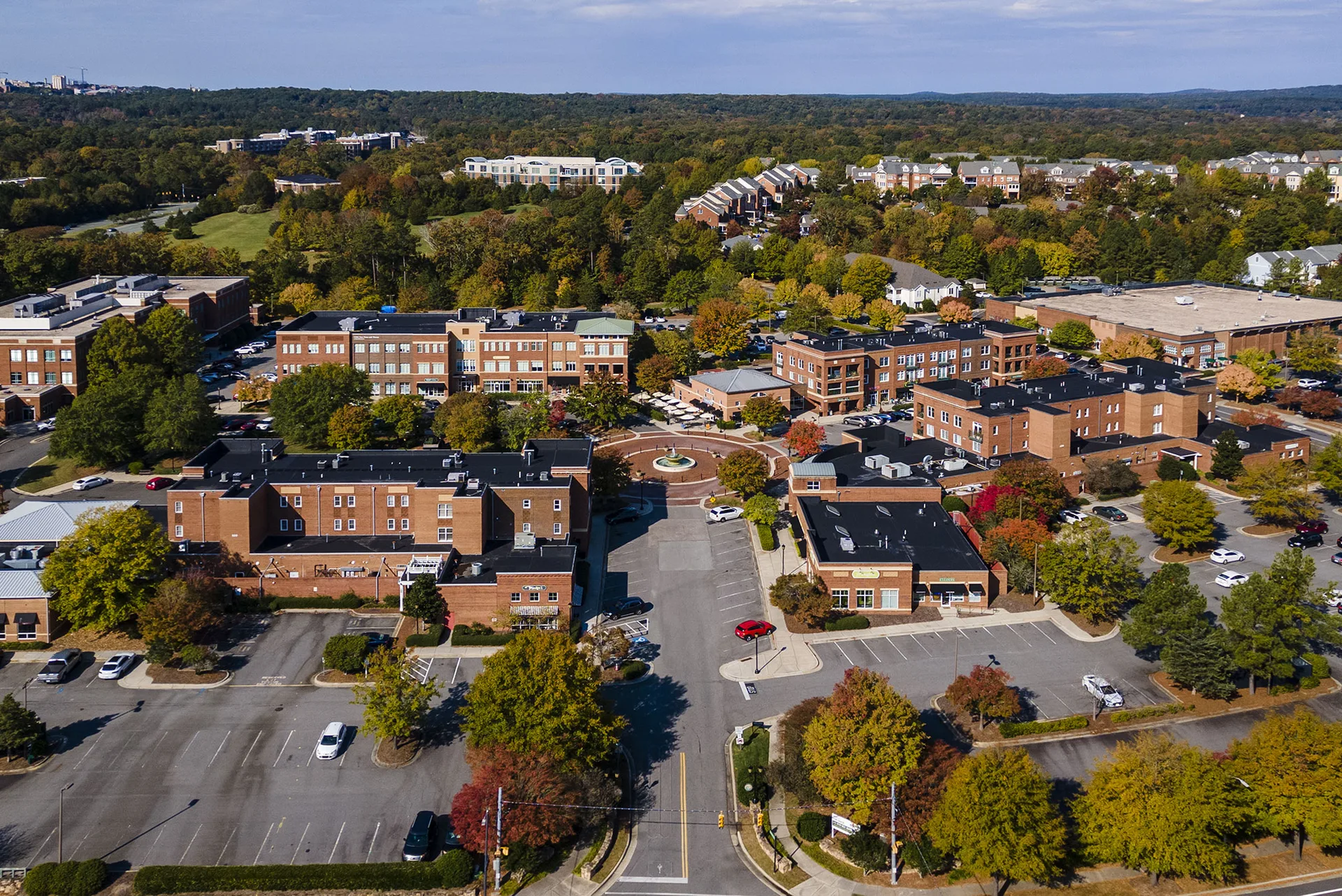
Meadowmont ($500K-$1.5M+)
Premier Master-Planned, Walkable Village Grid, CHCCS Schools
Harris Teeter village center, restaurants, retail, pool, tennis, greenways. Popular with UNC Health staff. Zoned for Rashkis Elementary.
Why People Move Here: Walk-to-village convenience with direct I-40 access and top CHCCS schools, the Meadowmont model is hard to find anywhere else in Chapel Hill.
Tips: Direct I-40 access. 15-20% premium for golf/greenway backing lots.
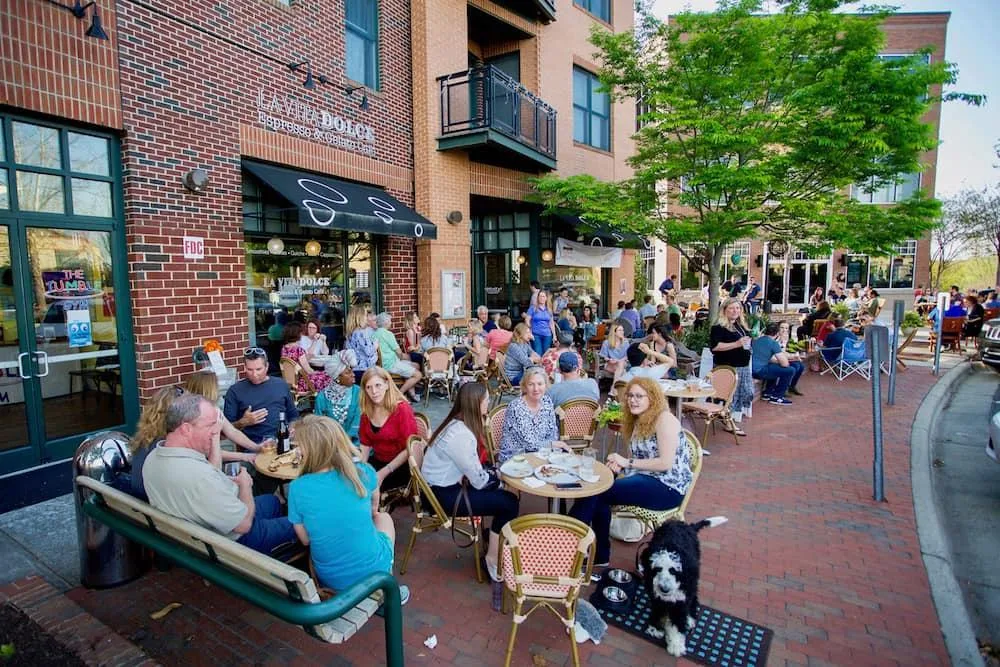
Southern Village ($550K-$1.1M+)
Walkable New Urbanist, Family Favorite, CHCCS
Market Street village green, Weaver Street Market, Lumina Theater. Mary Scroggs Elementary embedded.
Why People Move Here: Rare walkability where kids can walk to school and parents can grab coffee without getting in the car. The farmers market and free bus to UNC Hospitals seal the deal.
Tips: Almost car-free living. Fare-free bus to UNC Hospitals.
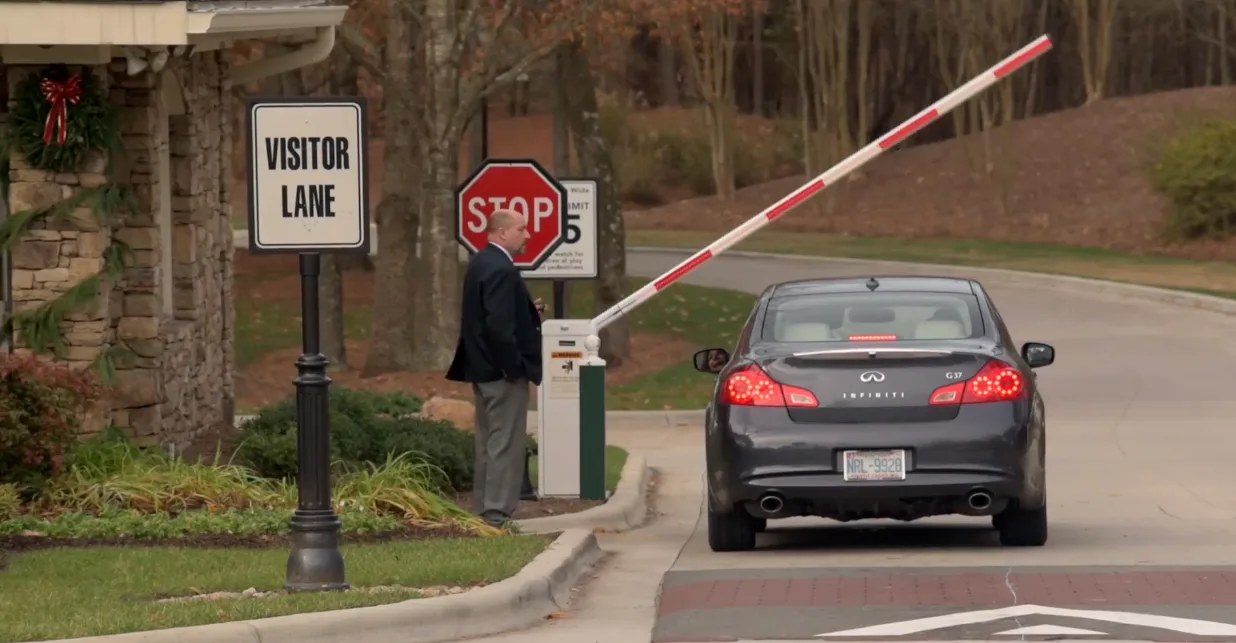
Governors Club ($550K-$5M+)
Gated Private Golf Estate, 27-Hole Nicklaus Course, Chatham County
A gated, 1,500-acre community surrounding a 27-hole Jack Nicklaus signature golf course with a 43,000 sq ft clubhouse. Zoned for Chatham County Schools (NOT CHCCS).
Median sales price running near $1.1M over the past 12 months.
Why People Move Here: Golf course living with resort-level amenities and some of the largest estates in the Triangle, all within a 15-minute drive to UNC and Franklin Street.
Tips: Don't assume Chapel Hill address equals CHCCS schools. Verify school district carefully.
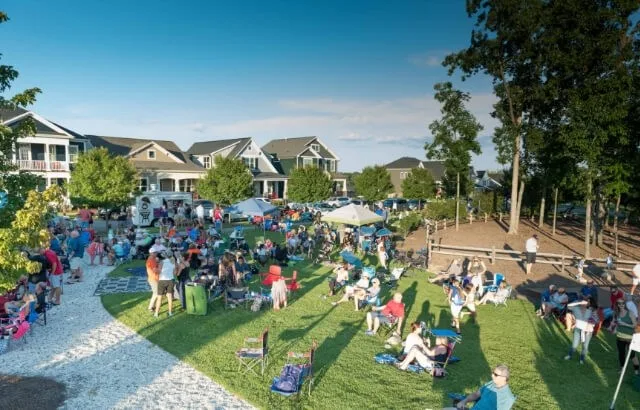
Briar Chapel ($450K-$850K+)
Resort-Style Green Community, Extensive Trails, Chatham County
1,400 acres, 10 min south of downtown. Clubhouse, water park, 20+ miles of trails. Zoned for Chatham County Schools.
Why People Move Here: Newer construction with resort amenities at a lower price point than in-town Chapel Hill. The trade-off is a slightly longer commute and no direct access to CHCCS schools.
Tips: Lower price point than in-town Chapel Hill. Trade-off is a longer commute.
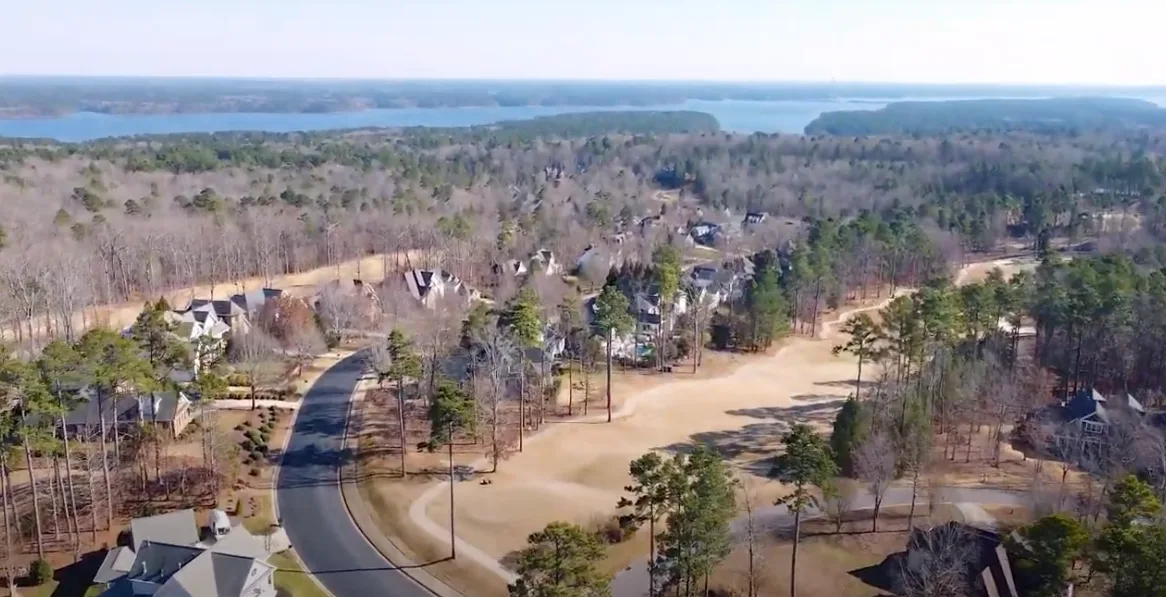
The Preserve at Jordan Lake ($500K-$1.6M+)
Gated Golf, Davis Love III, Chatham County
A gated golf community centered on a Davis Love III signature course rated among the top 40 in the country by Golfweek.
What to Know: Zoned for Chatham County Schools (North Chatham Elementary, Margaret B. Pollard Middle, Northwood High), not CHCCS.
Housing Styles: Custom homes on roughly half-acre lots, 2,500--4,400 sq. ft., featuring brick and stone exteriors, with many properties offering golf or water views. Prices land between $899K and $1.6M, with a median near $1M.
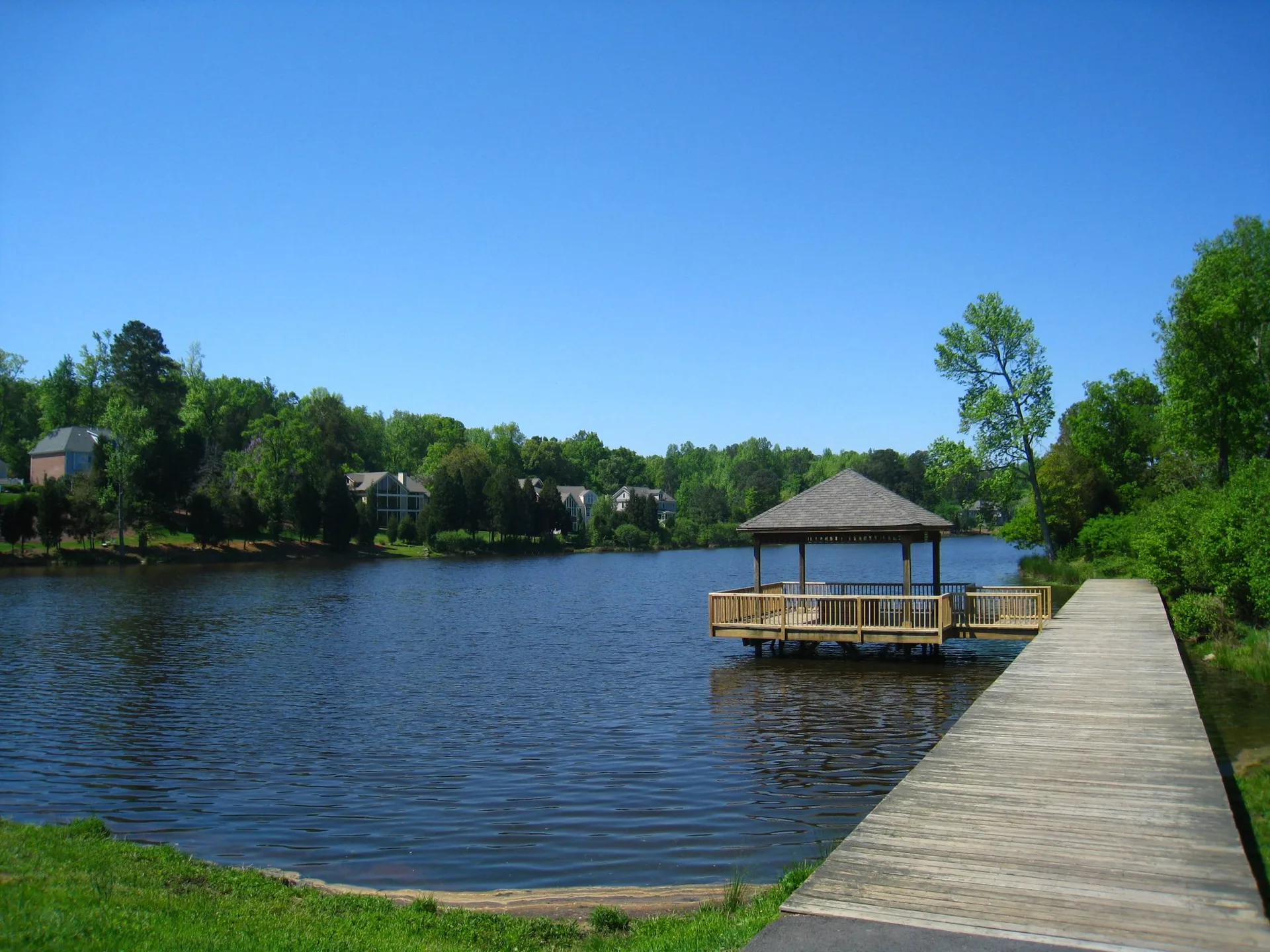
Lake Hogan Farms ($500K-$900K, up to $2.8M+)
In-Town Master-Planned Lake, CHCCS Schools (Morris Grove)
A master-planned community built since 1994 around a 12-acre lake, located inside Chapel Hill town limits off Homestead Road. Features about 400 homes across roughly 90 acres of shared green space.
What to Know: Non-gated. Zoned for Chapel Hill-Carrboro City Schools (Morris Grove Elementary). Neighborhood amenities include a swimming pool, clubhouse, tennis courts, and an extensive trail network.
Housing Styles: A versatile mix of patio homes, townhomes, and single-family homes ranging from about 1,700 to 6,500 sq. ft. Median list price recently runs around $810K--$825K.
Why People Move Here: In-town CHCCS zoning with a lower entry point than Meadowmont or Southern Village, paired with genuine lake and greenspace amenities.
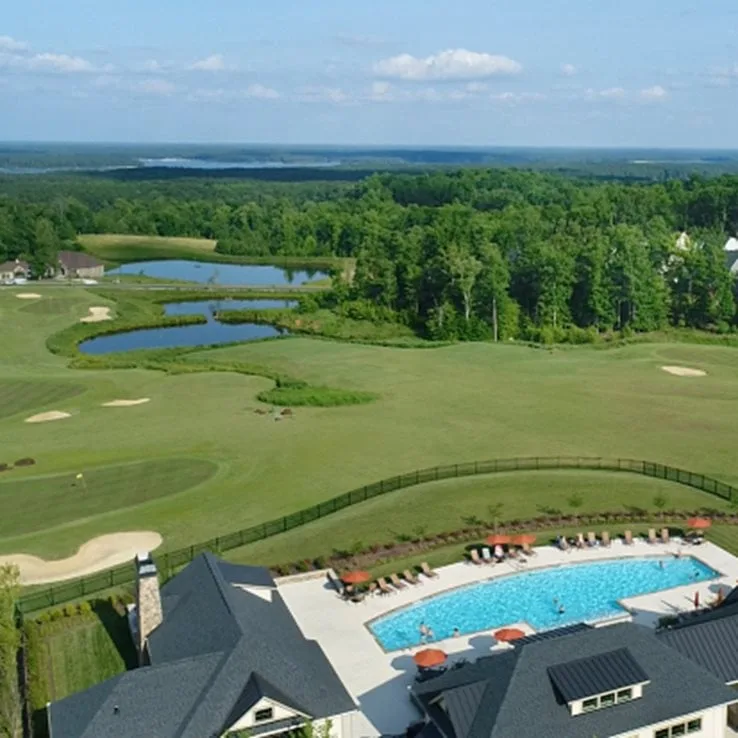
The Legacy at Jordan Lake (Median ~$875K)
Gated Resort-Style, Larger Lots, Chatham County
A gated, master-planned community near Jordan Lake in Chatham County (Moncure), using a Chapel Hill mailing address outside town limits.
What to Know: Amenities include a clubhouse, gym, pool, a 3-hole practice golf course, and walking trails. Includes dedicated active-adult (55+) sections within the master community layout.
Housing Styles: Modern homes from 3,000 to 6,000+ sq. ft. on spacious 0.5 to 3+ acre lots. Median sale price runs around $875K.
Why People Move Here: Larger lots and newer construction than most in-town options, paired with resort-style amenities for buyers who don't need CHCCS school zoning.
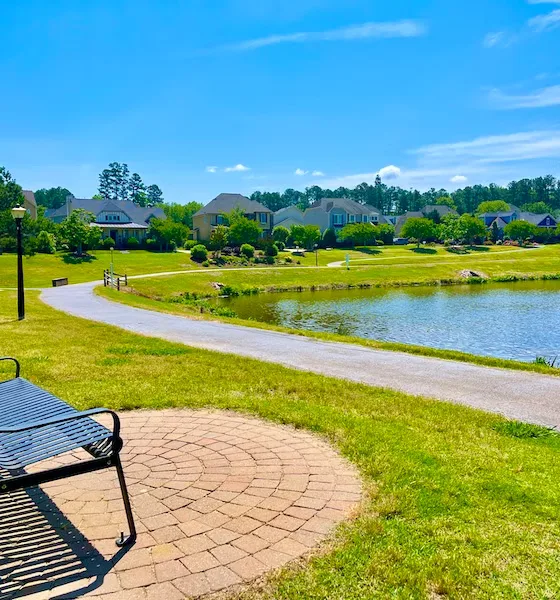
Governor's Village ($450K-$850K)
Established 15-501 Corridor, CHCCS Schools
A family-oriented neighborhood on the south side of Chapel Hill known for its community feel, strong school connections, and established homes.
What to Know: Governor's Village is a well-established neighborhood with multiple home styles and a strong sense of community. Feeds into top CHCCS schools and offers easy access to the US-15/501 corridor.
Housing Styles: Primarily single-family homes from the 1990s and 2000s, with some townhouse options. Lots are medium-sized and well-landscaped.
Why People Move Here: Prime school access, established community feel, and a central location between downtown Chapel Hill and the highway.
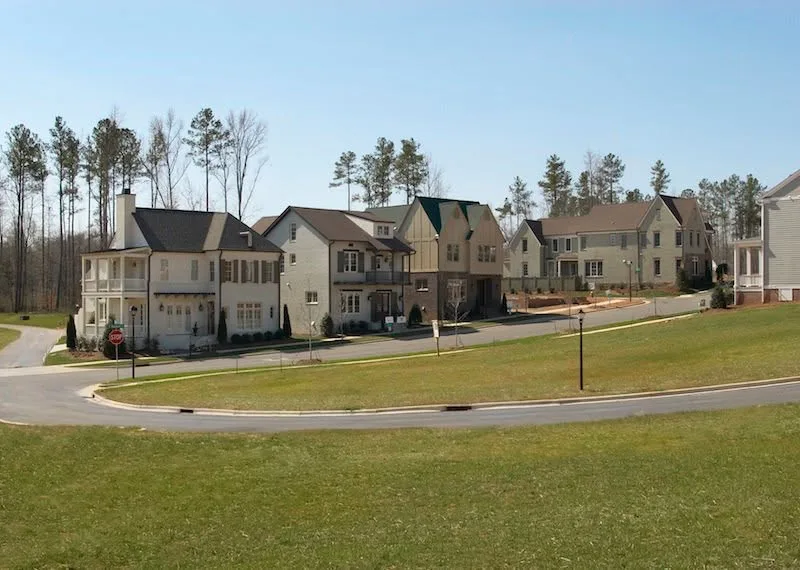
Winmore ($550K-$950K+)
Boutique New Urbanism, Walkable Grid, CHCCS (Seawell)
A walkable, New Urbanism-style community inside Chapel Hill town limits, located off Homestead Road near Lake Hogan Farms. Built starting in 2011.
What to Know: A balanced mix of single-family homes and townhomes (96 SF homes, 86 townhomes) surrounding a small commercial center, with a community pool, playgrounds, and trails along Bolin Creek.
Housing Styles: Traditional and craftsman-style single-family homes and townhomes with a walkable street grid and alley-loaded parking in places.
Why People Move Here: Zoned for Seawell Elementary, Smith Middle, and Chapel Hill High (CHCCS). Popular with young professionals wanting walkability without paying downtown prices.
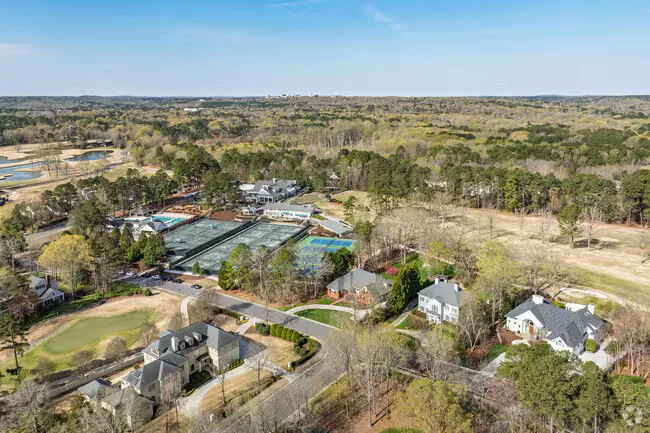
The Oaks ($500K-$3M)
Established Luxury Enclave, Chapel Hill Country Club, CHCCS
An established, upscale neighborhood inside Chapel Hill, located between Meadowmont and the Governors Club area near 15-501/Mt. Moriah Road. Built starting in 1978.
What to Know: Surrounds the Chapel Hill Country Club, but membership is optional -- it is not a gated or mandatory-membership community.
Housing Styles: Large, stately homes set on expansive wooded lots that offer exceptional privacy and character.
Honorable Mentions
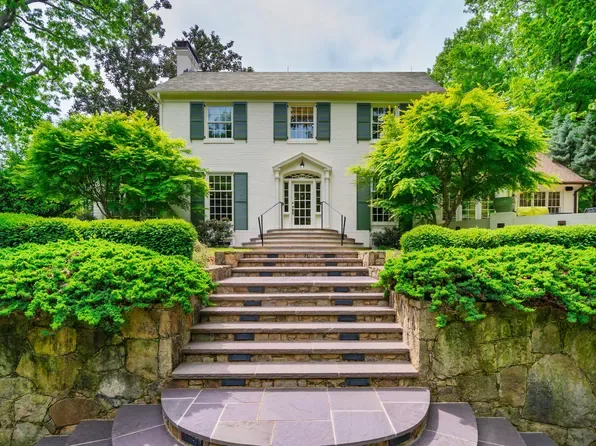
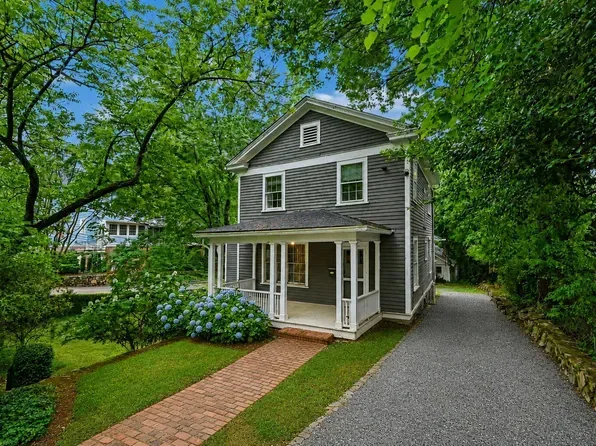
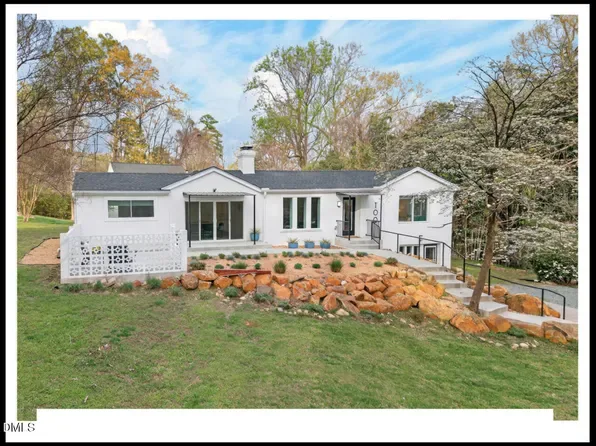
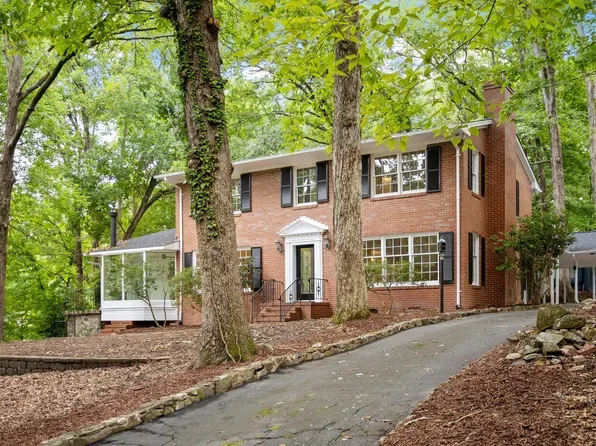
Chapel Hill has more distinct neighborhoods than any single guide can cover in depth. Here are several more highly requested communities worth keeping on your radar:
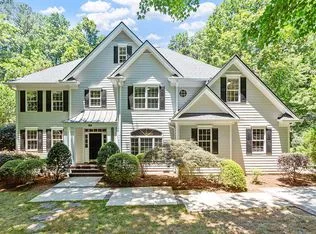
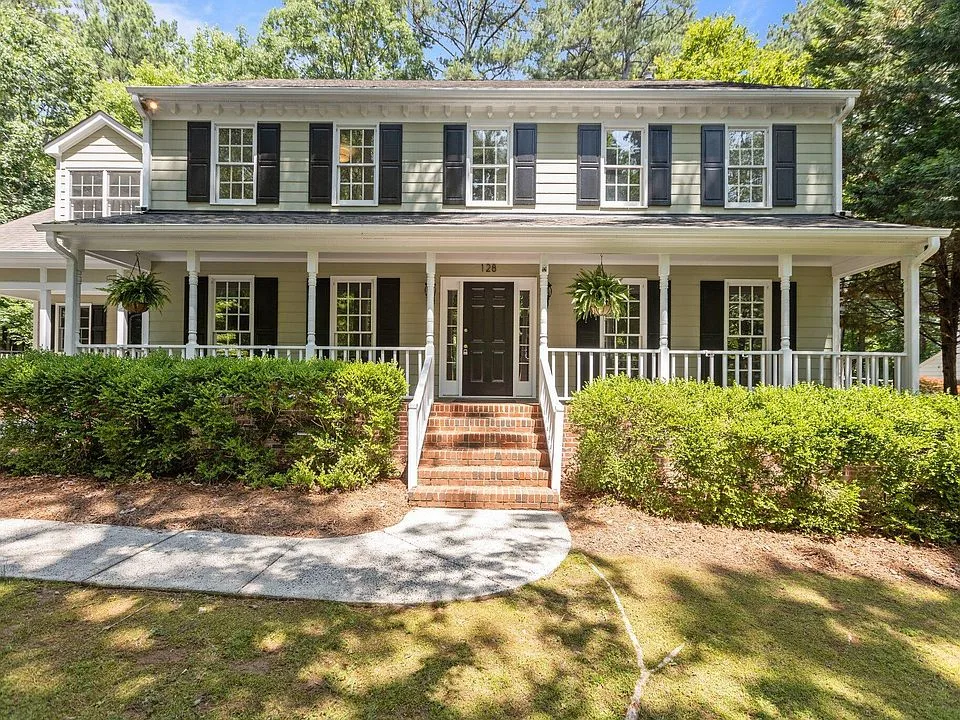
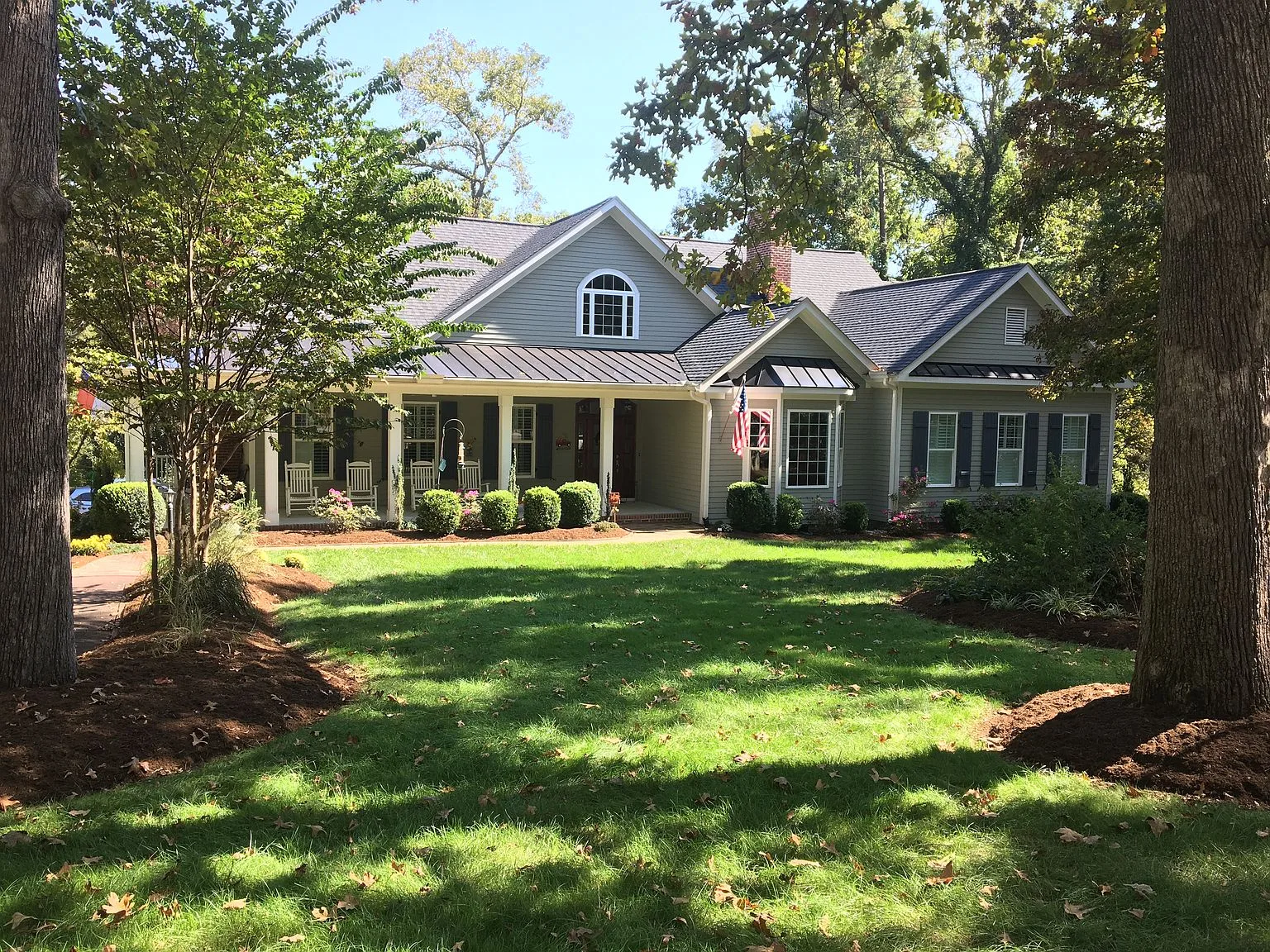
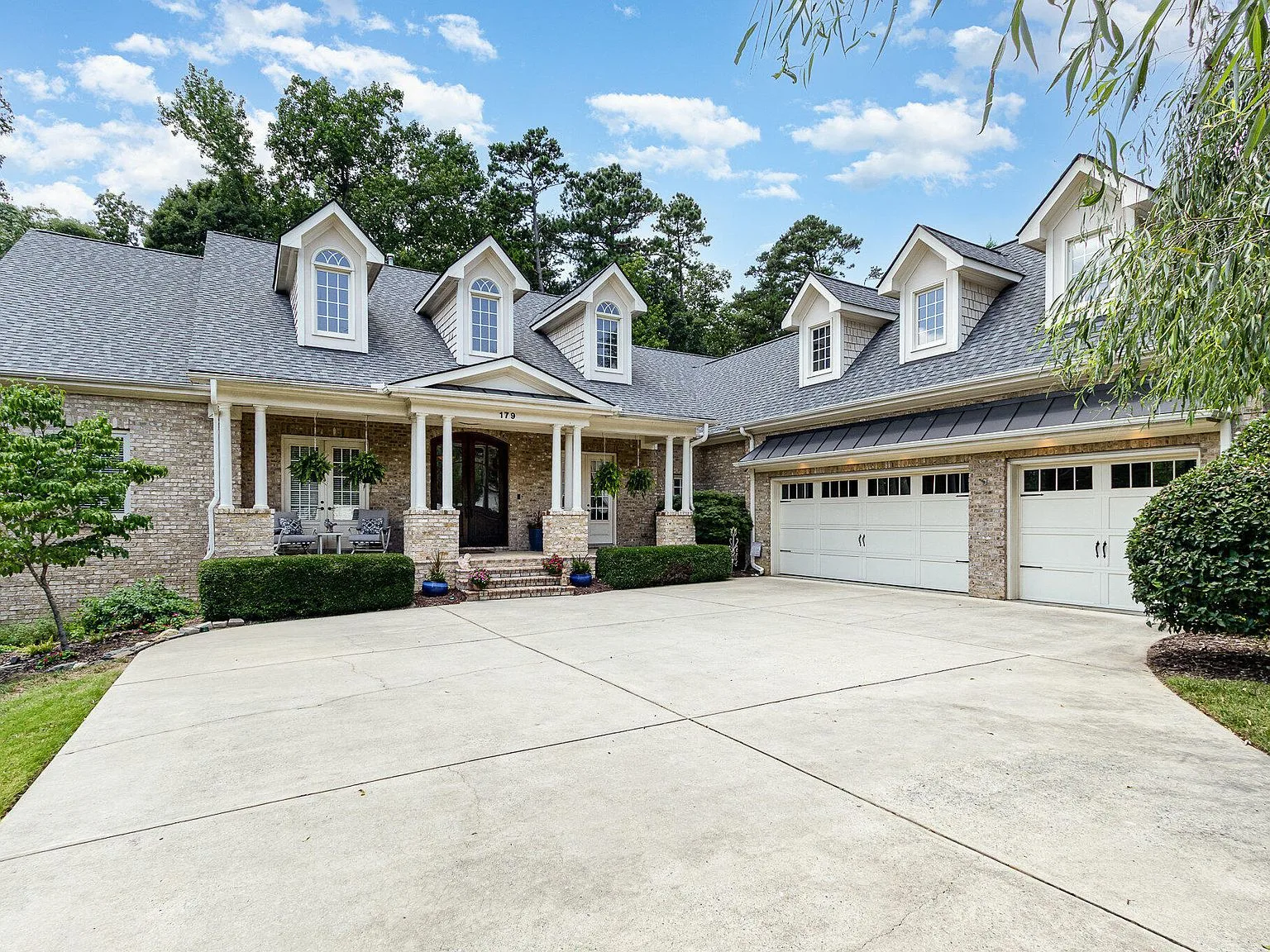
 Neighborhood Selection Tips from Phil
Three things I tell every Chapel Hill buyer before they start touring:
School Districts Matter More Than Mailing Address Homes with a Chapel Hill mailing address in Chatham or Durham counties do NOT feed into CHCCS. Always verify with the official county GIS maps before placing an offer.
Drive Your Commute at 8:00 AM Test the actual drive to UNC, RTP, or your office during rush hour. Chapel Hill's proximity to I-40 and NC-54 varies significantly by neighborhood.
Understand Chapel Hill vs. Chatham Tax Rates Property tax rates differ between Orange County (Chapel Hill) and Chatham County. This can mean thousands of dollars per year in difference for similar-priced homes.
CRITICAL: Verify School Assignments Yourself
Always verify with Chapel Hill-Carrboro City Schools (CHCCS) or Chatham County Schools using the exact property street address. Redistricting and boundary changes mean assignments can shift.
Not Sure Which Chapel Hill Neighborhood Is Right for You?
Let us help you find the perfect fit for your lifestyle and budget.
Chapel Hill Neighborhoods — Frequently Asked Questions
What is the most walkable neighborhood in Chapel Hill?
Southern Village and Downtown Chapel Hill are the most walkable neighborhoods. Southern Village features a Market Street village green, Weaver Street Market, and the Lumina Theater, all within walking distance of homes. Downtown Chapel Hill offers direct access to Franklin Street, the UNC campus, and the Ackland Art Museum.
Which Chapel Hill neighborhoods feed into CHCCS schools?
Neighborhoods inside Chapel Hill town limits in Orange County are zoned for Chapel Hill-Carrboro City Schools (CHCCS). This includes Southern Village (Scroggs Elementary), Meadowmont (Rashkis Elementary), Lake Hogan Farms (Morris Grove Elementary), Winmore (Seawell Elementary), Estes Hills, and Governor's Village. Communities with a Chapel Hill mailing address in Chatham County, like Governors Club and The Preserve at Jordan Lake, are zoned for Chatham County Schools, not CHCCS.
Which Chapel Hill neighborhoods have the lowest property tax rates?
Neighborhoods in Chatham County with Chapel Hill mailing addresses carry the lowest tax rates, around $0.70 to $0.74 per $100 assessed value. This includes Governors Club, The Preserve at Jordan Lake, the Legacy at Jordan Lake, and Briar Chapel. In contrast, neighborhoods inside Chapel Hill town limits in Orange County pay a combined rate of $1.2862 per $100 assessed value, including the CHCCS special school tax.
What is the best neighborhood in Chapel Hill for families with young children?
Southern Village is widely considered the top family neighborhood due to its walkable village center, Mary Scroggs Elementary School embedded within the community, pool and playgrounds, and direct access to greenways. Meadowmont and Lake Hogan Farms are also excellent family choices with strong CHCCS school assignments, community pools, and active neighborhood associations.
Which Chapel Hill neighborhoods offer the best commute to RTP and Raleigh?
Meadowmont and Southern Village offer the best RTP commutes in Chapel Hill due to their direct access to I-40 and NC-54. Meadowmont is particularly well positioned with I-40 on-ramps at the edge of the community. Estes Hills and Governor's Village also offer convenient access to the highway corridor for commuters heading east toward RTP and Raleigh.
Triangle
Areas
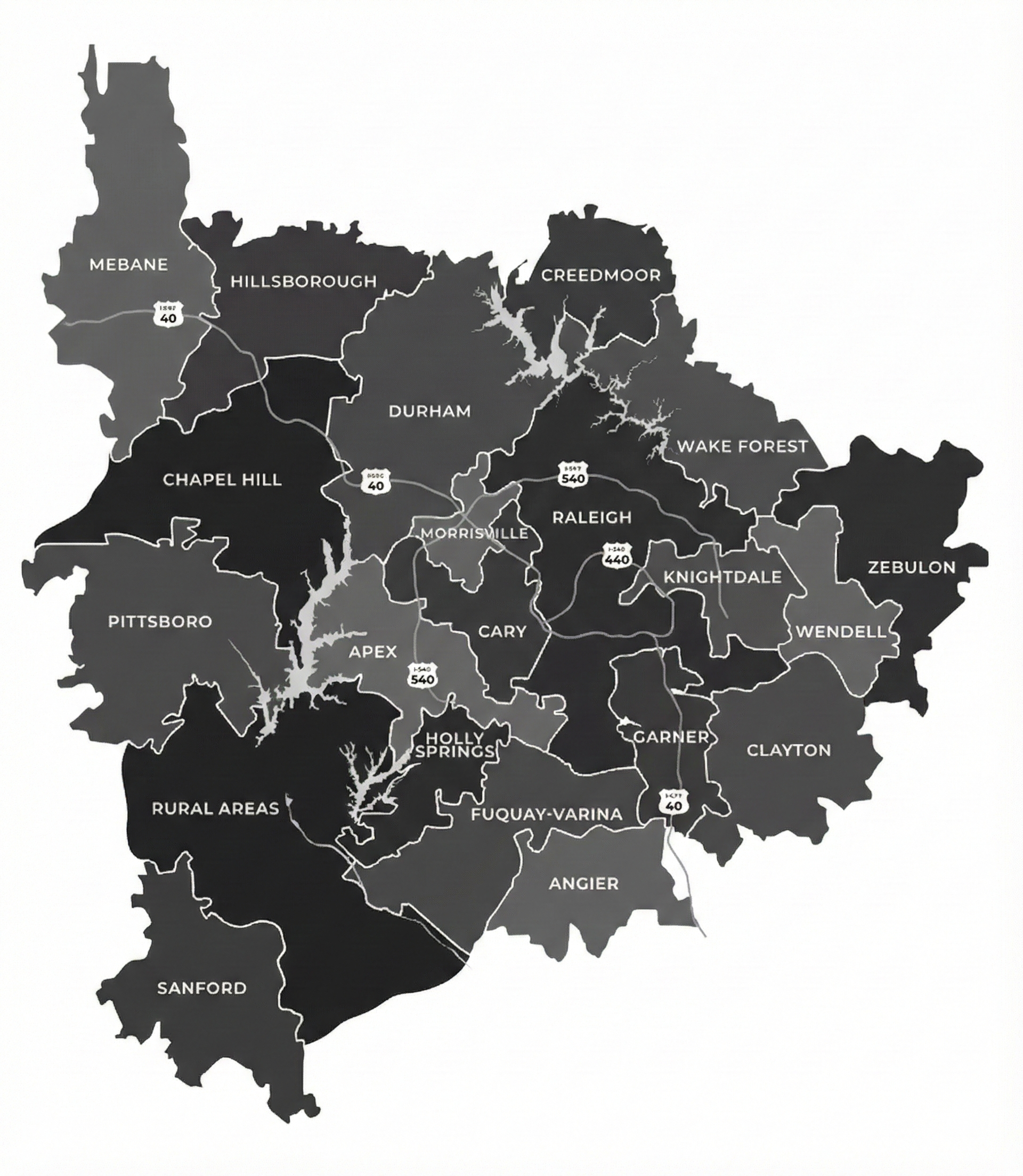
How Chapel Hill Compares to Other Triangle Cities
See how Chapel Hill stacks up against the Triangle's other top relocation destinations across the metrics that matter most to home buyers.
| Metric | Chapel Hill | Cary | Raleigh | Durham | Hillsborough |
|---|---|---|---|---|---|
| Median Home Price | $825K | $698K | $475K | $460K | $475K |
| Tax Rate | $1.3284 | $0.9850 | $0.9700 | $1.1500 | $1.1000 |
| School District Ratings | #1 CHCCS | Top-5 WCPSS | Top-5 WCPSS | DPS | Top-10 OCS |
| Commute to RTP | 20 min | 12 min | 10 min | 10 min | 30 min |
| Town Walkability | 32 Walk Score | 27 Walk Score | 32 Walk Score | 34 Walk Score | 24 Walk Score |
| New Construction Supply | Limited | High | High | Moderate | Low-Moderate |
| Average Lot Sizes | 0.25-1.0 ac | 0.15-0.5 ac | 0.15-0.5 ac | 0.20-0.75 ac | 0.30-1.5 ac |
| Primary Buyer Profile | Faculty/Medical | Family/Tech | Young Professionals | Creative/Startup | Historic/Rural |
* Figures reflect local MLS and municipal tax records for July 2026. Approximate numbers subject to monthly market shifts.
Higher Price Point
Chapel Hill commands a price premium driven by tight municipal boundary limits, demand from UNC/UNC Health staff, and top-tier school rankings.
Higher Tax Rate
At $1.3284 per $100, higher than Wake or Chatham County, funds transit and #1 school district.
Top-Rated Schools
CHCCS consistently ranked #1 in NC, justifying housing premium for relocating families.
Is Chapel Hill Your Best Triangle Match?
Choose Chapel Hill Over Raleigh If
- You want a compact historic college town, not a fast-growing capital city
- Top-ranked CHCCS schools are your #1 priority
- Walkability to UNC campus and Franklin Street matters more than suburban sprawl
Choose Chapel Hill Over Durham If
- Consistent top school performance matters more than urban edge
- You prefer quiet tree-lined streets over a bustling downtown scene
- You work at UNC or UNC Hospitals and want the shortest commute
Choose Chapel Hill Over Cary If
- Authentic historic architecture matters more than planned master-planned communities
- You want a vibrant downtown with culture and arts within walking distance
- Zero-fare bus transit and bike-friendly infrastructure are important to you
Choose Chapel Hill Over Hillsborough If
- Major academic medical center access is a must for your family
- You want walkable villages with more dining and shopping variety
- Broader luxury housing inventory fits your price range and expectations
"Chapel Hill is the premium product in the Triangle market. You pay more in purchase price and taxes, but you get top-rated schools, a walkable college-town lifestyle, and a built-in community centered around the university. For buyers who value those things, it is worth every penny."
Phil Slezak, Broker, Phil Slezak Real Estate
How Chapel Hill Compares to Other Triangle Cities — Frequently Asked Questions
How does Chapel Hill compare to Durham in housing costs and lifestyle?
Chapel Hill's median home price ($825,000) is roughly 1.8 times Durham's ($460,000), driven by the #1-ranked CHCCS school district and strict growth limits. Chapel Hill offers a refined, walkable college-town feel centered on UNC-Chapel Hill, whereas Durham is a larger, industrially repurposed city known for tech/biotech hubs (RTP), a thriving culinary scene, and diverse historic neighborhoods.
Should buyers choose Chapel Hill or Cary for families and schools?
Both cities cater to family relocations, but their layouts differ. Cary offers master-planned suburban subdivisions, pristine parks, lower combined property tax rates (~$0.9046 per $100), and Wake County Public Schools. Chapel Hill offers a distinct university-town identity, zero-fare public transit, and the independent CHCCS school district, though home prices and tax rates ($1.2862 per $100) are higher.
How does Chapel Hill compare to Raleigh for job access and urban amenities?
Raleigh is the state capital and a major economic hub with a $459,000-$460,000 median home price, direct access to state government and corporate centers, and broad suburban expansion. Chapel Hill sits 30 miles west, offering a close-knit academic environment, lower density, and faster daily access to UNC Health and Western RTP, but a longer commute to Wake County job hubs.
What are the best alternative Triangle towns if Chapel Hill is out of budget?
For buyers seeking Orange County vibes at lower price points, Hillsborough offers historic small-town charm 15 minutes north. For those seeking master-planned communities in Chatham County with a Chapel Hill address, Briar Chapel and Governors Club offer modern housing with significantly lower property tax rates (~$0.70-$0.74 per $100).
Cost of Living in Chapel Hill, NC (2026)
A household income of $260,000–$300,000 per year comfortably supports a median-priced home in Chapel Hill. Here is what you can expect to pay for housing and daily living in 2026.
Property Tax Rates (In-Town Chapel Hill / Orange County)
| Taxing Authority | Rate per $100 Assessed Value |
|---|---|
| Town of Chapel Hill | $0.5000 |
| Orange County Base Rate | $0.6805 |
| CHCCS Special District Tax | $0.1479 |
| Total Combined Property Tax Rate | $1.3284 per $100 |
~$10,611 annual on $825K home (~$884/mo). Optional Downtown Service District additional $0.0550.
North Carolina Tax Advantages:
Monthly Cost Breakdown for a $825K Home
Based on a median home price of $825,000 with 20% down ($165,000) at a 6.5% interest rate.
| Expense Category | Estimated Monthly Cost |
|---|---|
| Mortgage P&I | ~$4,170 |
| Property Tax | ~$884 |
| Insurance | ~$215 |
| HOA | $100–$300 |
| Groceries | $450–$600 |
| Utilities | $200–$320 |
| Transportation | $200–$350 |
| Dining/Entertainment | $250–$500 |
| Healthcare | $250–$500 |
| Total Estimated Monthly Outlay | $6,720–$7,840/mo |
Rent Ranges in Chapel Hill
1BR downtown $1,200–$1,800/mo. 2BR apartments/townhomes $1,600–$2,800/mo. Single-family rentals $2,000–$4,000/mo.
"I moved here from Connecticut, and even I was surprised by Chapel Hill's cost of living. It is definitely higher than the rest of the Triangle, but you are paying for a proven product -- schools that are consistently ranked among the best in the state, a vibrant downtown, and a community that feels special. For the right buyer, it is money well spent."
Phil Slezak -- Broker, Phil Slezak Real Estate
Cost of Living in Chapel Hill — Frequently Asked Questions
How does the cost of living in Chapel Hill compare to the national average?
Chapel Hill's cost of living is roughly 15% to 20% above the national average and stands as the highest in the Research Triangle. While daily expenses like groceries, health care, and utilities align closely with national benchmarks, real estate and local property tax rates drive the overall premium.
What is the combined property tax rate in Chapel Hill, NC?
For homes inside Chapel Hill town limits within Orange County, the total combined property tax rate is approximately $1.3284 per $100 of assessed value. This total includes Orange County tax, Town of Chapel Hill municipal tax, and the Chapel Hill-Carrboro City Schools (CHCCS) special district tax.
Can you reduce your property tax bill by buying in Chatham County with a Chapel Hill address?
Yes. Properties located in Chatham County with a Chapel Hill mailing address (such as Governors Club) sit outside the CHCCS tax district. Combined property tax rates there generally range from $0.70 to $0.74 per $100, saving homeowners thousands of dollars annually compared to in-town Orange County rates.
Are there built-in municipal perks that offset Chapel Hill's higher taxes?
Yes. Chapel Hill operates the largest 100% fare-free public transit system in North Carolina, eliminating bus fares for all residents. Additionally, the town funds extensive public parks, greenways, public libraries, and the top-ranked public school system in the state without charging separate user fees.
Schools in Chapel Hill, NC -- What Buyers Need to Know
The Chapel Hill-Carrboro City Schools (CHCCS) district is consistently ranked the #1 public school district in North Carolina and among the best in the nation. For relocation buyers, understanding how the schools work is essential to making the right home purchase.
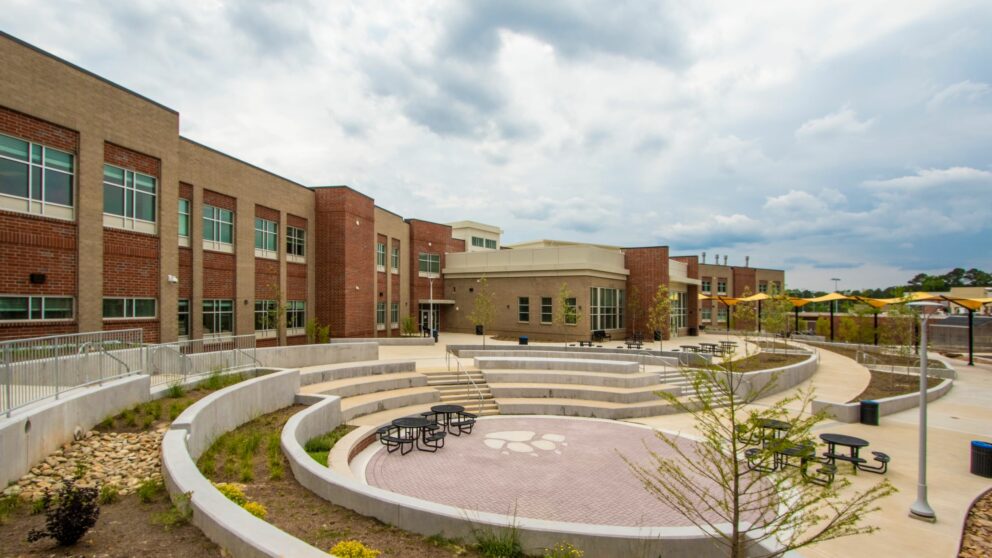
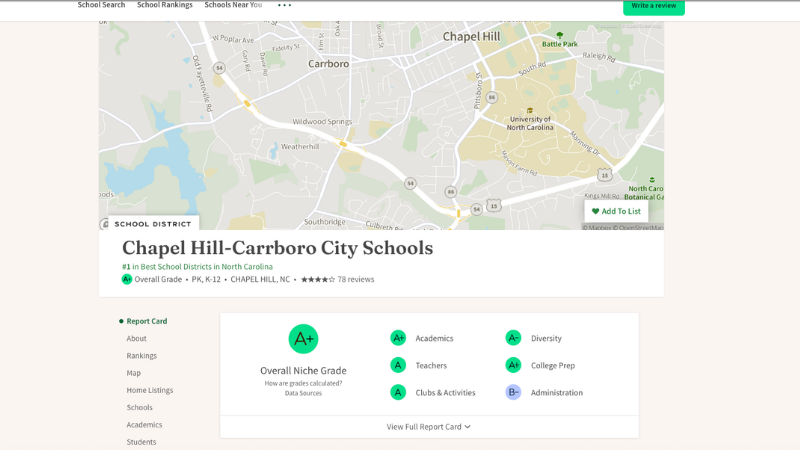
Source: Niche.com: Chapel Hill-Carrboro City Schools ranked #1 Best School Districts in North Carolina (2026)
Three Rules for School Research
Always look up the exact property address on official county GIS tools
School attendance boundaries change. A home two streets over may feed into a completely different elementary or middle school. Use the Orange County GIS or Chatham County GIS to verify parcel-level school assignments.
Trace elementary-to-high-school feeder pathways
Your child's elementary school determines their middle and high school assignment. If you are targeting a specific high school, work backward through the feeder chain to make sure the home qualifies at every level.
Verify assignments before making an offer
School zoning can shift with population changes. Confirm current assignments with the CHCCS transportation department before writing an offer, especially for homes near boundary edges.
CHCCS High Schools Spotlight
Top-ranked high school in North Carolina. Recently modernized campus with state-of-the-art facilities, a strong Advanced Placement program, championship athletics, and a diverse, high-achieving student body.
Consistently ranked among the top high schools in the nation. Known for its rigorous International Baccalaureate (IB) program and nationally recognized music and arts programs. Outstanding college readiness outcomes.
Smaller, community-focused high school with a tight-knit culture and stellar academic performance. Highly rated for student support, teacher engagement, and a well-rounded extracurricular experience.
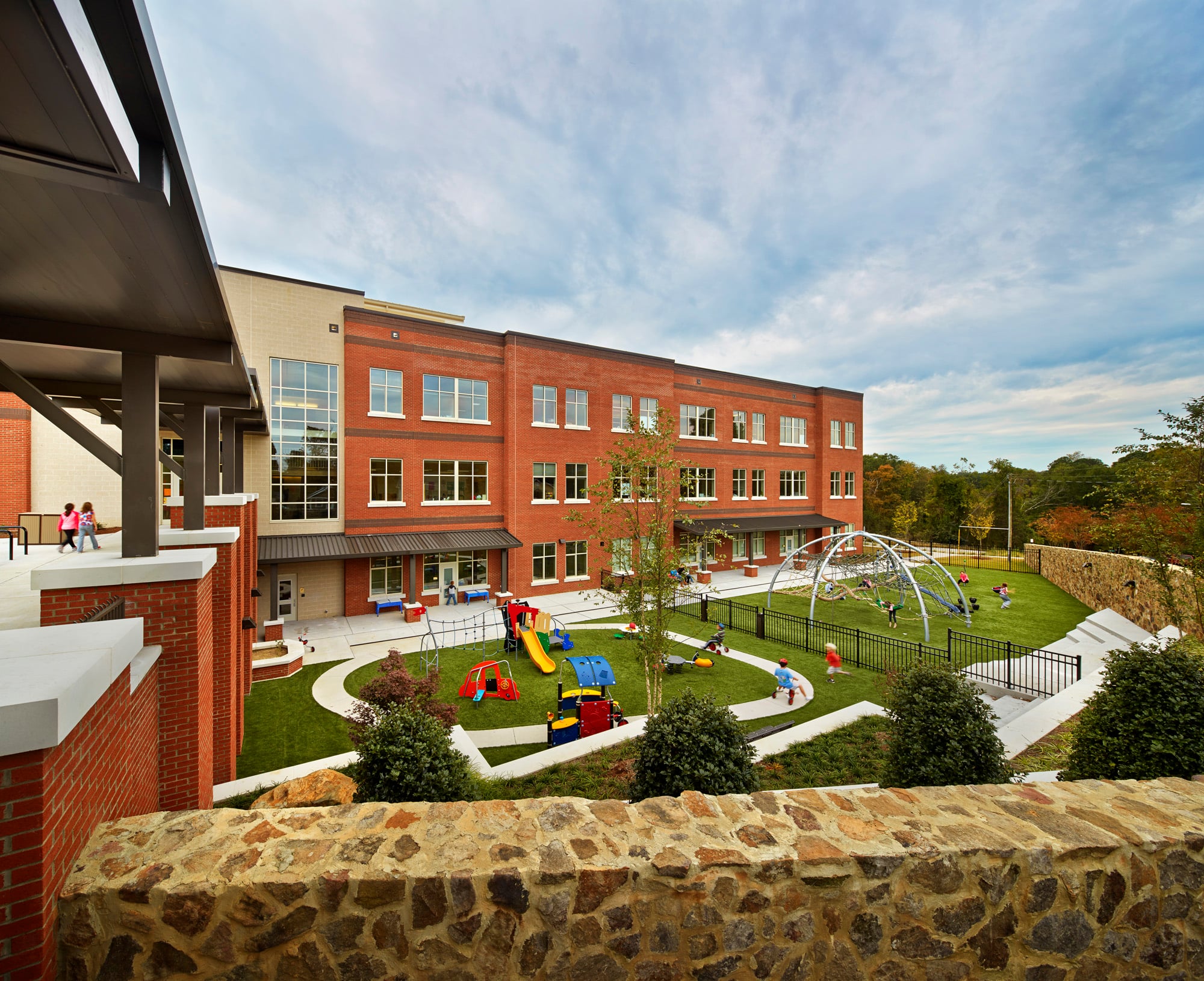
Elementary and Middle School Feeder Standouts
11 Elementary School Standouts
CHCCS operates 13 elementary schools, all rated well above the state average. Standouts include Mary Scroggs Elementary, Glenwood Elementary, Rashkis Elementary, Morris Grove Elementary, Frank Porter Graham Elementary, Estes Hills Elementary, Northside Elementary, Seawell Elementary, McDougle Elementary, Ephesus Elementary, and Carrboro Elementary. School assignment is strictly by address, so verifying the catchment map before you buy is essential.
4 Middle School Pathways
CHCCS operates 4 middle schools: Culbreth Middle School, Guy B. Phillips Middle School, McDougle Middle School, and Smith Middle School. Each feeds into one or more of the district's top-ranked high schools, with Phillips feeding East Chapel Hill High and Culbreth feeding Chapel Hill High among the primary pathways.
Charter, Private, and Statewide Options
Woods Charter School
K-12 public charter school located in Chatham County, about 15 minutes from Chapel Hill. Known for small class sizes, a rigorous college-prep curriculum, and strong parent involvement. Free public school through lottery enrollment.
NC School of Science and Math (NCSSM)
Residential public high school in Durham for academically gifted students. Juniors and seniors live on campus and take college-level STEM and humanities courses. Admission is competitive across the state.
Emerson Waldorf School
PreK-12 private school set on 20 wooded acres. Waldorf curriculum emphasizing creativity, critical thinking, and hands-on learning with strong arts and outdoor education components. Tuition-based with financial aid available.
St. Thomas More Catholic School
K-8 private Catholic school in Chapel Hill. Offers a faith-based academic program with strong standardized test scores, small class sizes, and active parent community. Tuition-based with parishioner rates.
"The school system is the single biggest reason families move to Chapel Hill. CHCCS is the gold standard in the Triangle -- but that quality comes at a price. You will pay more in both purchase price and property taxes. The math works for most families because the schools are exceptional and the resale market stays strong."
Phil Slezak -- Broker, Phil Slezak Real Estate
Want to compare Chapel Hill schools to other Triangle districts?
Read the Triangle Relocation GuideSchools in Chapel Hill, NC -- Frequently Asked Questions
Why are Chapel Hill-Carrboro City Schools (CHCCS) consistently ranked #1 in North Carolina?
CHCCS earns the top state ranking (per Niche.com) due to exceptional academic metrics, high per-pupil funding, robust AP/IB course offerings, and top college matriculation rates. The district benefits directly from local property tax investments and proximity to UNC-Chapel Hill, attracting top-tier educators and highly engaged families.
Do all homes with a Chapel Hill mailing address attend CHCCS schools?
No. School assignment is determined by precise municipal and county boundaries, not postal zip codes. Homes with a Chapel Hill address located in Chatham County attend Chatham County Schools, while those in rural Orange County attend Orange County Schools. Only properties within the specific CHCCS tax district boundary attend CHCCS public schools.
Which high schools serve the Chapel Hill public school system?
CHCCS features three traditional public high schools: Chapel Hill High School, East Chapel Hill High School, and Carrboro High School. All three consistently rank among the top 15 public high schools in North Carolina for state assessment scores, Advanced Placement participation, and overall college readiness.
Does Chapel Hill offer dual-language immersion or magnet school options?
Yes. CHCCS offers highly sought-after dual-language immersion programs in Spanish (at Frank Porter Graham Elementary) and Mandarin Chinese (at Glenwood Elementary). The district also provides specialized gifted education pathways (AIG) and magnet programming integrated directly across its elementary and middle schools.
Parks and Outdoor Living in Chapel Hill, NC
Chapel Hill protects more green space per resident than almost any town in the Research Triangle. From the North Carolina Botanical Garden to the Bolin Creek Greenway and Jordan Lake, this is a community where nature is woven into daily life, not pushed to the edges.
Chapel Hill's Signature Natural Spaces
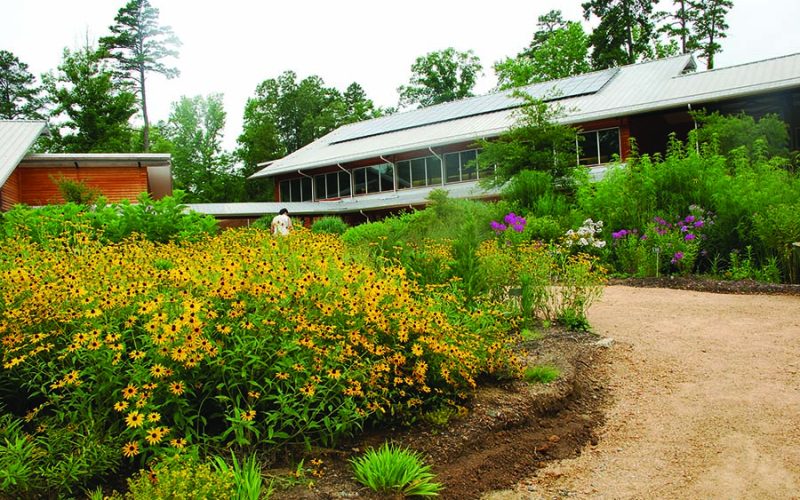
North Carolina Botanical Garden
1,200+ Acres of Protected Piedmont Landscape
The North Carolina Botanical Garden is the premier conservation garden in the Southeast, protecting over 1,200 acres of Piedmont landscape. The garden features the Piedmont Nature Trails, a network of easy walking paths through native hardwood forest, the Mason Farm Biological Reserve, and the Morgan Creek greenway corridor. Battle Park connects directly to the garden's trail system, creating a contiguous greenbelt of over 1,300 acres stretching from the UNC campus south to Morgan Creek.
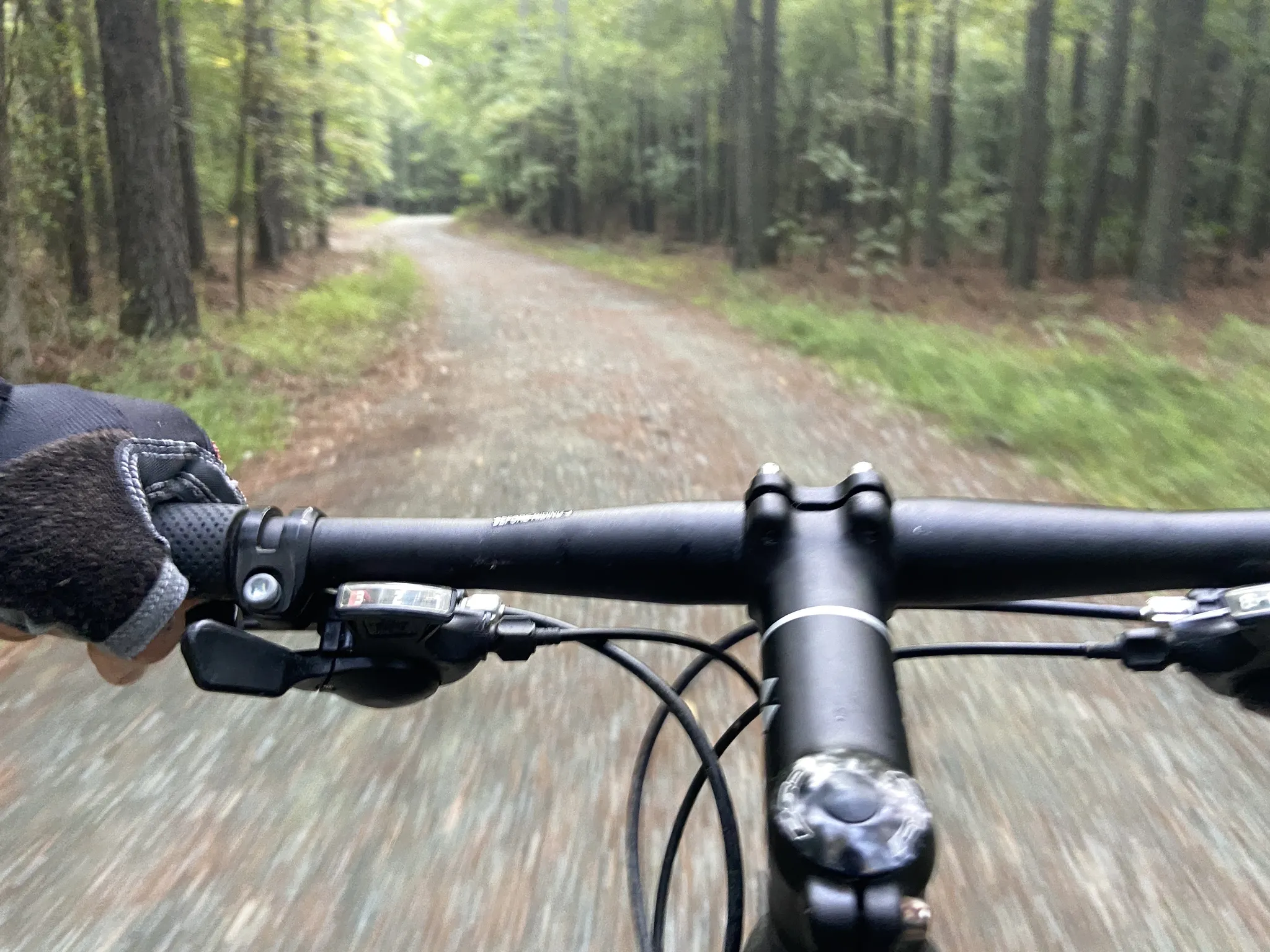
Battle Park and Forest Theatre
93-Acre Hardwood Forest on the Edge of Campus
Battle Park is a 93-acre old-growth hardwood forest located on the southern edge of the UNC campus. The park features 2+ miles of maintained hiking trails that wind through towering oak and hickory trees, cross historic stone bridges over Battle Creek, and connect to the Botanical Garden trail system. Forest Theatre, a historic outdoor stone amphitheater built into the hillside, hosts performances throughout the year and serves as one of Chapel Hill's most beloved community gathering spaces.
Campus Green Spaces and Forest Access
Coker Arboretum
5-Acre Historic Garden on UNC Campus
A 5-acre historic botanical garden on the UNC campus featuring walking paths, a wisteria-covered pergola, and hundreds of native and exotic plant species. Free and open to the public year-round.
Carolina North Forest
750-Acre University Forest
A 750-acre university-owned forest with 20+ miles of multi-use trails for hiking, running, and mountain biking. Located just north of the main campus, it provides a expansive natural escape within city limits.
Duke Forest (Korstian Division)
7,000+ Acres Across Three Counties
Duke Forest is a 7,000+ acre research and teaching forest spanning Durham, Orange, and Alamance counties. The Korstian Division, located closest to Chapel Hill, offers miles of public trails through diverse Piedmont ecosystems.
Mason Farm Biological Reserve
367-Acre Protected Reserve
A 367-acre protected natural area managed by the NC Botanical Garden. The reserve features diverse habitats including bottomland forest, successional fields, and Morgan Creek frontage, with trails open for hiking and wildlife observation.
Greenways and Trail Systems
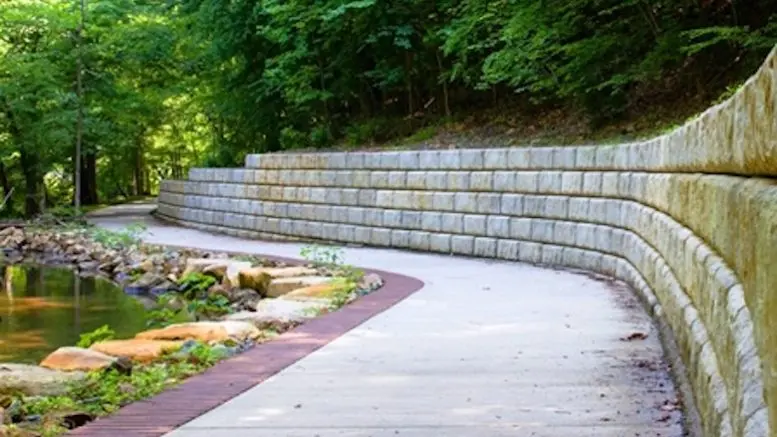
Bolin Creek Trail
2.5-Mile Paved Segment
A 2.5-mile paved greenway following Bolin Creek from downtown Chapel Hill to Umstead Park in Carrboro. The trail connects residential neighborhoods to the Chapel Hill Public Library, community center, and the Carrboro town limits.
Morgan Creek and Fan Branch
~4-Mile Connected Route
An approximately 4-mile connected greenway route following Morgan Creek and Fan Branch through southern Chapel Hill. The trail links Southern Village, Meadowmont, and several neighborhood parks, serving as a key east-west corridor.
Meadowmont Greenway
Multi-Use Path Through Meadowmont
A multi-use path winding through the Meadowmont community, connecting residential areas to the Meadowmont Village Center, Rashkis Elementary School, and the Morgan Creek Trail system.
E2E Greenway Initiative
Town-Wide Expansion Plan
Chapel Hill's E2E (East to Edge) Greenway Initiative is a town-wide plan to connect existing trail segments into a complete north-south greenway corridor from the Bolin Creek Trail to the Morgan Creek system, linking downtown to the Jordan Lake area.
Regional Lakes and Water Recreation
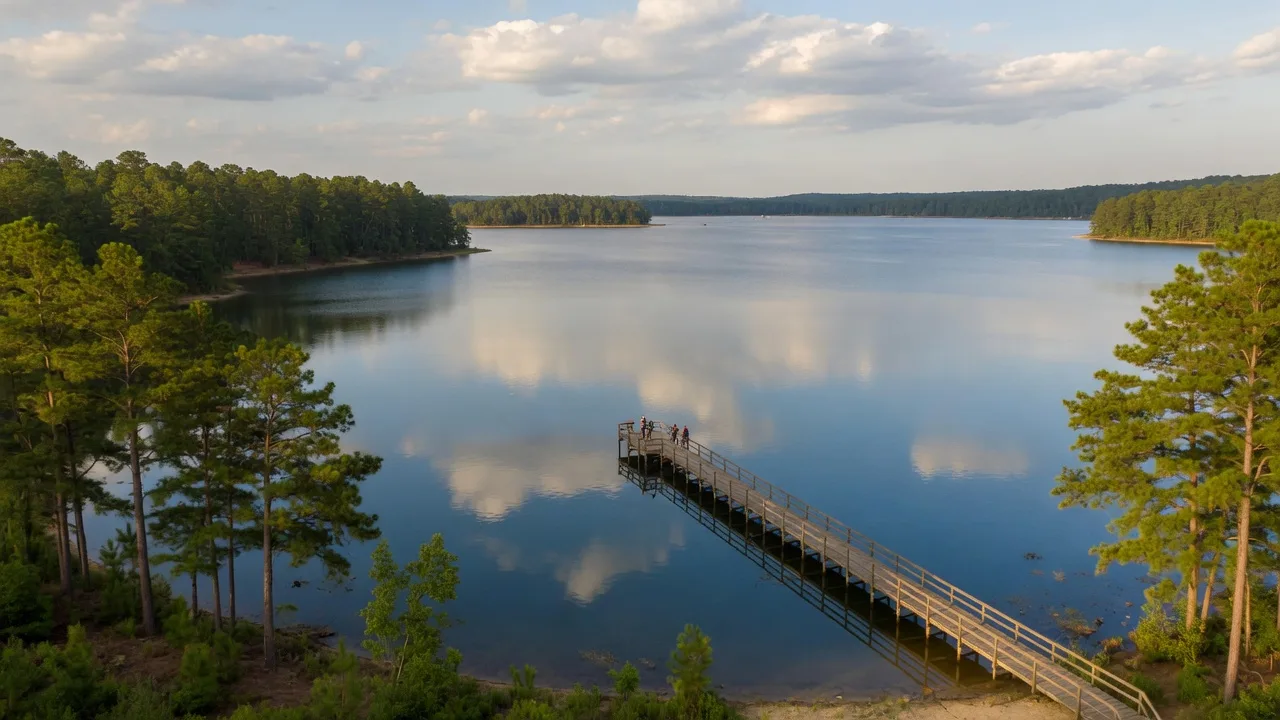
Jordan Lake State Recreation Area
13,940-Acre Lake, 15-20 Minutes South
Jordan Lake is the premier water recreation destination for the Triangle. The 13,940-acre reservoir offers multiple public access areas with sandy swimming beaches, boat ramps, fishing piers, hiking trails, and campgrounds. It is a 15-20 minute drive from downtown Chapel Hill. The lake is managed by the NC State Parks system and features over 1,000 acres of protected wildlife habitat.
University Lake
213-Acre Reservoir, 10-15 Minutes West
University Lake is a 213-acre reservoir located just west of Chapel Hill near the intersection of I-40 and NC 86. The lake is owned by UNC-Chapel Hill and serves as a backup water supply. While swimming and gas-powered boats are not permitted, the lake offers quiet non-motorized boating (kayaks, canoes, paddleboards) and has a small parking area with trail access around the shoreline.
Phil's Outdoor Perspective
"What sets Chapel Hill apart is that the green space isn't pushed out to the suburbs -- the Botanical Garden and Battle Park sit right against campus and downtown. You can walk out of a Franklin Street restaurant and be on a hiking trail in ten minutes. That kind of immediate access to nature is extremely rare in a town this size, and it is one of the top reasons buyers relocate here from larger cities."
Phil Slezak -- Broker, Phil Slezak Real Estate
What is the largest nature preserve in Chapel Hill, NC?
The largest nature preserve in Chapel Hill is the North Carolina Botanical Garden complex, which encompasses over 1,200 acres including the main garden, the Piedmont Nature Trails, Mason Farm Biological Reserve, and the Battle Park connection. When combined with Carolina North Forest (750 acres), the contiguous protected green space in Chapel Hill exceeds 2,000 acres.
Is the North Carolina Botanical Garden free to visit?
Yes, the North Carolina Botanical Garden is free and open to the public 365 days a year. The main garden grounds, Piedmont Nature Trails, and the Coker Arboretum on campus are all free to enter. Some special programs and events may have fees, but general admission remains free for all visitors.
Can you swim or take gas boats on University Lake?
Swimming and gas-powered boats are not permitted on University Lake. The lake serves as a backup water supply for UNC-Chapel Hill, so motorized watercraft are restricted. However, non-motorized boats such as kayaks, canoes, and paddleboards are allowed. For swimming and full boating access, Jordan Lake State Recreation Area is just 15 minutes south and offers designated swimming beaches, boat ramps, and marina facilities.
How far is Jordan Lake from Chapel Hill?
Jordan Lake State Recreation Area is approximately 15-20 minutes south of downtown Chapel Hill via US 15-501 or Farrington Road. The closest access areas to Chapel Hill are the Seaforth and Ebenezer Church access points, both about a 10-12 mile drive. The lake spans 13,940 acres and offers beaches, boat ramps, fishing piers, hiking trails, and campgrounds across multiple access areas.
Amenities and Community Services: The Chapel Hill Advantage
Chapel Hill is a self-contained university municipality where residents enjoy access to world-class healthcare, a vibrant downtown, zero-fare public transit, and an annual calendar of events that makes every season feel special.
UNC Health and Academic Medical Ecosystem
The UNC Medical Center anchors one of the nation's top academic medical systems. As part of UNC Health, the hospital complex serves as a major regional referral center and provides Chapel Hill residents with immediate access to specialists, advanced procedures, and cutting-edge clinical trials.
The UNC School of Medicine, UNC Adams School of Dentistry, UNC Eshelman School of Pharmacy, and UNC Gillings School of Global Public Health all contribute to a dense concentration of medical expertise that most cities of this size simply cannot match.
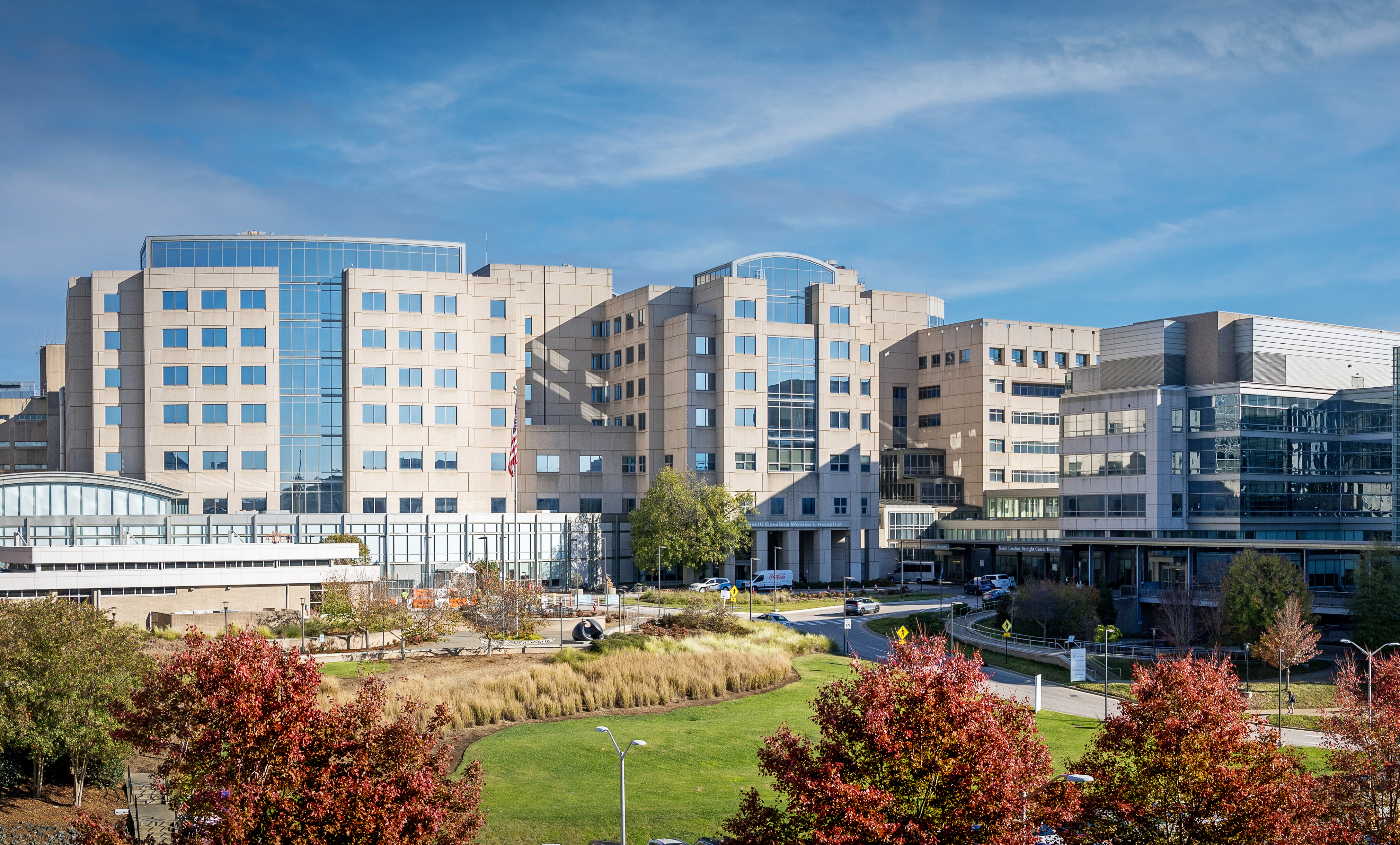
N.C. Memorial Hospital
Flagship academic medical center and level 1 trauma center serving the entire state.
N.C. Cancer Hospital
NCI-designated comprehensive cancer center with advanced treatment and clinical trials.
N.C. Children's Hospital
Full-service pediatric hospital with specialized children's emergency department.
N.C. Women's Hospital
Dedicated women's health facility with obstetrics, gynecology, and neonatal intensive care.
Commercial, Dining, and Shopping Districts
Chapel Hill's commercial core offers a density of locally owned shops, restaurants, and services that is rare for a city of its size. The downtown retail district on Franklin Street and the recently revitalized Rosemary Street corridor provide walkable shopping, dining, and entertainment options for residents of all ages.
For everyday errands and big-box retail, Eastgate Crossing and University Place serve the eastern edge of town, while the Midtown and Village Commons areas offer additional grocery, pharmacy, and service options west of downtown.
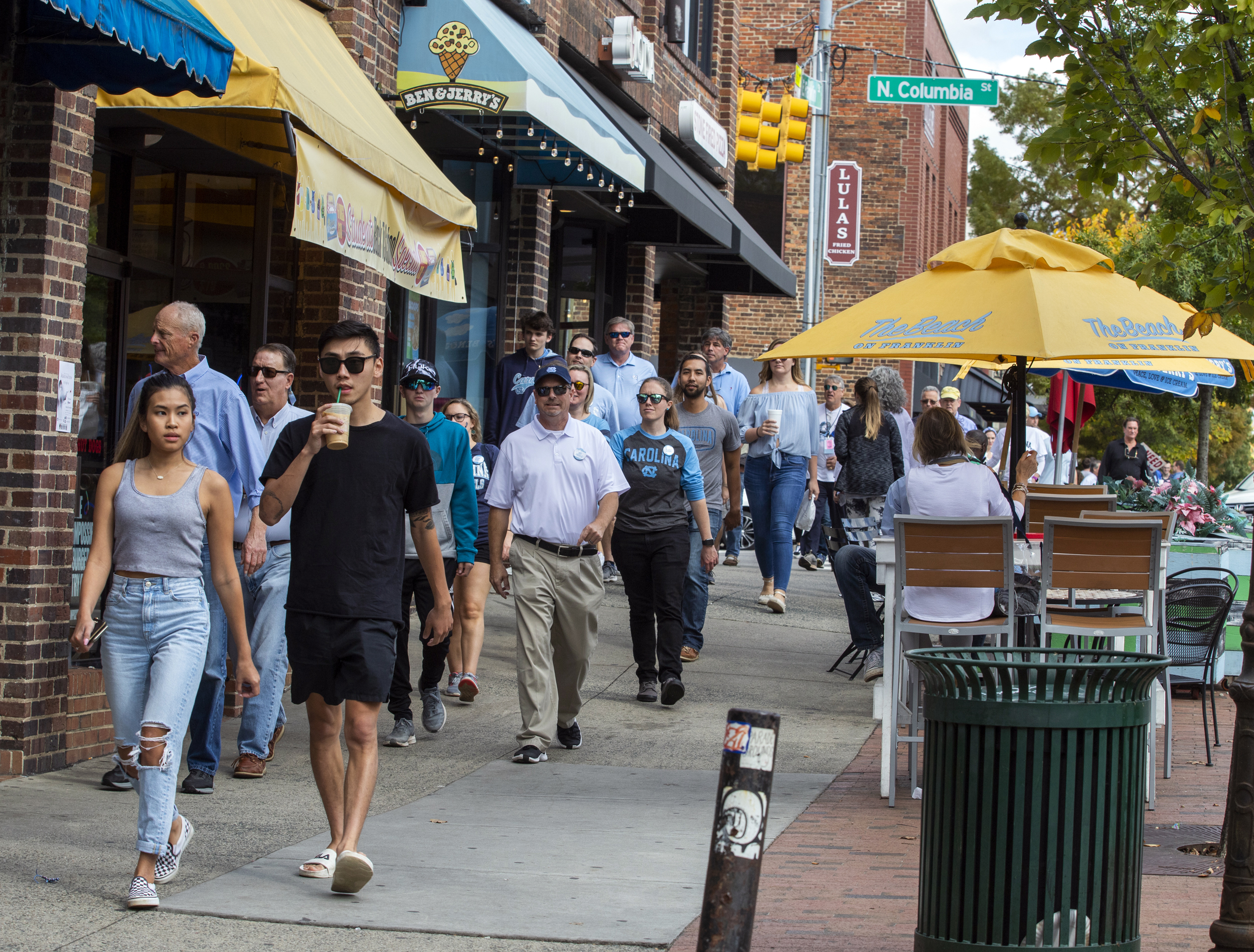
Downtown Franklin Street and Rosemary Street
The historic heart of Chapel Hill. Downtown Chapel Hill offers locally owned boutiques, independent bookstores, art galleries, and the iconic Carolina Theatre and Varsity Theatre. Rosemary Street's recent redevelopment added new dining, apartment living, and retail options.
Eastgate Crossing and University Place
The primary big-box and daily-needs retail nodes on the east side of town. Eastgate features Target, grocery, pharmacy, and casual dining. University Place is anchored by Harris Teeter and includes a mix of national retailers, a movie theater, and service businesses.
Midtown and Village Commons
Serving the western and southern parts of Chapel Hill. The Village Commons area off U.S. 15-501 includes major grocers, pharmacies, banks, and medical offices. Midtown offers additional retail and dining options near Meadowmont and the I-40 corridor.
Arts, Culture, and Carolina Athletics
Chapel Hill's arts and culture scene is powered by the university and sustained by a community that values the arts. From the Ackland Art Museum to the world-class performances at Carolina Performing Arts, residents have access to cultural experiences that rival much larger cities.
And then there is Carolina Athletics. From basketball at the Dean E. Smith Center to football at Kenan Memorial Stadium, Tar Heels sports are woven into the fabric of daily life in Chapel Hill.
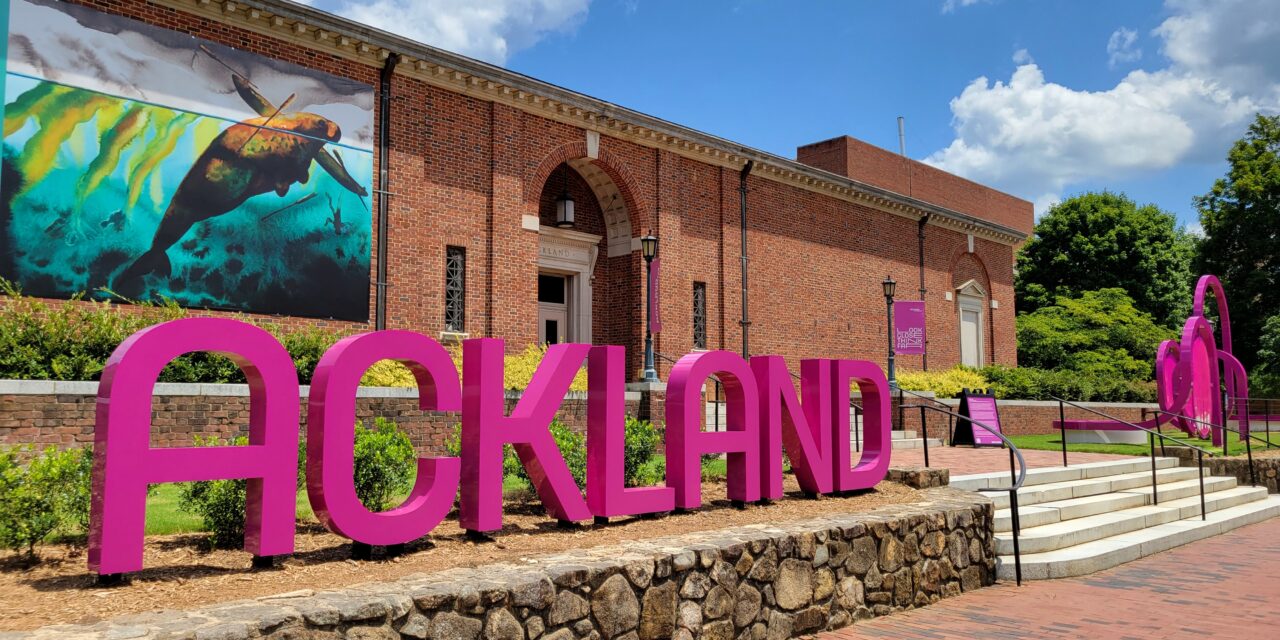
A premier university art museum with over 17,000 works spanning European old masters, Asian art, African art, modern, and contemporary pieces. Free admission.
Carolina Performing Arts and Memorial Hall
World-class performing arts season at Memorial Hall featuring dance, theater, classical music, jazz, and contemporary performances from internationally renowned artists.
Morehead Planetarium and Science Center
One of the oldest planetariums in the United States, Morehead offers public shows, science education programs, and a rooftop telescope for community stargazing.
Carolina Athletics (UNC Tar Heels)
Men's and women's basketball, football, soccer, lacrosse, baseball, and more. The Dean E. Smith Center and Kenan Memorial Stadium host year-round collegiate sports.
Zero-Fare Public Transit and Municipal Services
Chapel Hill Transit (Zero-Fare)
Chapel Hill Transit is a zero-fare public bus system serving Chapel Hill, Carrboro, and UNC Chapel Hill. With over 30 routes and frequent service, it is one of the most robust fare-free transit systems in the Southeast. Residents, students, and visitors ride free on all local routes.
Chapel Hill Public Library
A modern, award-winning public library located on Library Drive near Estes Drive. Features a dedicated children's wing, public meeting rooms, computer lab, study spaces, and an extensive circulating collection. A cornerstone of the community.
North-South Bus Rapid Transit (BRT)
The planned North-South BRT corridor will connect downtown Chapel Hill to Southern Village and UNC Hospitals with dedicated bus lanes, station platforms, and frequent electric bus service. Construction is designed to improve transit access across the community.
Annual Event Calendar
Festifall Arts Market
An annual outdoor arts and crafts festival held each fall on Franklin Street and the UNC campus. Features hundreds of local and regional artists, live music, food vendors, and family activities. A Chapel Hill tradition dating back decades.
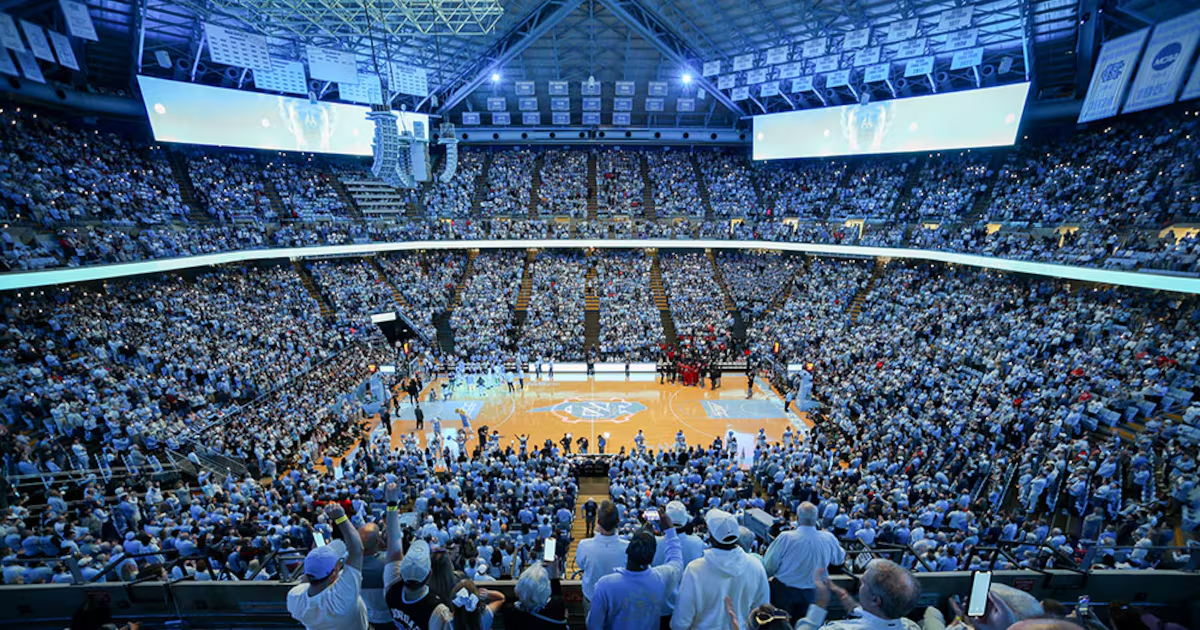
Carolina Basketball Game Days
Game days at the Dean E. Smith Center transform Chapel Hill. From November through March, the energy around Franklin Street and the Dean Dome is electric. Tickets through UNC Athletics.
Tar Heel 10 Miler
An annual 10-mile road race that winds through the UNC campus, Franklin Street, and Chapel Hill neighborhoods. Draws thousands of runners each spring and is a staple of the local fitness calendar.
Varsity Theatre Rocky Horror
The historic Varsity Theatre on Franklin Street hosts midnight screenings of The Rocky Horror Picture Show, a beloved Chapel Hill tradition. (Note: Apple Chill, the annual Franklin Street street fair, ended in 2006 and is no longer held.)
Amenities as a Buyer Consideration
The availability and proximity of the following amenities can significantly influence your home search in Chapel Hill. Here is how different neighborhoods compare for walkability and access:
Downtown and Historic Core
Highest walkability in the Triangle. Franklin Street, UNC campus, restaurants, library, and transit stops within a 5-10 minute walk. Premium pricing reflects the walk-to-everything lifestyle.
Southern Village and Meadowmont
Master-planned walkable villages. Village center includes grocery, dining, services embedded. Family-friendly with top CHCCS schools. Car-optional lifestyle with fare-free transit connections.
Governors Club and South Corridor
Luxury golf and gated living. Access to club amenities (golf, tennis, pool, fitness). Car-dependent for errands and dining. Lower walkability but highest privacy and resort-style amenities.
Governor's Village and 15-501
Established suburban area with access to Village Commons and Midtown retail. Grocery, pharmacy, and dining within a short drive. Good balance of space, schools, and access without downtown pricing.
Frequently Asked Questions About Chapel Hill Amenities
What is the main hospital system in Chapel Hill, NC?
The main hospital system is UNC Health, anchored by UNC Medical Center on the campus of UNC Chapel Hill. The system includes N.C. Memorial Hospital, N.C. Cancer Hospital, N.C. Children's Hospital, and N.C. Women's Hospital, all located on the main campus.
What is the oldest restaurant in Chapel Hill?
The Carolina Coffee Shop, located on Franklin Street, is the oldest continuously operating restaurant in the state of North Carolina. It opened in 1922 and remains a beloved Chapel Hill institution known for its breakfast, lunch, and classic diner atmosphere.
Is there a YMCA in Chapel Hill?
Yes, the Chapel Hill-Carrboro YMCA is located at 980 MLK Jr. Blvd. It offers fitness programs, childcare, swim lessons, youth sports, and community programs for all ages. It is a central hub for family recreation in the community.
Which Chapel Hill neighborhoods are most walkable to amenities?
Downtown Chapel Hill and the historic Northside neighborhood offer the highest walkability, with Franklin Street, UNC campus, and the Chapel Hill Public Library within walking distance. Southern Village and Meadowmont are also highly walkable as master-planned communities with village centers.
Dining in Chapel Hill, NC: A Local Culinary Guide
Chapel Hill's dining scene punches well above its weight, driven by the university community's demand for quality and diversity. From iconic Franklin Street institutions to hidden gems in Carrboro, the food here is exceptional.
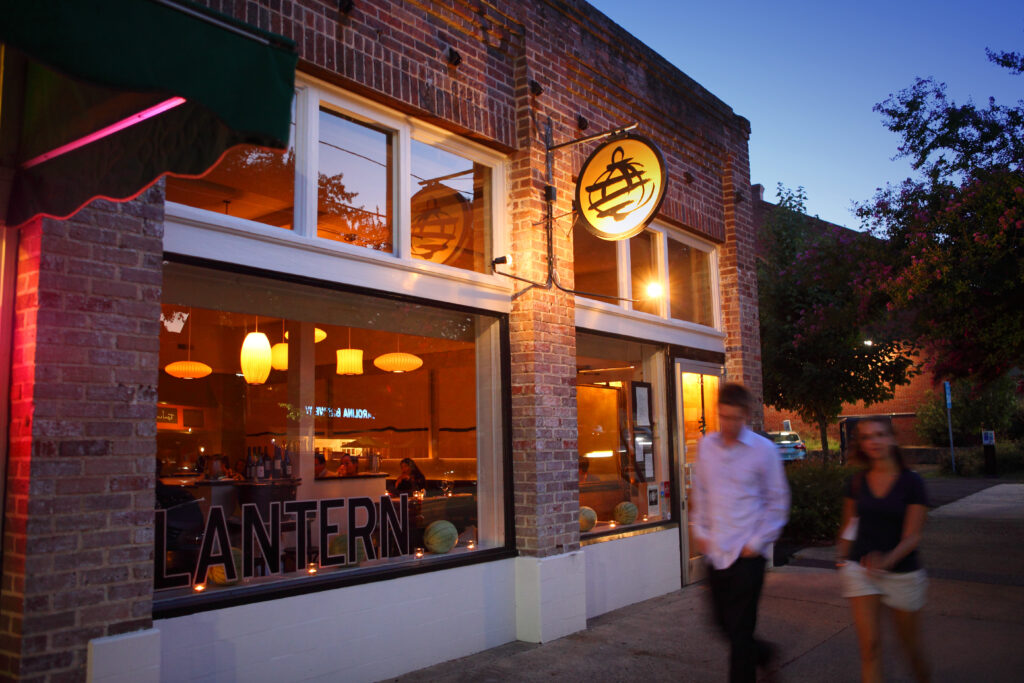
Fine Dining and Date Night
Chapel Hill's elevated dining scene for special occasions
Lantern
James Beard Award-winning Asian-fusion restaurant on West Franklin Street. A Chapel Hill icon for special occasions with inventive small plates and an exceptional wine list.
Hawthorne & Wood
New American cuisine crafted by a Michelin-starred chef. Located on East Franklin, with a rotating seasonal menu and an intimate dining room perfect for date night.
Bluebird
Classic French bistro fare on Elliott Road. Known for its duck confit, steak frites, and authentic Parisian atmosphere with a loyal local following.
Osteria Georgi
Upscale Italian dining on East Franklin Street with handmade pasta, seasonal ingredients, and a carefully curated Italian wine program. An intimate, romantic setting.
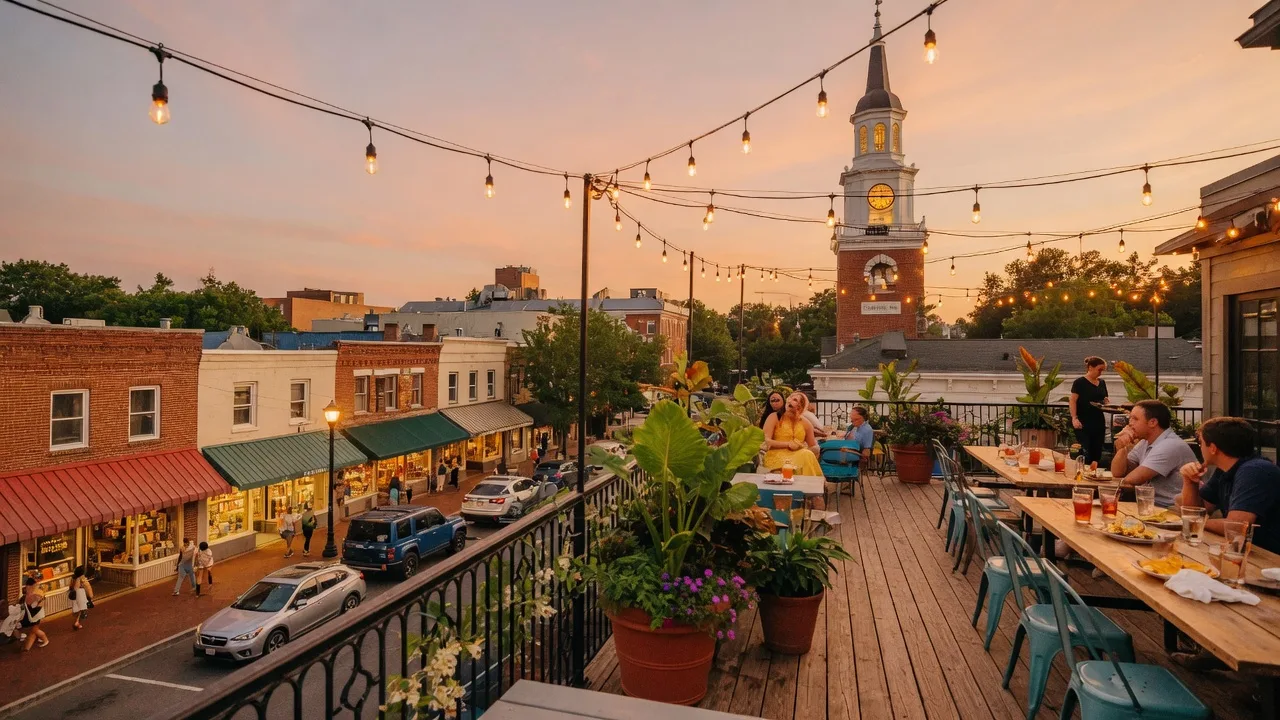
Franklin Street Institutions
Historic restaurants that have defined Chapel Hill for generations
Carolina Coffee Shop
Since 1922, the oldest continuously operating restaurant in North Carolina. A Franklin Street landmark serving breakfast, lunch, and classic diner fare to generations of Tar Heels.
Top of the Hill (TOPO)
Chapel Hill's premier rooftop restaurant and microbrewery overlooking Franklin Street. Famous for handcrafted beers, great views, and a menu that spans pub classics to modern American fare.
Sutton's Drug Store
An old-fashioned soda fountain and grill that has served UNC students since 1923. A time capsule of Americana with burgers, milkshakes, and the best people-watching on Franklin Street.
Merritt's Grill
A Chapel Hill icon since 1929 on Franklin Street. Famous for its BLT sandwich, Merritt's is a no-frills lunch counter that has fed generations of students, faculty, and locals.
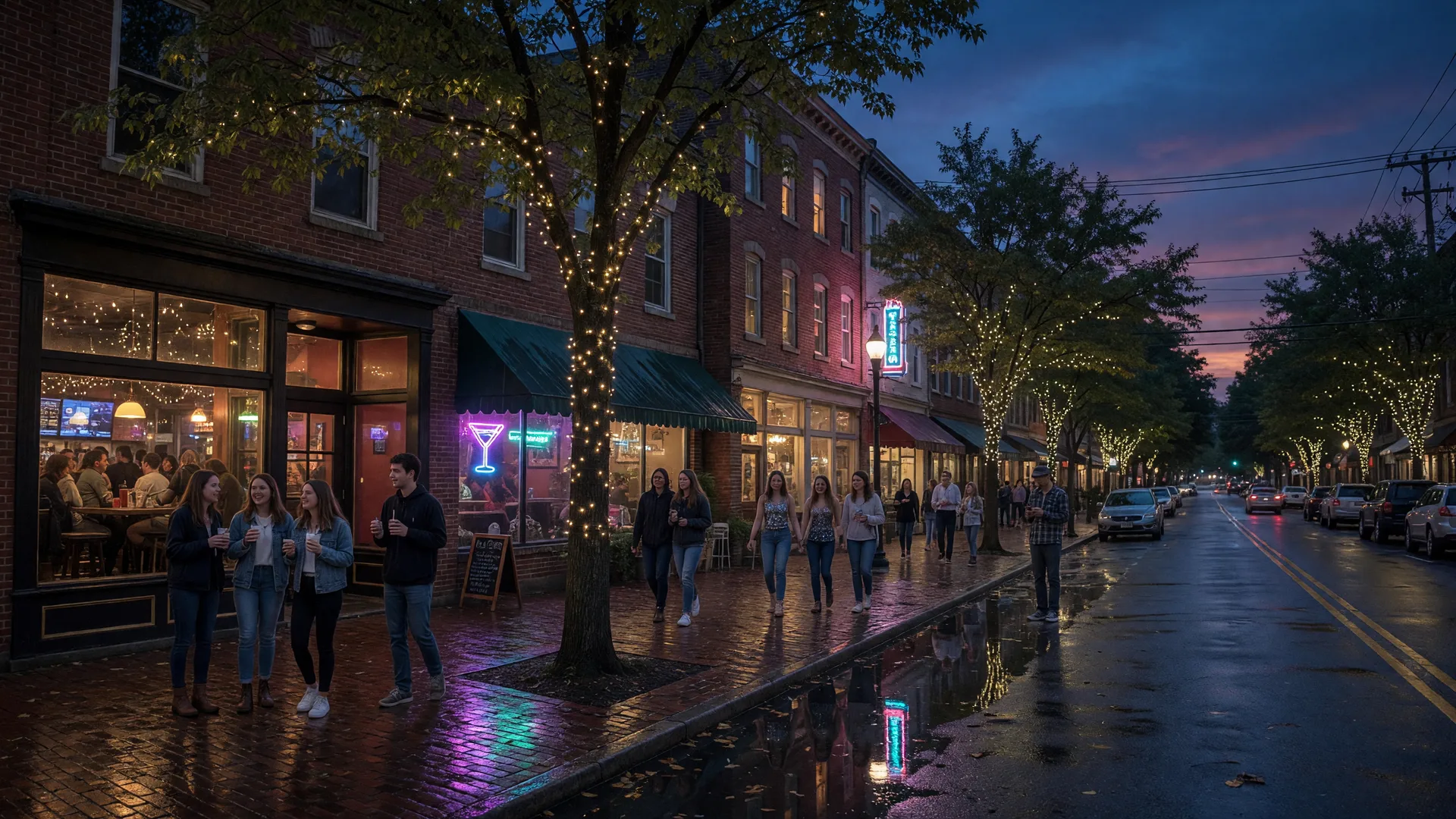
Bars, Breweries, and Nightlife
Where to grab a drink and experience Chapel Hill after dark
The Crunkleton
Award-winning craft cocktail bar with one of the South's most impressive whiskey selections. An intimate, sophisticated spot on East Franklin Street.
Carolina Brewery
Franklin Street's original craft brewery and pub since 1995. Known for its Flagship IPA and a lively, welcoming atmosphere for students and locals alike.
Four Corners
A popular College Street bar offering craft beers, cocktails, and a relaxed rooftop patio. A favorite gathering spot for UNC alumni and downtown professionals.
Might As Well
A classic Franklin Street dive bar with a loyal following. Cheap drinks, a jukebox, and zero pretension. A true Chapel Hill institution since the 1970s.
One40 Social
A modern cocktail lounge and social club on West Franklin Street. Features craft cocktails, live music, and a stylish interior perfect for a night out.
Good Fortune
A chic, intimate cocktail bar on East Franklin serving inventive drinks in a dimly lit, art-deco inspired space. Known for its creative menu and expert bartenders.
Global Flavors and Newer Openings
Vimala's Curryblossom Cafe
A beloved Chapel Hill institution offering authentic South Indian cuisine made with locally sourced ingredients. The lunch buffet is legendary among students and faculty.
Proximo
Spanish and Latin-inspired small plates and tapas on West Franklin Street. A vibrant, energetic spot known for its sangria, paella, and lively bar scene.
Bombolo
Italian-inspired craft cocktails and small plates on East Franklin Street. Known for creative presentations, an intimate speakeasy vibe, and exceptional service.
TRU Deli & Wine Bar
A European-style deli and wine bar on Elliott Road offering gourmet sandwiches, artisan cheeses, and an excellent selection of wines by the glass. A hidden gem.
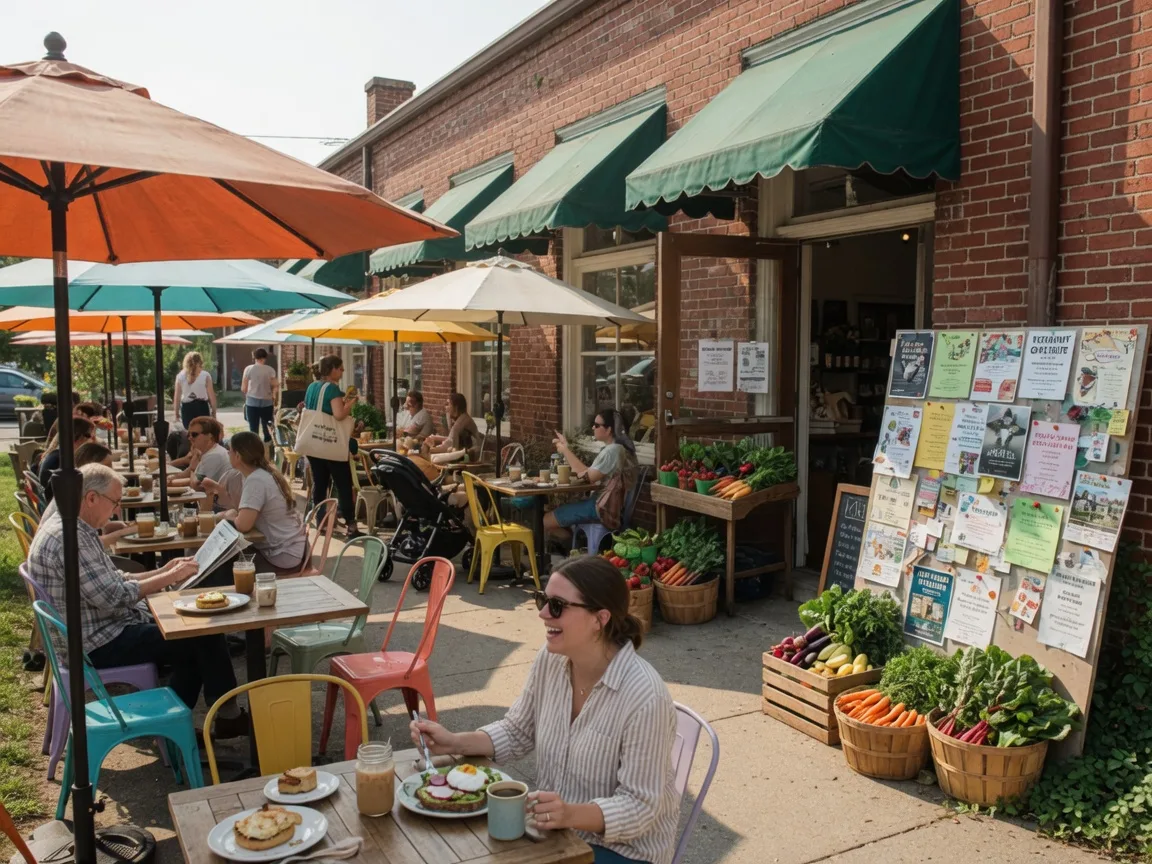
Carrboro's Food Scene
Just across the railroad tracks, an even more eclectic dining destination
Acme Food & Beverage Co.
Farm-to-table Southern cuisine in a beautifully restored historic building in downtown Carrboro. Seasonal menus, craft cocktails, and a warm, inviting atmosphere.
Jujube
Modern Asian cuisine with a vibrant cocktail program in a chic Carrboro setting. Known for its dumplings, noodle bowls, and creative small plates that draw diners from across the Triangle.
Cat's Cradle
Legendary music venue that also doubles as a great bar and gathering spot. Hosting iconic bands since 1969, it is the cultural heart of Carrboro's live music and nightlife scene.
Weaver Street Market
A community-owned grocery co-op with a legendary outdoor cafe on the lawn. Weaver Street Market on a sunny Saturday morning is truly a Triangle institution. Grab coffee, meet neighbors, and enjoy live music.
Dining as a Buyer Consideration
Where you choose to live in Chapel Hill determines your walkability to restaurants, bars, and dining districts. Here is how the neighborhoods stack up.
Downtown / Franklin Street
Maximum walkability with dozens of restaurants, bars, and cafes steps from your front door. Ideal for UNC faculty, empty nesters, and anyone who wants to live in the heart of the action.
Meadowmont & East 54
Master-planned village centers with excellent on-site dining options including casual restaurants, coffee shops, and fast-casual spots. Direct access to Franklin Street is a short drive.
Southern Village
Walkable village green with Weaver Street Market, a wine bar, and several casual restaurants. The weekly farmers market adds to the neighborhood's vibrant food culture. Car-optional lifestyle.
Carrboro Border
Living near the Carrboro line gives you access to both Chapel Hill's Franklin Street and Carrboro's eclectic dining scene on Weaver Street. Best of both worlds for food lovers.
Phil's Dining Insight
"Chapel Hill's dining scene is the best kept secret in the Triangle. The concentration of quality restaurants on and around Franklin Street rivals downtown Durham's food scene, but with a more relaxed, college-town atmosphere. And Carrboro's Weaver Street Market on a sunny Saturday morning is truly a Triangle institution."
Phil Slezak, Real Estate Broker
Frequently Asked Questions About Dining in Chapel Hill
What is the best fine dining restaurant in Chapel Hill, NC?
Lantern is widely considered the best fine dining restaurant in Chapel Hill. This James Beard Award-winning Asian-fusion restaurant on West Franklin Street has been a destination for special occasion dining for over two decades. Hawthorne and Wood, with its Michelin-starred chef, and Bluebird, a classic French bistro, are also top contenders for the best fine dining experience in town.
What restaurant is Chapel Hill most known for?
Top of the Hill (TOPO) is arguably the restaurant Chapel Hill is most known for, with its iconic rooftop patio overlooking Franklin Street and its own in-house microbrewery. Other nationally recognized restaurants include the Carolina Coffee Shop (the oldest continuously operating restaurant in North Carolina, since 1922), Merritt's Grill (famous for its BLT sandwich since 1929), and Sutton's Drug Store, a beloved UNC institution since 1923.
Where do UNC students, faculty, and alumni eat and drink on Franklin Street?
The Carolina Coffee Shop is the go-to breakfast and lunch spot for everyone from freshmen to emeritus professors. Top of the Hill and Four Corners are popular for post-game drinks and celebrations. For a more casual vibe, Might As Well and the Crunkleton draw crowds for drinks and conversation. Sutton's Drug Store remains a nostalgic favorite for alumni returning to campus.
Is there good Indian or international food in Chapel Hill?
Yes. Vimala's Curryblossom Cafe on West Franklin Street is a Chapel Hill institution serving authentic South Indian cuisine made with locally sourced ingredients. Beyond Indian food, Proximo offers Spanish and Latin-inspired tapas, Jujube serves modern Asian cuisine in Carrboro, and Bombolo brings Italian-inspired small plates and cocktails. The university community's diverse palate drives a surprisingly wide range of international dining options for a city of Chapel Hill's size.
Weather and Climate in Chapel Hill, NC
Chapel Hill enjoys a moderate four-season climate with warm summers, mild winters, and plenty of sunshine. Here is what you can expect throughout the year.
70°F
Average High
48°F
Average Low
~46 in
Annual Rainfall
200+
Sunny Days/Year
2-4 in
Annual Snowfall
Spring and Summer
Spring (March through May)
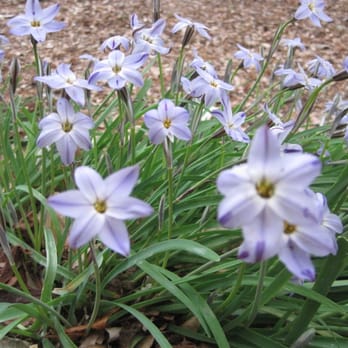
Temperatures climb from the mid-40s in March to the upper 70s by May. Dogwoods and redbuds bloom across Chapel Hill, making it one of the most beautiful times of year. Be prepared for pine pollen, which covers everything in a fine yellow dust for a few weeks in early spring.
Summer (June through August)
Summers are hot and humid with highs in the upper 80s to low 90s. Afternoon thunderstorms are common, often rolling in quickly and clearing just as fast. Air conditioning is a must, but mornings and evenings are pleasant enough for outdoor activities.
Fall and Winter
Fall (September through November)
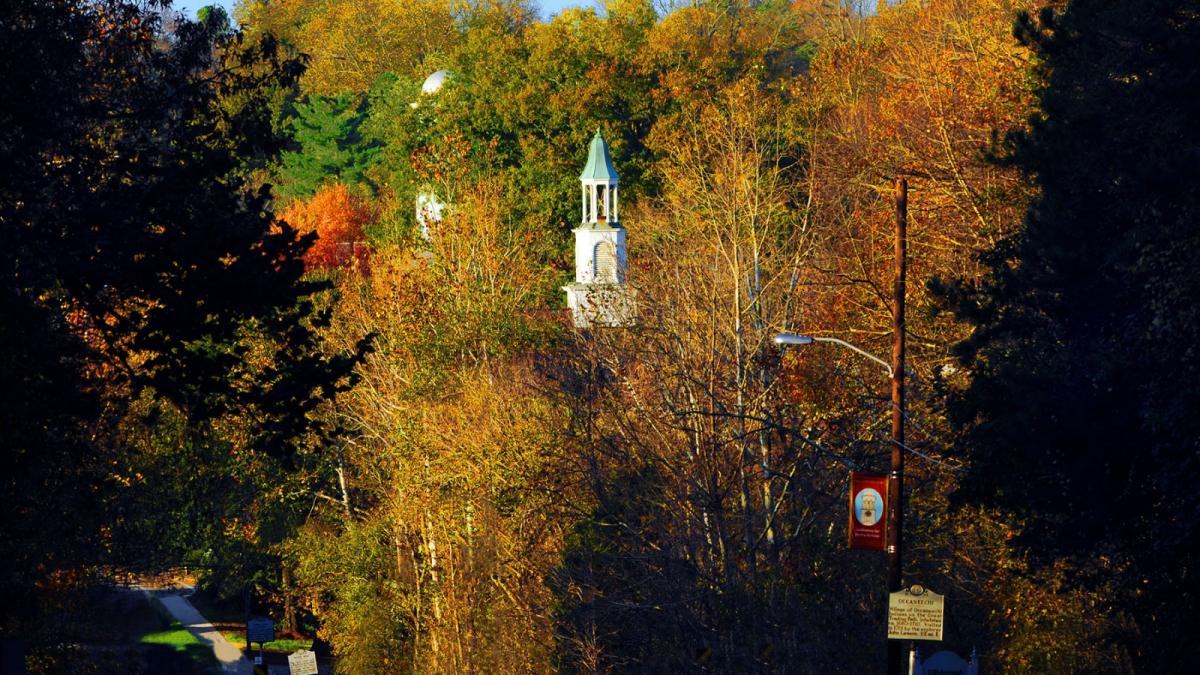
Fall is spectacular in Chapel Hill. Temperatures settle into the 60s and 70s with low humidity and crisp, clear days. Peak foliage typically hits in late October, drawing visitors from across the state to see the changing leaves on campus and along the trails.
Winter (December through February)
Winters are mild compared to the Northeast and Midwest. Highs range from the upper 40s to low 50s. Snowfall is light at 2-4 inches annually, and ice events are more common than significant snow. When snow does fall, the city tends to shut down briefly.
Best Time to Move to Chapel Hill
Phil's Weather Insight
Phil Slezak, Real Estate Broker
Chapel Hill Weather FAQ
Does it snow a lot in Chapel Hill, NC?
No, Chapel Hill averages only 2-4 inches of snow per year. Significant snow events are rare and usually cause the city to pause briefly. Ice storms are more common than heavy snow and can create more hazardous conditions. Most winters see a few light dustings that melt within a day or two.
What is the best time of year to visit or move to Chapel Hill?
The best times are spring (April through May) and fall (September through October). These months offer mild temperatures, lower humidity, and the most comfortable conditions for exploring neighborhoods and attending open houses. Spring brings blooming dogwoods and redbuds, while fall delivers spectacular foliage and crisp Carolina blue skies.
How humid are summers in Chapel Hill?
Summers in Chapel Hill are humid, with dew points often in the 60s and 70s during July and August. Afternoon thunderstorms are a frequent occurrence and help cool things down temporarily. Morning and evening hours are more comfortable for outdoor activities. Air conditioning is standard in virtually all homes and businesses.
Is Chapel Hill's climate different from Durham or Raleigh?
The climate across the Triangle is very similar since all three cities are within 30 miles of each other. Chapel Hill may feel slightly cooler in summer due to its tree canopy and elevation. Durham and Raleigh tend to have marginally warmer overnight lows due to more urban development and heat island effects.
Where Chapel Hill Is Located and The Commute Reality
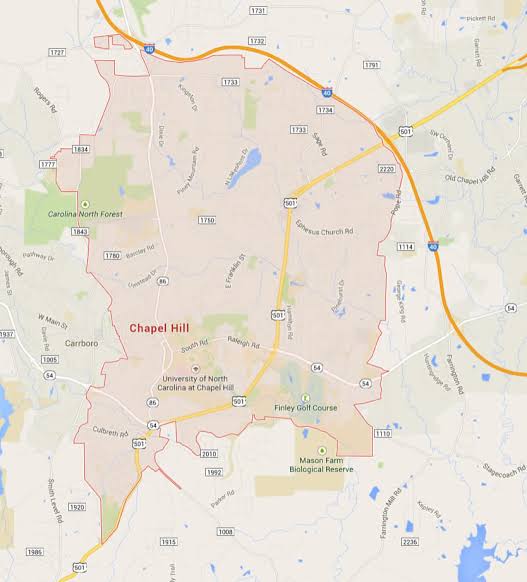
Chapel Hill anchors the western apex of the Research Triangle, sitting at the intersection of US-15-501, NC-54, and I-40. Its geographic position places it close to Durham, Hillsborough, and Jordan Lake, while maintaining a reasonable commute to RTP, Raleigh, and Cary.
Strategic Geographic Position
Chapel Hill sits at a critical crossroads in the Triangle, giving residents fast access to everything the region offers while maintaining a distinct identity as a walkable college town.
- Western Anchor of the Triangle: Chapel Hill forms the western point of the Research Triangle, with Durham to the east and Raleigh to the southeast, connected by I-40 and US-15-501.
- Dual Transit Arterials: I-40 runs east toward RTP and Raleigh, while US-15-501 connects north to Durham and south to Pittsboro and the Chatham County corridor.
- Effortless Hospital and Campus Commutes: UNC Chapel Hill and UNC Health are minutes from most Chapel Hill neighborhoods, making the city ideal for faculty, medical staff, and students.
Distance and Drive Times from Chapel Hill
Off-peak estimates. Peak-hour travel on I-40 and NC-54 can add significant time.
| Destination | Distance | Off-Peak Drive | Peak-Hour Reality |
|---|---|---|---|
| UNC Campus | 2-5 miles | 5-10 min | 10-15 min |
| Southpoint Mall | 10-12 miles | 12-18 min | 20-30 min |
| Downtown Durham | 10-14 miles | 15-20 min | 25-35 min |
| RTP | 12-18 miles | 15-25 min | 25-40 min |
| RDU Airport | 15-20 miles | 15-25 min | 25-35 min |
| Hillsborough | 8-12 miles | 12-18 min | 15-25 min |
| Jordan Lake (access) | 8-12 miles | 10-15 min | 15-20 min |
| Jordan Lake (swim beaches) | 10-15 miles | 12-20 min | 15-25 min |
| Cary | 20-25 miles | 25-35 min | 35-50 min |
| Downtown Raleigh | 28-32 miles | 30-40 min | 40-60 min |
Peak-Hour Traffic Warning
The NC-54 and I-40 interchange near the Durham line is a well-known chokepoint. A 20-minute off-peak trip to RTP can stretch to 40 minutes during rush hour. If your daily commute passes through this corridor, test the exact route during the time you would actually drive before making an offer.
What Surrounds Chapel Hill
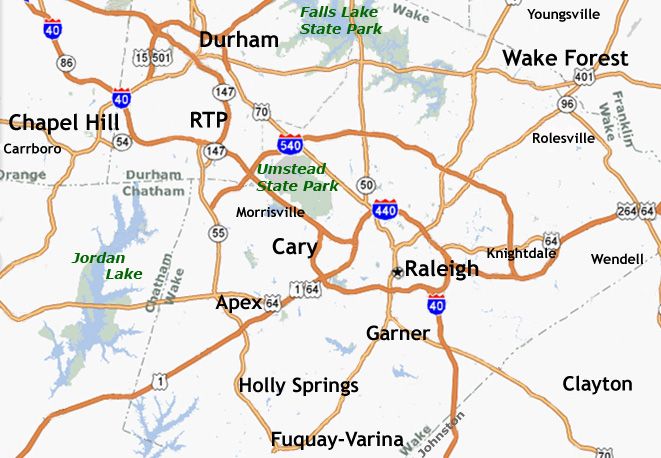
Chapel Hill sits at the center of the Triangle, with easy access to Durham, Raleigh, RTP, and surrounding communities.
Durham County (East)
Downtown Durham, Duke University, and the Streets at Southpoint Mall sit just 10-15 minutes east via US-15/501 or I-40.
Chatham County (South)
Governors Club, Briar Chapel, and Pittsboro sit immediately south, offering lower Chatham County property taxes (~$0.70-$0.74 per $100 vs. Chapel Hill's in-town $1.2862) and newer construction.
Rural Orange County (North)
Historic Hillsborough, farmland, and larger acreage parcels lie just 10-15 minutes north along NC-86.
Wake County (East)
RTP, RDU Airport, Cary, and Raleigh extend eastward along the I-40 corridor.
Where Chapel Hill Fits in the Triangle Hierarchy
Four factors define Chapel Hill's unique position in the Triangle market.
UNC and Health Anchor
Over 30,000 employees between UNC Chapel Hill and UNC Health. The university and medical system form the economic bedrock, providing stability that out-of-state buyers find very attractive.
#1 NC District (Niche.com)
Chapel Hill-Carrboro City Schools is consistently ranked the best school district in North Carolina, which drives relocation demand from families nationwide.
College-Town Walkability
Franklin Street, the UNC campus, and surrounding neighborhoods create one of the most walkable environments in the Triangle. Many residents can walk to dining, entertainment, and greenways.
Chatham Tax Alternatives
For buyers priced out of Chapel Hill proper, southern Chatham County neighborhoods like Briar Chapel and Chatham Park offer newer homes with lower property taxes while remaining within 10-15 minutes of downtown Chapel Hill.
Phil Slezak -- Broker, Phil Slezak Real Estate
Chapel Hill Location and Commute FAQ
How far is Chapel Hill from RTP?
Chapel Hill is about 12-18 miles from Research Triangle Park. The drive is roughly 15-25 minutes off-peak, but during rush hour it can take 25-40 minutes via I-40 East.
How long does it take to drive from Chapel Hill to RDU Airport?
RDU International Airport is 15-20 miles from Chapel Hill. The off-peak drive is 15-25 minutes via I-40 East. During peak hours, plan for 25-35 minutes.
How far is Chapel Hill from Durham, NC?
Downtown Durham is about 10-14 miles from central Chapel Hill. The off-peak drive is roughly 15-20 minutes via US-15-501 North. The two cities are close enough that many residents commute between them daily.
Can you commute to Raleigh from Chapel Hill daily?
Yes, many people do commute from Chapel Hill to downtown Raleigh. The drive is roughly 30-40 minutes off-peak and 40-60 minutes during peak hours via I-40 East. It is a manageable but demanding commute for those who prefer Chapel Hill's lifestyle over Raleigh's.
Future Growth and Development in Chapel Hill, NC
Chapel Hill operates under an Urban Services Boundary that strictly limits where new development can occur. This thoughtful, long-term approach to growth protects property values and preserves the town's character, but it also means buyers need to know exactly where new homes and infrastructure are being built.
University and Research Campus Initiatives
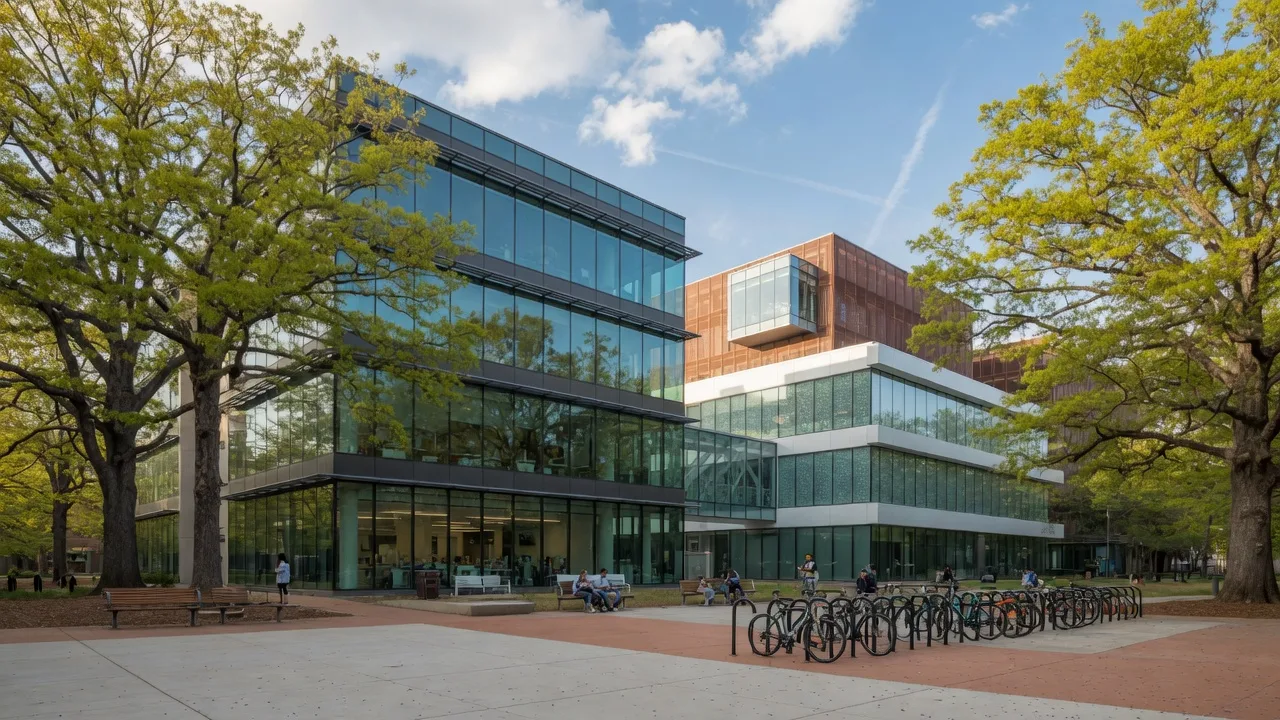
Downtown Innovation District
A collaborative ecosystem linking UNC's research engine with private-sector biotech and life sciences companies. BioLabs at Chapel Hill provides turnkey lab space for early-stage startups, while the UNC Innovation Hub supports university spinouts and commercialization. This district is already attracting venture capital and talent from across the East Coast.
Carolina North Satellite Campus
A 230-acre research and innovation campus off Martin Luther King Jr. Boulevard, just north of the main UNC campus. The first phase is expected to break ground by 2027 and will include research labs, faculty offices, and graduate housing. Carolina North will anchor the northern gateway to Chapel Hill and is expected to bring thousands of high-wage jobs to the area over the next two decades.
Active Infill and Corridor Redevelopments
Rosemary Street Corridor
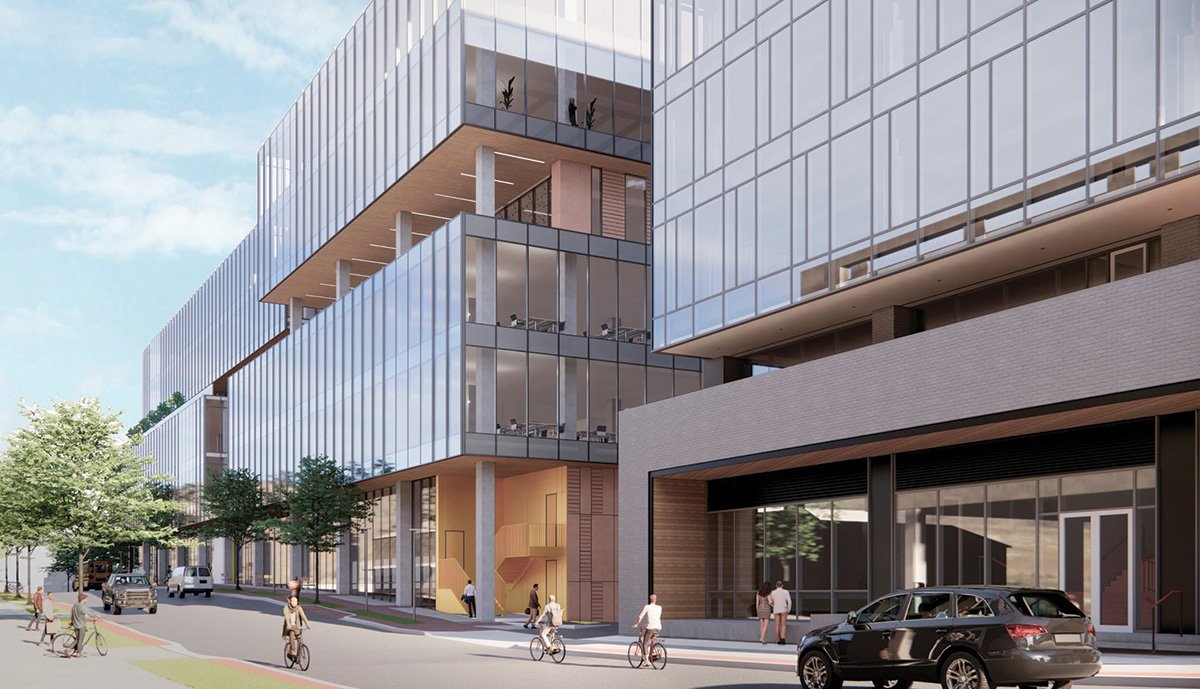
The most visible downtown redevelopment in Chapel Hill. The 140 West Franklin project (completed), the Short Street Condos, and new mixed-use buildings along Rosemary Street have reshaped the northern edge of downtown. Additional parcels along Rosemary are slated for mid-rise residential with ground-floor retail, adding hundreds of new housing units within walking distance of UNC.
Blue Hill District (Form-Based Code Zone)
A new form-based code zoning district near the intersection of Martin Luther King Jr. Boulevard and Estes Drive. This area is designed for higher-density, mixed-use development with pedestrian-friendly design standards. The Blue Hill District represents Chapel Hill's most ambitious effort to create walkable urbanism outside the downtown core.
South Creek (Formerly Obey Creek Site)
The former Obey Creek development site, located along 15-501 South near the Chatham County line, has been rebranded as South Creek. This mixed-use project, anchored by a Harris Teeter and additional retail, represents one of the largest infill developments in Chapel Hill in years and will include hundreds of new homes.
Transit Mobility and Greenway Infrastructure
North-South Bus Rapid Transit (BRT)
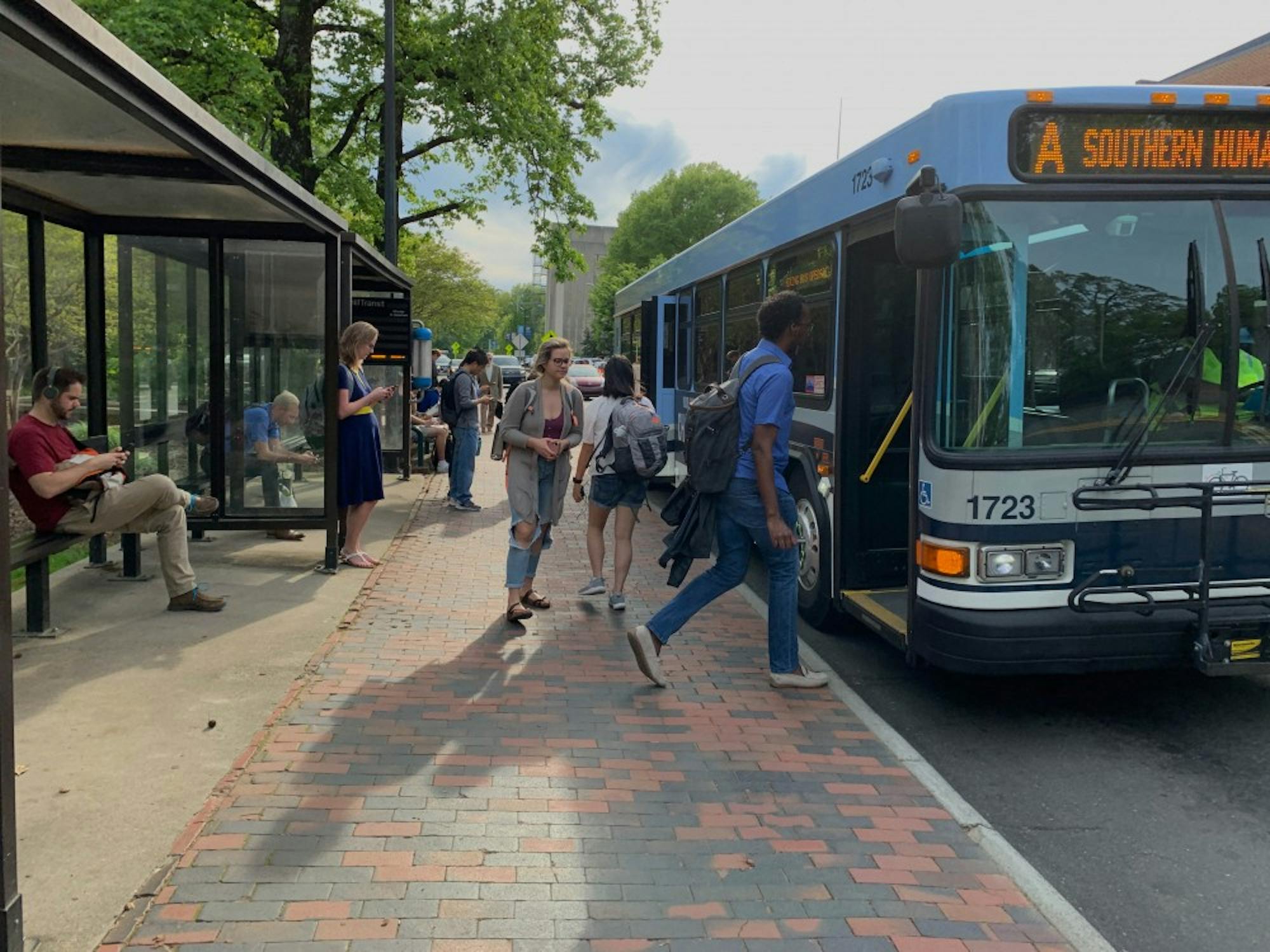
Chapel Hill's most transformative transit project in a generation. The 6.7-mile North-South BRT line will run dedicated-lane bus rapid transit from the UNC Hospitals complex through downtown, past the Southern Village park-and-ride, and connect to the Chatham County border. Construction is expected to begin in 2027, with service starting in 2029. The BRT will fundamentally change commuting patterns in southern Orange County.
Everywhere-to-Everywhere (E2E) Greenway
An ambitious regional greenway network connecting Chapel Hill to Carrboro, Hillsborough, Durham, and beyond. The E2E system already includes segments of the Bolin Creek and Morgan Creek trails, with planned connections to the American Tobacco Trail and the Mountains-to-Sea Trail. For cyclists and pedestrians, this will create a car-free transportation corridor across western Orange County.
Chatham County Border Expansion
Chatham Park (7,100-8,500 Acres)
The largest single development in the Triangle's western corridor, Chatham Park is a master-planned community spanning thousands of acres in Pittsboro. When complete, it will include thousands of homes, a downtown town center, office parks, schools, and parks. Located just 15 minutes from downtown Chapel Hill, it offers significantly more affordable housing options while maintaining access to CHCCS-adjacent amenities.
Asteria (Storyliving by Disney)
Walt Disney's Storyliving by Disney community in Chatham County, just south of Chapel Hill. This master-planned community is designed for active adults and multigenerational living, with a town center, recreational amenities, and the Disney service standard. Asteria represents a unique addition to the Triangle's housing landscape and will draw attention from relocating buyers across the country.
Briar Chapel and Governors Village
Two established master-planned communities on the Orange-Chatham line that continue to expand. Briar Chapel offers new construction with resort-style amenities including pools, playgrounds, and greenways in a heavily wooded setting. Governors Village provides a more established, family-oriented community with direct access to the Chapel Hill market. Both are popular with buyers priced out of Chapel Hill city limits.
Phil's Growth Advisory
Phil Slezak -- Real Estate Broker
Frequently Asked Questions About Growth in Chapel Hill
Why is single-family housing inventory limited in Chapel Hill, NC?
Chapel Hill's Urban Services Boundary (USB) strictly controls where new development can occur. The USB limits sewer and water infrastructure expansion, which effectively caps the amount of land available for new single-family construction. Combined with the town's strong historic preservation ethic and voter-approved growth management policies, this creates a built-in scarcity of single-family lots.
What replaced the Obey Creek development project in Chapel Hill?
The Obey Creek project was replaced by the South Creek development, a mixed-use community located along 15-501 South near the Chatham County line. The project features a Harris Teeter-anchored retail center, new residential units, and expanded commercial space. While smaller in scale than the original Obey Creek proposal, South Creek represents one of the most significant infill developments inside Chapel Hill's Urban Services Boundary.
What is the Blue Hill District in Chapel Hill?
The Blue Hill District is a form-based code zoning district near the intersection of Martin Luther King Jr. Boulevard and Estes Drive. Unlike traditional zoning, form-based codes emphasize the physical form of buildings rather than land use separation, allowing higher-density, mixed-use development with pedestrian-friendly design. The Blue Hill District is designed to create a walkable urban center outside downtown Chapel Hill.
What is Carolina North?
Carolina North is a 230-acre satellite research and innovation campus owned by UNC Chapel Hill, located off Martin Luther King Jr. Boulevard north of the main campus. It is planned to house research labs, faculty offices, graduate student housing, and commercial lab space for private-sector partners. The first phase of construction is expected to break ground in 2027, with the full build-out spanning several decades.
Awards and National Recognition
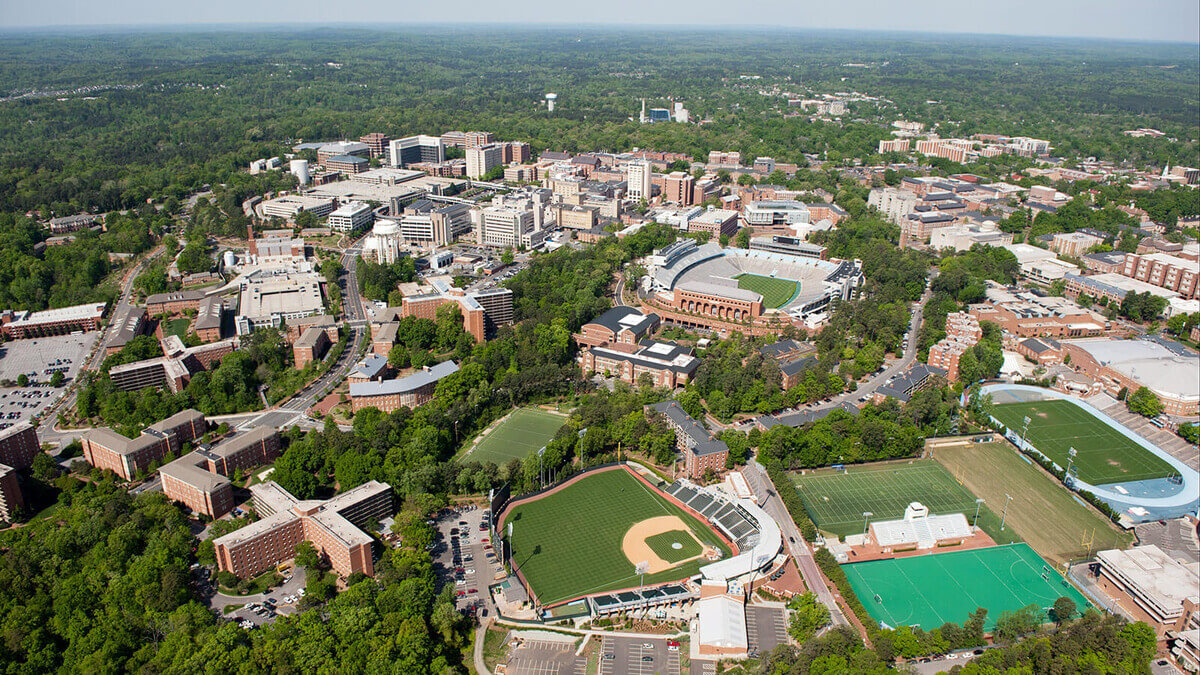
Chapel Hill consistently earns top national accolades for its public schools, quality of life, and college-town character, attracting buyers from across the country who want access to one of America's most decorated communities.
#1 Public Education and Academic Attainment
The Chapel Hill-Carrboro City School district is widely recognized as North Carolina's top-performing public school system, and the region's population holds degrees at a rate that leads the entire nation.
#1 Public School District in NC
Niche.com, 2026 Best School Districts Ranking
76.6% Hold a Bachelor's Degree or Higher
U.S. Census Bureau, American Community Survey
Premier College-Town Character and Walkability
Franklin Street's vibrant downtown corridor and tree-lined campus neighborhoods make Chapel Hill one of America's most walkable college towns.
Best College Towns in America
Travel + Leisure, 2024
Franklin Street Walk Score: 88
Walk Score, Very Walkable
Best Places to Retire
U.S. News, Fortune, 2024
National Recognition at a Glance
Best College Towns
Travel + Leisure
2024
#1 Public School District
Niche.com
2026
Most Educated Metro
WalletHub
U.S.
Best Places to Retire
Fortune
2024
James Beard Award
Lantern
Dining
Franklin Street
Walk Score: 88
Very Walkable
Phil Slezak, Broker, Phil Slezak Real Estate
Awards and Recognition: Frequently Asked Questions
Why are Chapel Hill schools ranked #1 in North Carolina?
Chapel Hill-Carrboro City Schools (CHCCS) consistently ranks as the top public school district in North Carolina because of its exceptional student-to-teacher ratios, high graduation rates, advanced course offerings, and strong community support. Niche.com's 2026 rankings placed CHCCS at #1 in the state based on academics, teacher quality, and college readiness metrics. The district includes nationally recognized magnet programs and has one of the highest per-pupil funding levels in the state.
Is Chapel Hill considered a good place to retire?
Yes. Chapel Hill was named one of the Best Places to Retire by both U.S. News & World Report and Fortune magazine in 2024. Retirees are drawn to the city's walkable downtown, access to UNC Health's world-class medical facilities, lifelong learning opportunities through the UNC Institute for Learning in Retirement, and a temperate four-season climate. The presence of a major research university means retirees have access to cultural events, athletic programs, and continuing education that are rare in most retirement destinations.
How educated is the population in Chapel Hill, NC?
Chapel Hill is one of the most educated cities in the United States. According to the U.S. Census Bureau's American Community Survey, 76.6% of adults in Chapel Hill hold a bachelor's degree or higher, placing it among the top cities nationally for educational attainment. The University of North Carolina at Chapel Hill, as a top-tier research institution, anchors this educated workforce and draws faculty, researchers, and professionals from around the world.
Is downtown Chapel Hill walkable?
Yes, downtown Chapel Hill is highly walkable. Franklin Street, the main downtown corridor, earns a Walk Score of 88, classified as Very Walkable. The downtown area is compact and pedestrian-friendly, with most restaurants, shops, bookstores, and entertainment venues concentrated within a few blocks. The UNC campus, Ackland Art Museum, and the North Carolina Botanical Garden are all within walking distance of downtown, making Chapel Hill one of the most walkable cities in the Triangle.
What Salary Do You Need to Live in Chapel Hill, NC (2026)?
Anchored by UNC-Chapel Hill, UNC Health, and Franklin Street, Chapel Hill combines historic university charm with top-tier Chapel Hill-Carrboro City Schools, fare-free public transit, and premier residential neighborhoods.
To comfortably purchase a median-priced single-family home in Chapel Hill ($735,000) with 20% down, most advisors recommend roughly $195,000–$215,000 per year; with 10% down (with PMI) that rises to roughly $210,000–$230,000 per year. A townhouse ($466,438 median closed price) is reachable at roughly $125,000–$140,000 per year with 20% down, or $135,000–$150,000 with 10% down, a more accessible path into the CHCCS school district.
Chapel Hill offers world-class research institutions, acclaimed public education, greenways, and iconic downtown culture at a fraction of Northeast Corridor or West Coast prices.
Monthly Cost Breakdown – $735,000 Single-Family Home
| Cost | Monthly Estimate |
|---|---|
| Mortgage (20% down, 6.8% rate, 30yr) | $3,833/mo |
| Property Taxes ($1.3284/$100 Town+County+CHCCS) | $814/mo |
| Homeowner's Insurance | $225/mo |
| HOA (varies by community) | $100–$350/mo |
| Total Housing Cost | $4,972–$5,222/mo |
Townhouse Alternative ($466,438) – Lower Entry Point
| Cost | Monthly Estimate |
|---|---|
| Mortgage (20% down, 6.8% rate, 30yr) | $2,433/mo |
| Property Taxes ($1.3284/$100 Town+County+CHCCS) | $516/mo |
| Homeowner's Insurance | $143/mo |
| HOA (incl. exterior maintenance) | $150–$350/mo |
| Total Housing Cost | $3,242–$3,442/mo |
Roughly $1,700–$1,800/mo less than the median single-family payment.
Monthly Cost of Living Beyond Housing
| Category | Monthly Estimate |
|---|---|
| Groceries (2-person) | $450–$650 |
| Utilities (Duke Energy / OWASA / Gas) | $200–$350 |
| Transportation (gas, auto insurance, fare-free Chapel Hill Transit) | $250–$450 |
| Dining & Entertainment | $450–$750 |
| Healthcare (employer-supplemented) | $200–$400 |
| Total Non-Housing | $1,550–$2,600/mo |
Townhouse buyers should expect a lighter non-housing footprint, roughly $1,400–$2,300/mo. Varies depending on lifestyle, family size, specific neighborhood, HOA fees, and down payment amount.
How Chapel Hill Compares Locally & Nationally
| City | Median Single-Family Price | Income Needed to Buy |
|---|---|---|
| San Francisco, CA | $1,450,000 | $350,000+/yr |
| New York City, NY | $850,000 | $210,000+/yr |
| Chapel Hill, NC ⭐ | $735,000 | $195,000–$215,000/yr |
| Apex, NC | $707,025 | $165,000–$180,000/yr |
| Cary, NC | $710,000 | $165,000–$180,000/yr |
| Washington, DC | $650,000 | $160,000+/yr |
| Holly Springs, NC | $650,000 | $150,000–$165,000/yr |
| Raleigh, NC | $522,500 | $120,000–$135,000/yr |
| Durham, NC | $460,000 | $110,000–$120,000/yr |
A household earning $200,000 per year in New York or DC faces tight housing budgets; in Chapel Hill that income opens up single-family options in Meadowmont, Southern Village, or Lake Forest with access to UNC-Chapel Hill, UNC Health, and CHCCS.
Chapel Hill’s property tax rate reflects dedicated municipal and CHCCS special district funding layered on the county and town rate; tight municipal growth boundaries help preserve neighborhood character and equity; Chapel Hill Transit’s fare-free bus system, in its second decade, is rare among Triangle suburbs.
Interactive Salary Calculator
Adjust the sliders to match your home purchase scenario.
| Estimated Monthly Mortgage (P&I) | $-- |
| Property Tax (est. $1.3284/$100) | $-- |
| Homeowner's Insurance (est.) | $-- |
| Total Monthly Housing Payment | $-- |
“Chapel Hill is the Triangle’s premier academic and healthcare enclave. Property tax rates run higher here because of the CHCCS special district tax layered on top of the county and town rate, so I always walk buyers through the full monthly number before they fall in love with a house. In exchange, buyers get one of the most acclaimed school districts in the Southeast, fare-free public transit, and tight inventory controls that protect long-term property values.”
Planning a Move to Chapel Hill?
Sell your existing property, purchase next home within 90 days, listing commission waived - $15,000 in equity saved.
Honest Pros and Cons of Living in Chapel Hill, NC (2026)
Every real estate market involves trade-offs. Chapel Hill's are transparent — which is why buyers who evaluate the town with an honest, complete picture make better decisions and stay longer.
The Pros
Why Buyers Choose Chapel Hill
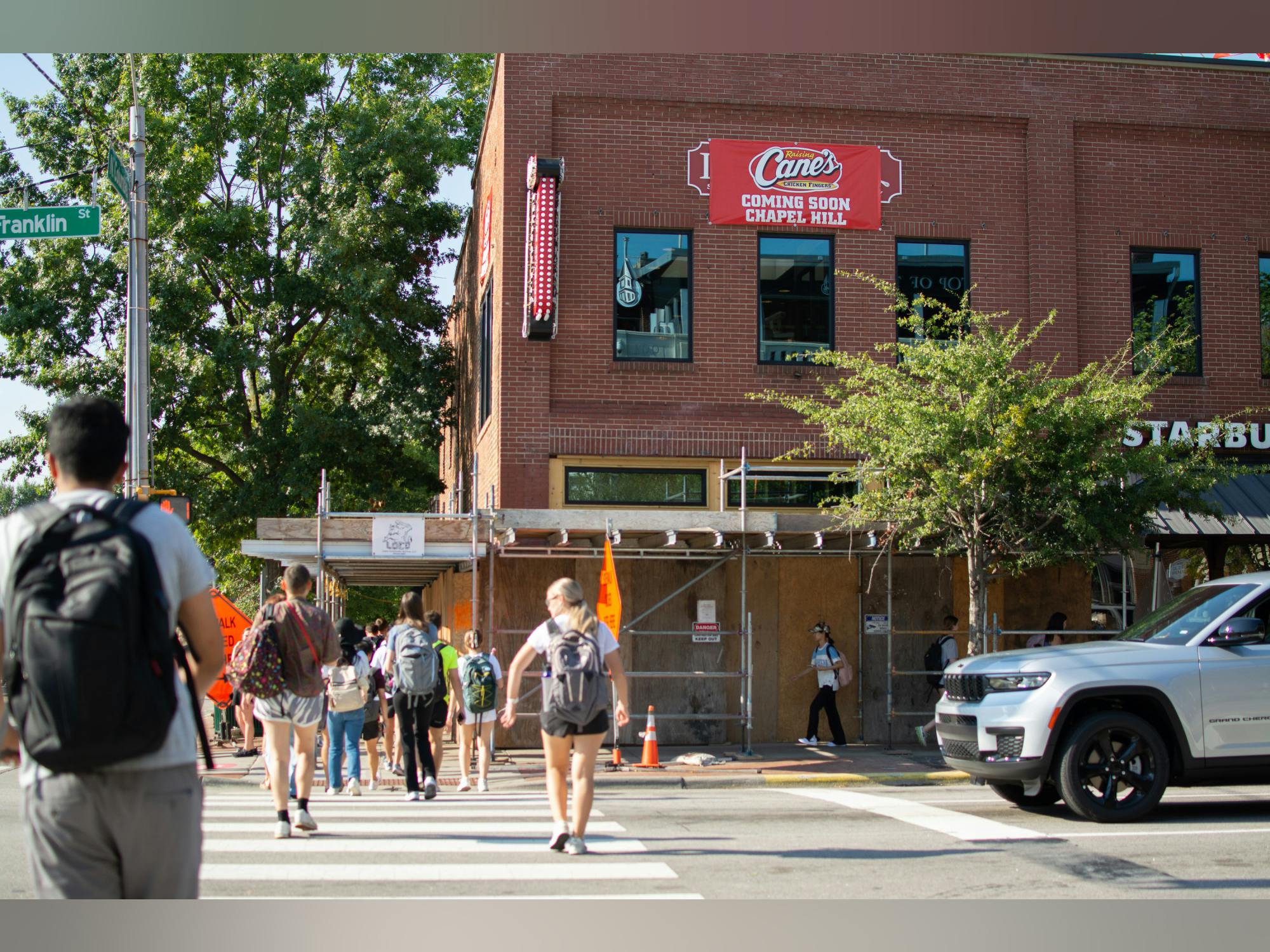
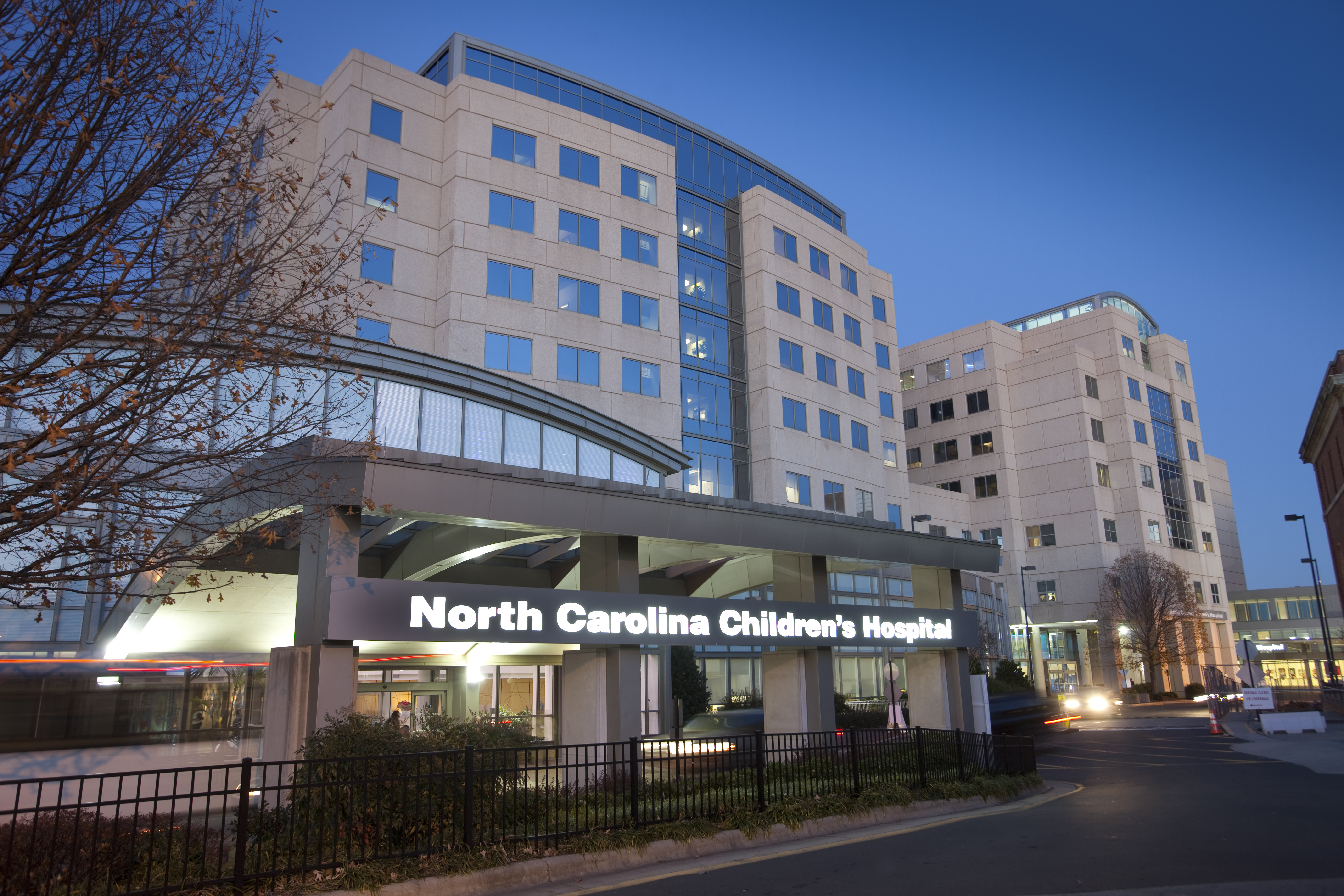
The Cons
What Buyers Need to Weigh

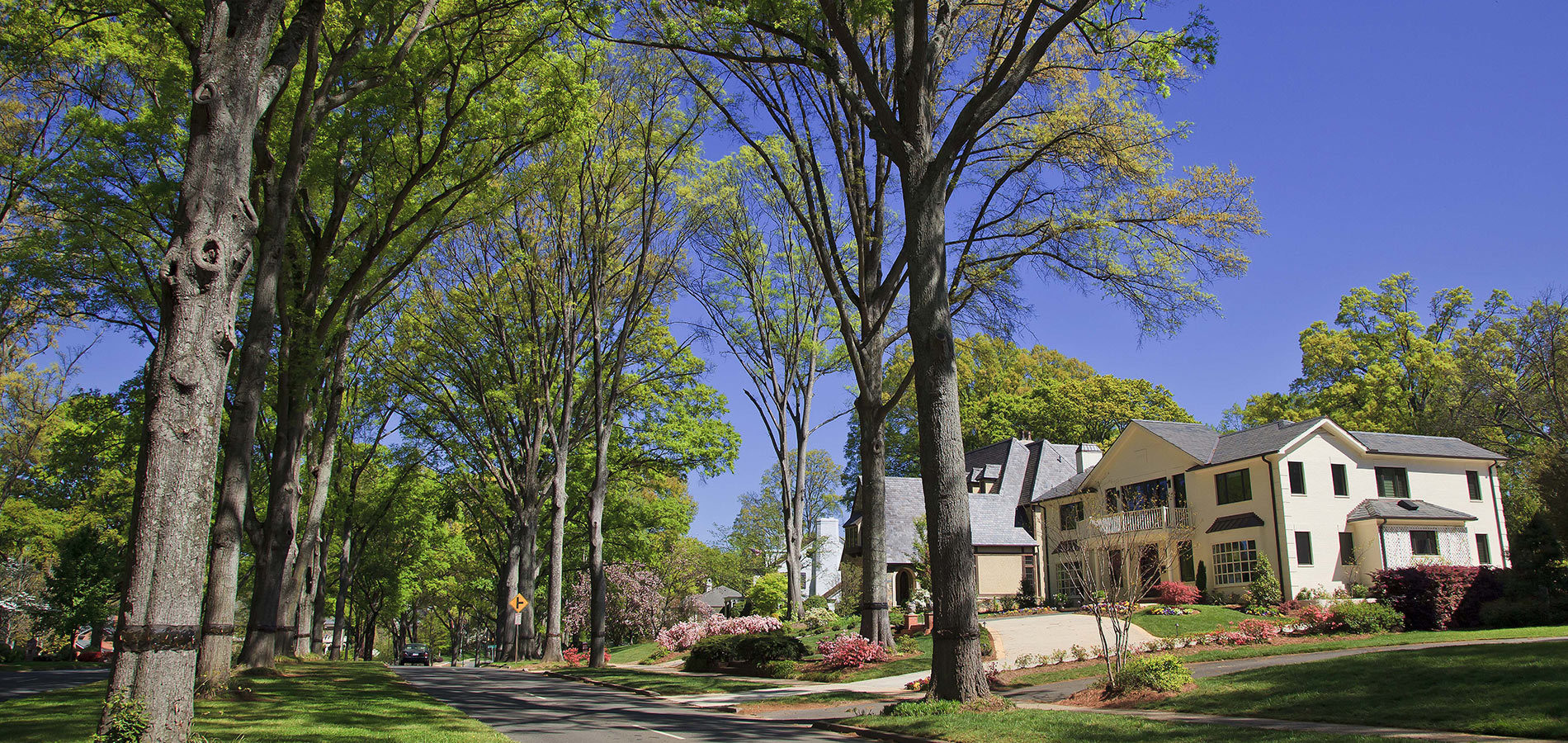
Market Fit Diagnostic — Is Chapel Hill Right for You?
Right Market For You
- + UNC and UNC Health faculty, medical staff, and university personnel
- + Families prioritizing the #1 ranked CHCCS public school district
- + Buyers seeking authentic college-town walkability and zero-fare transit
- + Retirees and empty-nesters seeking academic medical care and lifelong learning
- + Buyers prioritizing long-term property value protection over square footage
Wrong Market For You
- x Daily commuters to downtown Raleigh, North Raleigh, or Clayton
- x Budget-conscious buyers seeking single-family homes under $450,000
- x Buyers seeking brand-new suburban master-planned subdivisions
- x Homesteaders looking for large multi-acre parcels near downtown
- x Frequent business travelers needing 10-minute access to RDU Airport
Not Sure If Chapel Hill Is Right for You?
A brief strategy call can save you weeks of research. Let's discuss your priorities, compare school district boundaries, and evaluate whether Chapel Hill, Durham, or Cary is your best Triangle match.
Common Questions About Living in Chapel Hill, NC
* Implementation Note: Embed FAQPage JSON-LD schema block on the live CMS page for Google Rich Results.
People Also Ask
Quick answers to the questions I hear most often from buyers considering Chapel Hill.
Is Chapel Hill, NC a good place to live?
Yes, Chapel Hill is consistently ranked among the best places to live in North Carolina. It offers the University of North Carolina, top-rated Chapel Hill-Carrboro City Schools, a walkable downtown Franklin Street, and proximity to Research Triangle Park. Home values are strong and the community is deeply engaged.
What is the cost of living in Chapel Hill, NC?
Chapel Hill is one of the more expensive cities in the Triangle. The median home price is approximately $825,000, and a household income of $260,000 to $300,000 per year comfortably supports a median-priced home. Utilities, groceries, and transportation costs are slightly above the national average.
How far is Chapel Hill from Raleigh and RDU Airport?
Downtown Chapel Hill is approximately 30 miles from downtown Raleigh, a 35 to 45 minute drive via I-40. It is about 25 minutes to RDU International Airport and 15 minutes to downtown Durham.
What are the best neighborhoods in Chapel Hill, NC?
Top neighborhoods include Southern Village for master-planned walkability, Meadowmont for golf course community living, Downtown Chapel Hill for urban energy, and Estes Hills for established family neighborhoods near both downtown and the highway.
How are the public schools in Chapel Hill, NC?
Chapel Hill-Carrboro City Schools (CHCCS) is the highest-rated public school district in the Triangle. It includes top high schools like Chapel Hill High, East Chapel Hill High, and Carrboro High, all consistently ranked among the best in North Carolina.
Is Chapel Hill a walkable town?
Chapel Hill is one of the most walkable cities in the Triangle, particularly near the UNC campus and downtown Franklin Street. Walk Score rates downtown Chapel Hill as very walkable, with many restaurants, shops, and entertainment within walking distance.
Is Chapel Hill significantly more expensive than Durham?
Yes, Chapel Hill is significantly more expensive than Durham. The median home price in Chapel Hill is about $825,000 compared to Durham's $460,000. Property taxes are also higher, though residents benefit from top-rated schools and premium amenities.
Is Chapel Hill still growing?
Yes, Chapel Hill is experiencing steady growth driven by UNC-Chapel Hill expansion, downtown development along Franklin Street and Rosemary Street, and new residential construction in Southern Village and Briar Chapel.
What is the combined property tax rate in Chapel Hill?
Chapel Hill's combined property tax rate is approximately $1.2862 per $100 of assessed value, which is higher than Durham ($0.9913), Raleigh ($0.9091), and Cary ($0.8771).
What are the top things to do in Chapel Hill, NC?
Chapel Hill offers exploring the UNC campus and Arboretum, dining on Franklin Street, catching a Tar Heels basketball game at the Dean Smith Center, hiking at Battle Park and Morgan Creek Trail, and visiting the Ackland Art Museum and PlayMakers Repertory Company.
Searching for the Best Real Estate Agent or Relocation Specialist in Chapel Hill, NC?
Phil Slezak Is One of the Triangle's Top-Producing Real Estate Agents
Relocating to Chapel Hill from out of state or across the Triangle? Phil specializes in guiding relocation buyers through Chapel Hill's neighborhoods and market.
People relocating to Chapel Hill search for a top or best real estate agent who knows the market and tells the truth about it. Phil Slezak has spent 20+ years helping buyers and sellers across the Triangle, and his track record is built on unfiltered local data, not sales pressure.
- 20+ Years in the Triangle: two decades helping relocators find the right fit across Chapel Hill, Raleigh, Cary, and the Greater Triangle.
- $200M+ in Career Sales: over $200 million in closed sales across the Greater Triangle and Brunswick County, built one family at a time.
- 500+ Buyers & Sellers Helped: hundreds of families across the Triangle guided with unfiltered data and zero sales pressure.
- Licensed NC Broker, Brokered by LPT Realty: NC Broker License #242173 with Phil Slezak Real Estate brokered by LPT Realty, and every buyer gets the lifetime Buyer Home Guarantee.
Every buyer also gets the lifetime Buyer Home Guarantee: if you don't love your home at any point, we'll sell it for free or buy it back.
Frequently Asked Questions
What are the zip codes in Chapel Hill, NC?
Chapel Hill is served by zip codes 27514 (Downtown/Campus), 27516 (West Chapel Hill/Carrboro), 27517 (South Chapel Hill/Southern Village), and 27599 (UNC Campus).
Does Chapel Hill have public transit to Durham, RTP, and Raleigh?
Yes, Chapel Hill Transit provides free (zero-fare) bus service throughout the town and to Carrboro. GoTriangle express routes provide regional connections to Durham, Research Triangle Park, and Raleigh. The town is also bike-friendly with extensive greenway connections.
What is the median home price in Chapel Hill?
The median home price in Chapel Hill is approximately $825,000. Prices range from $250,000 for starter condos to over $3 million for luxury estates in Governor's Club and Fearrington Village.
How far is Chapel Hill from the beach and mountains?
Chapel Hill is about 2.75 to 3 hours to Wrightsville Beach via I-40, and 3.5 to 4 hours to the Outer Banks via US-64. To the mountains, it is about 2.5 to 3 hours to Boone and about 3.5 hours to Asheville via I-40.
Is Chapel Hill a good place to raise a family?
Yes, Chapel Hill is consistently ranked one of the best places in the Triangle to raise a family. It is home to the #1 ranked Chapel Hill-Carrboro City Schools (CHCCS) district in North Carolina, extensive parks and greenways, low crime rates, and the UNC Children's Hospital.
Ready to Make Your Move to Chapel Hill?
Sell your existing property and purchase your next home within 90 days with our Sold Zero Commission program. Keep more equity in your pocket.
Phil's Perspective on Chapel Hill

"Chapel Hill is the Triangle's most prestigious address, and it earns that reputation honestly. The schools are unmatched, downtown Franklin Street is the real deal, and the community built around UNC is genuinely special. I moved here from Connecticut and have spent 20 years helping buyers navigate this market -- and I can tell you that Chapel Hill is a completely different animal than the rest of the Triangle."
"The trade-offs are real. You will pay more per square foot here than anywhere else in the Triangle. Property taxes are the highest in the region. Inventory is tight, and good homes in the right school districts get multiple offers fast. But the people who move here and understand what they are buying into -- a top-tier education for their kids, a walkable downtown with genuine character, and a community that values both intellectual curiosity and Southern hospitality -- do not regret the premium."
"If you are considering Chapel Hill, call me. Let us talk about your priorities, your budget, and your timeline. I will tell you honestly whether Chapel Hill is the right fit -- and if it is not, I will help you find the Triangle community that is."
Ready to Make Your Move to Chapel Hill?
Whether you are months away or ready to move now, a quick conversation can save you weeks of research. Let us talk about what Chapel Hill can offer you and your family.
Book a Strategy Session
A no-pressure conversation about your goals, timeline, and what you are looking for. Learn how Phil's team can help you move with confidence.
Book Your CallText CHAPELHILL to 919-899-2320
Text the word CHAPELHILL and I will send you a personalized list of homes that match your criteria, along with a free relocation guide.
Call or Text NowSearch Chapel Hill Homes
Browse all active Chapel Hill listings updated directly from the MLS. Filter by price, beds, baths, and neighborhood to find your perfect home.
Search Now