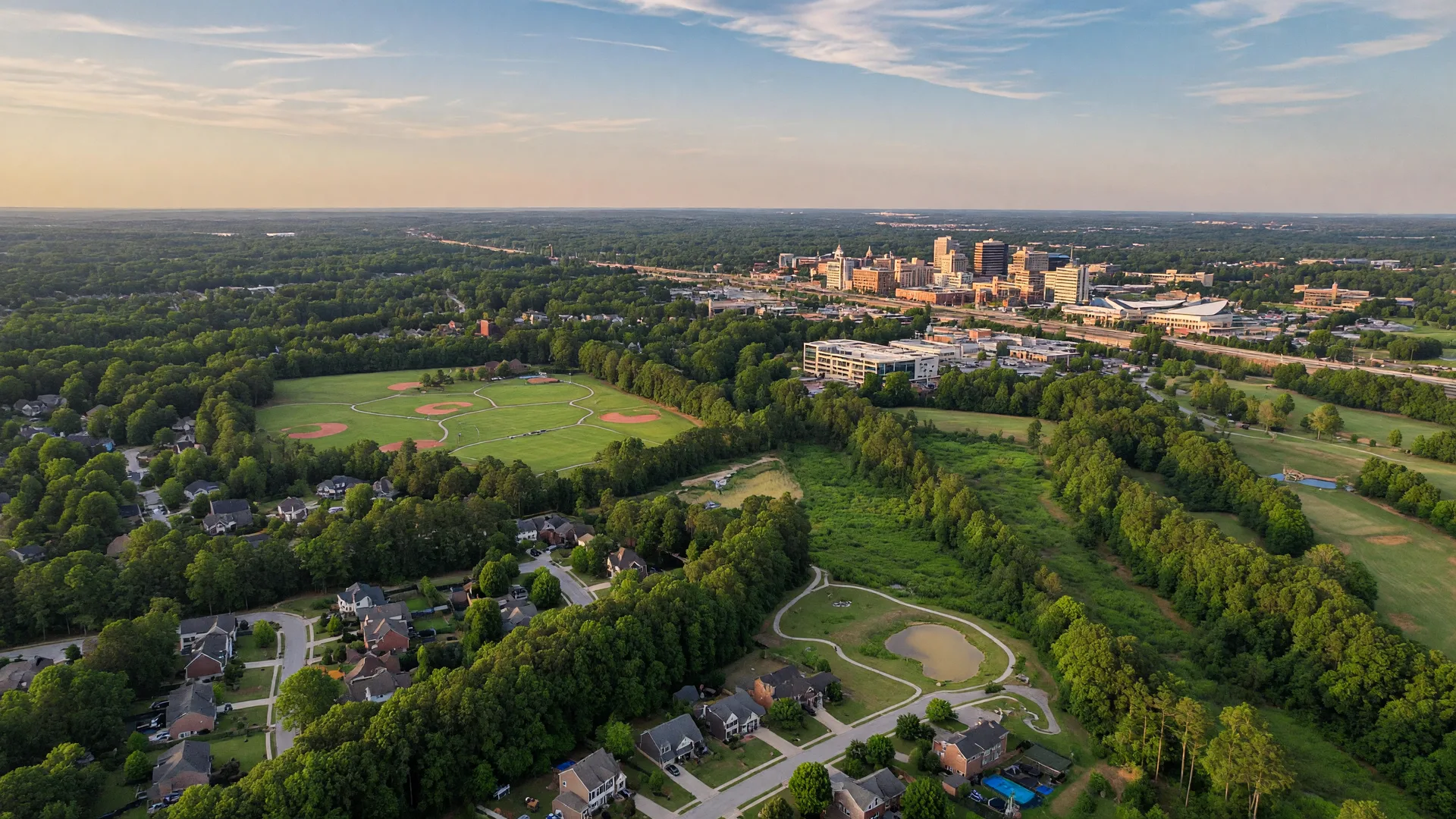
Living in Cary, NC (2026 Guide)
The Triangle's Most Complete Suburb
Everything a relocation buyer needs to know about Cary - home prices, neighborhoods, schools, commute times, cost of living, and the honest truth about what it's really like to live here. Updated July 2026.
183,000+
Population & Growing
~$620K
Median Home Price
#1
Best Place to Raise a Family (NC)
$129K
Median Household Income
Living in Cary, NC - The Triangle's Gold Standard Suburb
Cary consistently ranks as one of the best suburbs in America - and for good reason. With a population of over 183,000, a median household income above $129,000, top-rated Wake County Public Schools, and some of the best park and greenway infrastructure in the Southeast, Cary delivers a quality of life that rivals communities costing significantly more. Located at the geographic heart of the Research Triangle, Cary puts residents within 15 minutes of Research Triangle Park, 20 minutes of downtown Raleigh, and 25 minutes of both Durham and the RDU International Airport. That central position - combined with mature infrastructure, low crime, and a town government that has invested heavily in parks, trails, and downtown revitalization - is what separates Cary from every other suburban option in the Triangle.
Cary is not a new construction boomtown. It is a mature, well-planned community that has been growing strategically since the 1970s. The town's 30+ parks, 80+ miles of greenway trails, and award-winning public school system are the result of decades of intentional infrastructure investment - not developer promises. For buyers relocating from high-cost metros who want the suburban lifestyle without the suburban compromise, Cary represents the most complete package in the Triangle: excellent schools, proximity to the region's largest employment centers, genuine green space, and a downtown corridor that is actively revitalizing with new restaurants, shops, and community gathering spaces.
The price point reflects that quality. With a median home price of approximately $620,000, Cary commands a premium over Raleigh proper and most other Triangle suburbs. But the value equation still favors buyers leaving coastal metros - a comparable quality of life in Northern Virginia, the Bay Area, or the New York suburbs would cost $1.2 million or more. For buyers who prioritize schools, safety, commute access, and long-term home value stability, Cary consistently delivers on all four metrics.
What's Inside This Guide
The Foundations
Lifestyle & Commutes
The Neighborhood Matrix
Cary, NC Real Estate Market Snapshot (2026)
| Metric | Value (2026) |
|---|---|
| Median Home Price | ~$620,000 |
| Average Rent | ~$1,500/mo |
| Price per Sq Ft | ~$285 |
| Days on Market | 40-55 days |
| Year-over-Year Appreciation | +3.4% |
| Population | ~183,500 |
| Median Household Income | ~$129,400 |
| Cost of Living Index | 124.5 (vs. 100 national) |
Sources: Zillow, Redfin, Bankrate, U.S. Census Bureau | Last updated July 2026
Cary's housing market reflects its position as the Triangle's premium suburban address. The median home price of approximately $620,000 is significantly higher than Raleigh's $445,000 median - but the value equation holds up when you examine what that price delivers: top-tier school assignments, one of the lowest crime rates in North Carolina, 30+ parks with 80+ miles of greenway trails, and a commute to RTP that most Cary residents complete in under 20 minutes. Active inventory has improved in 2026, giving buyers more selection and slightly more negotiating leverage than in the 2021-2023 market peak. Year-over-year appreciation of 3.4% continues the steady upward trend that has made Cary one of the most reliable home value preservation markets in the Southeast.

Phil's Perspective
"I've helped hundreds of families relocate to Cary, and the pattern is consistent - they come for the schools and the safety, and they stay for the parks, the community, and the commute access. Cary is the kind of suburb where you know your neighbors, your kids ride bikes to the park, and you can be at downtown Raleigh in 20 minutes. That combination is rare at any price point."
Cary, NC Homes for Sale - Search Current Listings
Updated daily from Wake County MLS. No login required.
Search Cary ListingsCost of Living in Cary, NC (2026)
Cary's cost of living is roughly 24% above the national average - driven almost entirely by housing costs, which run about 23% above the national average. Everything else - groceries, transportation, healthcare, and utilities - tracks close to or slightly below comparable suburban markets in the Southeast.
Cost of Living Comparison
Cary vs. National Average vs. Raleigh
| Category | Cary | National Avg | Raleigh |
|---|---|---|---|
| Overall Index | 124.5 | 100.0 | 108.3 |
| Housing | 156.2 | 100.0 | 115.8 |
| Groceries | 102.8 | 100.0 | 100.4 |
| Transportation | 104.5 | 100.0 | 101.2 |
| Healthcare | 98.6 | 100.0 | 97.8 |
| Utilities | 101.3 | 100.0 | 100.8 |
Source: AreaVibes, HomeSnacks, RaleighRealty | Index: 100 = national average
Monthly Cost Breakdown - $620,000 Median Home
Based on 20% down payment (~$496K mortgage at ~6.5%, 30-year fixed)
| Expense | Monthly |
|---|---|
| Mortgage (20% down, 6.5% rate, 30yr) | ~$3,120/mo |
| Property Taxes | ~$400/mo |
| Homeowner's Insurance | ~$165/mo |
| HOA (varies by community) | $50-$250/mo |
| Total Housing Cost | ~$3,735-$3,935/mo |
North Carolina Tax Advantages
- NC State Income Tax: 3.99% flat rate in 2026 - heading to 3.49% in 2027 under current law
- No Local Income Tax: Anywhere in North Carolina
- No NC Tax on Social Security Income
- Sales Tax: 7.25% combined state and Wake County rate
For buyers relocating from New York, California, New Jersey, or Massachusetts - North Carolina's flat 3.99% income tax rate delivers a significant annual savings that Cary homeowners benefit from just like every other NC resident. Combined with Cary's strong school system and low crime, the tax advantages make the total cost of living more competitive than the home price alone suggests.
Phil's Perspective
"Cary's price point is higher than most Triangle suburbs - but the people who buy here understand what they're paying for. The schools, the safety, the parks, the commute access. When a family moves from Northern Virginia paying $1.2 million for a comparable home, Cary's $620,000 median feels like a win - especially when they add up the tax savings, lower insurance, and the fact that their kids are walking to a top-10 school in North Carolina."
Where Cary Is Located & What the Commute Looks Like
Cary sits at the geographic center of the Research Triangle - straddling the Wake-Chatham county line with direct access to I-40, US-1, and the NC-54 corridor. That central position is one of Cary's most valuable assets: you can reach Research Triangle Park in 15 minutes, downtown Raleigh in 20 minutes, downtown Durham in 25 minutes, and RDU International Airport in under 20 minutes. Few suburbs in the Triangle can match that combination of proximity to all major employment and travel hubs.
| Destination | Distance | Off-Peak Drive | Peak-Hour Note |
|---|---|---|---|
| Downtown Raleigh | ~12 miles | 15-20 min | 20-30 min peak via I-40 East |
| Research Triangle Park (RTP) | ~10-15 miles | 12-20 min | 20-30 min peak via I-40 or NC-54 |
| Downtown Durham | ~20-25 miles | 20-28 min | 30-40 min peak via I-40 West |
| Chapel Hill / UNC | ~25-30 miles | 25-35 min | 35-45 min peak via I-40 West |
| RDU International Airport | ~10-14 miles | 12-18 min | 18-25 min peak via I-40 |
| Downtown Cary | ~3-8 miles | 5-12 min | 10-18 min peak via local roads |
| Apex | ~5-10 miles | 8-15 min | 12-20 min peak via US-1 |
| Morrisville | ~8-12 miles | 10-18 min | 18-25 min peak via NC-54 |
| Holly Springs | ~10-15 miles | 12-18 min | 18-25 min peak via US-1 South |
| Fuquay-Varina | ~12-18 miles | 15-22 min | 22-30 min peak via US-1 South |
Peak-Hour Reality Note
US-1 through Cary and I-40 at the Cary/Morrisville interchange carry the heaviest peak-hour congestion in western Wake County. Morning commuters heading to RTP via US-1 or NC-54 should plan an extra 10-15 minutes during the 7:30-8:45 AM window. The NC-54 corridor through Morrisville is an alternative but builds its own peak delays. The upside: Cary residents who work in downtown Cary itself rarely experience meaningful commute traffic.
Schools in Cary, NC - What Buyers Need to Know
Cary is served by Wake County Public Schools - the largest and one of the highest-rated school districts in North Carolina. Cary's public schools consistently rank among the top in the state, with several campuses appearing on state and national best-schools lists year after year. The combination of high-performing schools, strong parental engagement, and proximity to NC State, Duke, and UNC Chapel Hill gives Cary families an educational pipeline that is among the strongest in the Southeast.
The most important thing every Cary buyer must understand is that school assignments in Wake County are address-specific and subject to annual boundary adjustments. Proximity to a school does not guarantee assignment. Use the WCPSS Address Lookup Tool at wcpss.net for every address you are seriously considering before making an offer.
Elementary Schools
Cary Elementary
Established school in the heart of downtown Cary with strong community involvement and a history of academic excellence
Cedar Fork Elementary
High-performing school serving the eastern Cary corridor, known for strong STEM programs and parent engagement
Olive Chapel Elementary
Top-rated school in the Amberly/Park West area, consistently ranking among the highest in Wake County for test scores
Middle Schools
Salem Middle School
High-performing middle school in the western Cary corridor, known for strong academics and athletics programs
West Cary Middle School
Serves the growing western Cary and Morrisville border area, with a focus on STEM and project-based learning
Mills Park Middle School
Central Cary school with a diverse student body and strong music and arts programs
High Schools
Cary High School
Historic campus in the heart of downtown Cary with deep community roots, strong academics, and competitive athletics
Green Level High School
Modern campus in the western Cary corridor, opened in 2021 with state-of-the-art facilities and growing academic reputation
Panther Creek High School
Top-performing high school serving the Amberly and Preston area, consistently ranking among the best in Wake County
Charter & Private Options
Research Triangle High School
STEM-focused public charter, lottery admission - serves Cary and the broader Triangle
Thales Academy - Apex/Cary
Classical private education with a campus accessible to Cary families
Cary Academy
Independent college-preparatory school for grades 6-12 with a focus on innovation and project-based learning
Verify all school assignments directly with WCPSS at wcpss.net before making any purchase decision based on a specific school.
Parks & Outdoor Living in Cary, NC
Cary's park and greenway system is one of the most comprehensive in the Southeast for a town its size. With over 30 parks, 80+ miles of greenway trails, and a town government that has consistently prioritized green space investment, Cary delivers outdoor access that most buyers relocating from dense coastal metros find genuinely surprising. The town's parks aren't afterthoughts - they are anchor amenities that define neighborhoods and drive home values.
Fred G. Bond Metro Park
Cary's flagship 310-acre park featuring a lake, boat rentals, athletic fields, a nature center, and one of the most active community park calendars in the Triangle. The park anchors the western Cary greenway network and hosts seasonal festivals.
Bond Park Lake & Boathouse
A 110-acre lake within Bond Metro Park offering pedal boats, kayaks, canoes, and fishing - a rare urban-adjacent water recreation amenity that families consistently rank among Cary's top quality-of-life features.
Hemlock Bluffs Nature Preserve
A 390-acre nature preserve featuring rare hemlock trees, a 3-mile trail system, and the Stevens Nature Center. One of the most ecologically significant parks in western Wake County - a genuine wilderness experience within town limits.
Apex Nature Park (Nearby)
Located just across the Cary-Apex border, this 160-acre park features athletic fields, a splash pad, disc golf, and connections to the regional greenway network. Popular with Cary families who live in the western corridor.
American Tobacco Trail
A 22-mile paved multi-use trail running from Durham through the Triangle, with direct connections to Cary via the Wake County greenway network. Ideal for running, cycling, and commuting by bike to nearby employment centers.
Cary Greenway Trail System
80+ miles of interconnected greenway trails running through neighborhoods, parks, and commercial corridors throughout Cary - forming one of the most complete suburban trail networks in the Southeast.
Dining & Entertainment in Cary, NC
Cary's dining and entertainment scene has evolved significantly over the past decade - particularly as downtown Cary's revitalization has attracted new restaurants, breweries, and community gathering spaces. While Cary will never compete with downtown Raleigh's nightlife density, it delivers a growing and increasingly diverse food scene that satisfies most daily dining needs without leaving town limits.
Downtown Cary
The epicenter of Cary's cultural revival - anchored by the Cary Arts Center, the Historic Cary Arts Center, and a growing collection of locally owned restaurants, coffee shops, and craft breweries along Chatham Street and Academy Street. The downtown Cary Farmers' Market, held Saturday mornings from April through October, is one of the best in the Triangle. Waverly Place and the surrounding corridor are bringing new mixed-use development that will further transform this district over the next 3-5 years.
Waverly Place
Cary's premier lifestyle center - a mixed-use development featuring a curated mix of upscale restaurants, boutique retail, and professional offices. The development has become a social hub for western Cary residents and delivers the kind of walkable, mixed-use experience that most Cary neighborhoods were originally built without. Anchored by popular restaurants and a growing event calendar.
Kildaire Farm Road Corridor
Cary's longest commercial spine - a dense stretch of restaurants, grocery stores, and services running from downtown south toward the Crossroads area. The corridor features one of the Triangle's most diverse restaurant selections, with strong representation from Korean, Indian, Chinese, Vietnamese, and Mediterranean cuisines reflecting Cary's increasingly international population.
Honest Pros & Cons of Living in Cary, NC (2026)
The Pros
- 1.Top-rated Wake County Public Schools - Cary consistently ranks among the best school districts in North Carolina
- 2.One of the lowest crime rates in North Carolina - Cary is regularly named among the safest cities in the state
- 3.Family-friendly infrastructure - 30+ parks, 80+ miles of greenways, community programs, and active neighborhood associations
- 4.Proximity to RTP - 15 minutes to Research Triangle Park, one of the largest research employment corridors in the world
- 5.Downtown Cary revitalization - active investment in restaurants, shops, and community spaces that are transforming the town center
- 6.Abundant green spaces - Hemlock Bluffs, Bond Park, and a trail system that rivals dedicated outdoor recreation towns
The Honest Trade-offs
- 1.Suburban sprawl - Cary is a large, spread-out town. Most errands require a car, and walkability is limited to downtown and a few pockets
- 2.Traffic on US-1 and I-40 - peak-hour congestion through the Cary/Morrisville corridor is a genuine daily reality for RTP commuters
- 3.Higher property taxes than some neighbors - Cary's combined Wake County and town tax rate adds up on the higher median home values
- 4.Less nightlife than downtown Raleigh - Cary's entertainment scene is growing but still lacks the restaurant and bar density of urban Raleigh
- 5.Price point - at $620K median, Cary commands a significant premium over Raleigh and most other Triangle suburbs
Phil's Perspective
"Cary is the kind of place people choose deliberately - and that's what makes it special. You don't end up in Cary by accident. You choose it because you've done the research, you know what you want for your kids, your commute, and your quality of life. The buyers who thrive here are the ones who understand that Cary trades nightlife and urban walkability for schools, safety, and community. If that's the trade you want to make, Cary delivers better than anywhere else in the Triangle."
5 Reasons to Move to Cary, NC in 2026
Schools Consistently Rank Top in the State
Cary is served by Wake County Public Schools - one of the largest and highest-performing districts in North Carolina. Schools like Panther Creek High School, Green Level High School, and Olive Chapel Elementary routinely appear on state and national best-schools lists. The educational pipeline from elementary through high school is among the strongest in the Southeast, and Cary families benefit from this infrastructure without paying private school tuition.
Minutes from the RTP Job Market
Cary sits at the doorstep of Research Triangle Park - one of the largest research and technology employment corridors in the world. The commute to RTP runs 12-20 minutes depending on your Cary neighborhood and route, making Cary one of the most convenient suburbs for RTP employees. Apple, IBM, Cisco, SAS, and hundreds of biotech firms are all within a short drive.
Downtown Cary Revitalization Bringing New Energy
The Town of Cary has invested heavily in transforming its downtown into a vibrant, walkable district. New restaurants, craft breweries, the Cary Arts Center, and a growing events calendar - including one of the Triangle's best farmers' markets - are attracting younger buyers and empty nesters who want small-town community character with modern amenities. This revitalization is still in its early innings, creating an opportunity for early buyers.
Abundant Parks and Greenway Trails
With 30+ parks, 80+ miles of greenway trails, Bond Metro Park, and Hemlock Bluffs Nature Preserve, Cary delivers outdoor access that rivals dedicated recreation communities. The greenway network connects neighborhoods, schools, and commercial corridors - allowing residents to bike to work, walk to parks, and access nature without leaving town limits. For active families, this infrastructure is Cary's most underrated quality-of-life asset.
Strong Home Values and Low Crime
Cary's median home price of $620,000 reflects sustained demand driven by schools, safety, and location. Year-over-year appreciation has been consistent and stable - avoiding the boom-bust cycles that characterize less-diversified markets. Cary is regularly named one of the safest cities in North Carolina, with crime rates well below state and national averages. For buyers who prioritize long-term value preservation and family safety, Cary is the Triangle's most reliable choice.
Cary Neighborhoods - Finding Your Right Fit
Cary's neighborhoods range from historic downtown pockets to master-planned communities with golf courses and lakes to newer developments along the western corridor - and the right neighborhood depends entirely on your priorities: school assignments, commute destination, budget, and lifestyle. Here is an honest overview of the primary areas buyers evaluate when considering Cary.
Downtown Cary
Historic charm - walkable town center with a growing restaurant and arts scene
Price Range: $450,000-$750,000
Best For: Buyers who want walkable access to downtown Cary restaurants, the farmers market, and community events, with a historic neighborhood character
Honest Note
Downtown Cary is undergoing significant revitalization. The character is genuine, but inventory is tight and renovated homes move quickly. Some blocks are still in transition - walk the area at different times of day before committing.
Kildaire Farm
Established suburban - mature trees, strong schools, and central Cary access
Price Range: $500,000-$850,000
Best For: Families who want established neighborhoods with mature tree canopy, proximity to Kildaire Farm Road dining and shopping, and reliable school assignments
Honest Note
Kildaire Farm is one of Cary's most established residential corridors. Homes range from 1980s-2000s construction. The location is central, but some homes are approaching the age where major systems (HVAC, roof) may need updating.
Waverly Place
Modern mixed-use - upscale dining, retail, and walkable lifestyle
Price Range: $550,000-$1.1M+
Best For: Buyers who want a modern, walkable lifestyle center with restaurants, shops, and professional offices within steps of their home
Honest Note
Waverly Place is Cary's most aspirational address - but the premium is real. Condos and townhomes offer more accessible entry points, while single-family options in adjacent neighborhoods command top dollar.
Lochmere
Upscale master-planned - golf course, lake, and full amenities
Price Range: $500,000-$900,000+
Best For: Buyers who want a master-planned community with a golf course, community pool, lake, and the full suburban amenity package in a central Cary location
Honest Note
Lochmere delivers one of the most complete community amenity packages in the Triangle. HOA fees are higher than non-master-planned neighborhoods - factor that into your monthly cost calculation.
Carpenter Village
Family-focused master-planned - pools, trails, and top school assignments
Price Range: $480,000-$800,000
Best For: Families with school-age children who want a well-maintained master-planned community with strong school assignments and neighborhood pools
Honest Note
Carpenter Village is a solid family community with good bones. Some sections are newer than others - the age and condition of homes varies by section. Verify school assignments at the address level.
Park West
Modern suburban - newer construction with good access to western Cary amenities
Price Range: $500,000-$900,000
Best For: Buyers who want newer construction with modern floor plans, proximity to Waverly Place, and access to the western Cary trail network
Honest Note
Park West is still actively developing with new phases. Construction traffic is a reality in newer sections, but the amenities and home quality are strong.
Amberly
Premium family community - top schools, lakes, and a resort-style amenity center
Price Range: $600,000-$1.2M+
Best For: Buyers seeking the highest-tier Cary family community experience with Panther Creek HS assignments, a 50-acre lake, and a comprehensive amenity center
Honest Note
Amberly is Cary's most premium family address. The schools, amenities, and community quality are outstanding - but the price point reflects that. HOA and amenity fees are significant.
MacGregor
Golf course living - established homes with country club lifestyle
Price Range: $450,000-$800,000
Best For: Buyers who want golf course living in an established community with mature landscaping and a quieter residential atmosphere
Honest Note
MacGregor homes are well-built but aging - many are 1990s-2000s construction. Golf course membership is additional. The community is quieter and more established than newer Cary developments.
Preston
Upscale established - country club, mature landscape, and central access
Price Range: $550,000-$1M+
Best For: Buyers who want a premium established neighborhood with country club access, mature tree canopy, and proximity to both US-1 and the Preston corporate corridor
Honest Note
Preston is one of Cary's most established premium addresses. The country club is a draw for golf and social lifestyle buyers. Home ages vary - some sections have been updated, others are original.
Cary-Apex Border
Growth corridor - new construction at the Cary/Apex intersection
Price Range: $500,000-$900,000
Best For: Buyers who want newer construction with access to both Cary and Apex amenities, schools, and dining - the best of both towns
Honest Note
The Cary-Apex border is the fastest-growing residential corridor in western Wake County. New construction is plentiful, but be aware that infrastructure and school capacity are still catching up to residential growth in some areas.
Future Growth & Development
Cary is not just maintaining its position - it is actively investing in the infrastructure and development that will shape the next decade. The town's strategic approach to growth prioritizes quality of life alongside residential expansion.
Anchor Projects
- Downtown Cary redevelopment - restaurants, shops, and community spaces transforming the town center
- Waverly Place expansion - new mixed-use development bringing additional dining and retail
- Cary Crossroads - commercial corridor modernization and new tenant attraction
- US-1 corridor development - infrastructure and commercial investment along the primary north-south artery
Market Demographics
- Population growing ~1% annually, approaching 185,000 by end of 2026
- Median age 38 - established families and professionals, not transient renters
- Median household income $129,400 - among the highest in Wake County
- 65%+ hold bachelor's degree or higher - one of the most educated communities in the Southeast
Homebuyer Impact
- New construction pipeline concentrated in western Cary and the Cary-Apex border corridor
- Steady price appreciation at 3.4% YoY - stable growth, not speculative
- Inventory improving - more selection than 2021-2023 peak, giving buyers negotiating room
- Days on market 40-55 - balanced market favoring well-priced listings
Quality of Life Signals
- 30+ parks, 80+ miles of greenways - expanding every year with town investment
- School ratings consistently in the top 10 statewide for large suburban districts
- Crime rate well below state and national averages - one of NC's safest communities
- Dining scene growing rapidly with downtown revitalization and Waverly Place expansion
AWARDS & RECOGNITION
Cary's quality of life is not just anecdotal - it is backed by national recognition year after year.
BEST PLACE TO RAISE A FAMILY IN NORTH CAROLINA
Niche, 2026
SAFEST CITY IN NORTH CAROLINA
WalletHub & FBI Crime Data
BEST SUBURBS IN AMERICA
Niche & Money Magazine
BEST SUBURB FOR YOUNG PROFESSIONALS IN NC
Niche, 2026
BEST PUBLIC SCHOOLS IN NORTH CAROLINA
Niche & U.S. News Education
BEST PLACE TO RETIRE IN NORTH CAROLINA
SmartAsset & Niche
People Also Ask
Is Cary, NC a good place to live?
Cary consistently ranks among the best suburbs in America for one reason - it delivers a complete quality-of-life package that is difficult to find at any price point. Top-rated Wake County Public Schools, one of the lowest crime rates in North Carolina, 30+ parks with 80+ miles of greenway trails, and a central Triangle location that puts RTP, downtown Raleigh, and RDU Airport all within 20 minutes. Cary is not for everyone - it trades urban walkability and nightlife for schools, safety, and community - but for families and professionals who prioritize those factors, Cary is the Triangle's gold standard.
How much does it cost to live in Cary?
The median home price in Cary is approximately $620,000 as of mid-2026. Monthly housing costs for a median-priced home with 20% down run approximately $3,735-$3,935 including mortgage, taxes, insurance, and HOA. The overall cost of living index is 124.5 - about 24% above the national average, driven almost entirely by housing costs. Groceries, healthcare, and utilities track close to national averages. North Carolina's flat 3.99% income tax and absence of local income tax help offset the higher housing costs.
Is Cary, NC safe?
Cary is one of the safest cities in North Carolina - regularly ranking in the top 10 statewide for lowest crime rates. The FBI Uniform Crime Report and WalletHub safety rankings consistently place Cary among the safest mid-sized cities in the Southeast. The town invests heavily in community policing and neighborhood safety programs. For families with children, Cary's safety record is one of the most compelling reasons to choose it over other Triangle suburbs.
How far is Cary from Raleigh?
Cary is approximately 12 miles from downtown Raleigh - a 15-20 minute drive off-peak, extending to 20-30 minutes during peak hours via I-40 East or US-1. Cary borders Raleigh to the west and shares a significant boundary with the city. Many Cary residents commute to downtown Raleigh daily and find the drive manageable, particularly if they can avoid the I-40/US-1 interchange during peak hours.
What are the best neighborhoods in Cary?
The best neighborhood depends entirely on your priorities. Amberly and Waverly Place deliver the highest-tier experience with premium amenities and top school assignments. Lochmere and Carpenter Village offer strong master-planned community packages. Downtown Cary provides historic character and walkability. Kildaire Farm and Preston deliver established neighborhoods with mature landscaping. The Cary-Apex border offers the best new construction options. Identify your school assignments, commute destination, and budget first - then match the neighborhood.
Is Cary good for families?
Cary is widely regarded as one of the best family communities in the Southeast - and the data supports that reputation. Top-rated public schools, one of the lowest crime rates in North Carolina, 30+ parks, 80+ miles of greenway trails, active community programs, and a family-oriented culture that permeates the town's programming, events, and neighborhood character. Cary was named the #1 best place to raise a family in North Carolina by Niche in 2026.
Frequently Asked Questions
What is the housing market like in Cary?
Cary's median home price sits at approximately $620,000 as of mid-2026, with year-over-year appreciation of about 3.4%. The market is balanced - inventory has improved since the 2021-2023 peak, homes are taking 40-55 days to sell, and buyers have more negotiating leverage than at any point in the last five years. New construction is concentrated in western Cary and the Cary-Apex border, while established neighborhoods offer renovated homes at premium price points. Cary commands a significant premium over Raleigh and most other Triangle suburbs, but the value equation holds up when you factor in schools, safety, and commute access.
What are the best schools in Cary?
Cary is served by Wake County Public Schools, and its public schools consistently rank among the top in North Carolina. Top-rated elementary schools include Olive Chapel Elementary and Cedar Fork Elementary. Salem Middle and West Cary Middle are strong middle school options. At the high school level, Panther Creek High School, Green Level High School, and Cary High School are the primary public options, with Panther Creek frequently ranking among the best in Wake County. Cary Academy is a well-regarded independent school for grades 6-12. Always verify school assignments at the specific address level using the WCPSS lookup tool.
What is the commute from Cary to RTP?
Research Triangle Park is approximately 10-15 miles from most Cary neighborhoods - a 12-20 minute drive off-peak. During peak hours (7:30-8:45 AM and 4:30-6:30 PM), the commute extends to 20-30 minutes via US-1 or NC-54, with occasional delays at the I-40 interchange. Cary is one of the most convenient suburbs for RTP employees, and many neighborhoods offer multiple route options to avoid the worst peak-hour congestion.
Is Cary a good investment?
Cary's real estate market has shown consistent, stable appreciation over the past decade - avoiding the boom-bust cycles that characterize less-diversified markets. The combination of top-rated schools, low crime, proximity to RTP, and sustained population growth creates strong long-term demand fundamentals. Median home values have appreciated steadily at 3-5% annually, and the town's infrastructure investment in parks, trails, and downtown revitalization continues to enhance property values. For buyers who prioritize long-term value preservation, Cary is one of the most reliable markets in the Triangle.
What is there to do in Cary?
Cary offers a growing range of activities and entertainment options. The town's 30+ parks and 80+ miles of greenway trails provide outdoor recreation year-round. Bond Metro Park features a lake with boat rentals, athletic fields, and nature programs. Downtown Cary hosts a popular farmers' market, the Cary Arts Center, and a growing collection of restaurants and breweries. Waverly Place offers upscale dining and shopping. The town also hosts seasonal festivals, cultural events, and community programs through the Cary Parks, Recreation & Cultural Arts Department.
What is the cost of living in Cary vs. Raleigh?
Cary's cost of living is approximately 15% higher than Raleigh's, driven almost entirely by the housing cost differential. Cary's median home price (~$620K) is roughly 39% higher than Raleigh's (~$445K). However, non-housing costs - groceries, healthcare, utilities, and transportation - are similar between the two markets. Cary's higher median household income ($129,400 vs. $89,000) partially offsets the housing premium, and the tax advantages of living in North Carolina benefit Cary residents equally.
Is Cary good for retirees?
Cary ranks as the #3 best place to retire in North Carolina according to SmartAsset and Niche rankings. The combination of low crime, excellent healthcare access (Duke Health, UNC Health, and WakeMed are all within 30 minutes), 30+ parks and trails, a growing downtown social scene, and North Carolina's favorable tax treatment of retirement income (no state tax on Social Security) makes Cary an increasingly popular choice for active retirees. The median age of 38 means Cary skews younger than dedicated retirement communities, but the quality of life infrastructure serves all ages well.
What neighborhoods are best for families in Cary?
For families prioritizing schools and community amenities, the top neighborhoods include Amberly (Panther Creek HS assignments, 50-acre lake, resort-style amenity center), Carpenter Village (strong school assignments, neighborhood pools, family-oriented programming), Lochmere (golf course, lake, and full master-planned amenities), and Park West (newer construction, modern floor plans, proximity to Waverly Place). Each offers a slightly different balance of price, age, and amenities - the right fit depends on your budget, school priorities, and lifestyle preferences.
How is Cary different from Apex?
Cary and Apex are adjacent Triangle suburbs with distinct characters. Cary is larger (183,000+ population vs. Apex's ~65,000), more established, and offers a wider range of housing stock, neighborhoods, and commercial amenities. Apex is smaller, with a celebrated historic downtown and a reputation for charming small-town character. Both serve the RTP corridor well and share the same Wake County Public School system. Cary's median home price is slightly higher than Apex's, reflecting its larger park system, more established neighborhoods, and broader commercial base. Buyers who value community size, park infrastructure, and neighborhood variety tend to prefer Cary; buyers who value small-town charm and historic character lean toward Apex.

Ready to Make Your Move to Cary?
You have done the research. You understand the market, the neighborhoods, the schools, the commute, and the honest trade-offs. The next step is a conversation with someone who knows this market from the inside. I relocated here from Connecticut. I have been in this market for over 20 years. And I built this site because nobody gave me the straight answers I needed when I was making this decision - so now I make sure every buyer I work with gets them.
Schedule a 15-Minute Strategy Call
Talk through your situation, timeline, and priorities.
Book DirectlyPhil Slezak | Real Estate Broker | LPT Realty | Greater Triangle Area